

Introduction
Hello Friends, in this blog post(Adjectives and Adverbs in English), we are going to discuss Adjectives and Adverbs.
They are both considered the most important parts of speech in English grammar.
They provide description, detail, and clarity to our English sentences.
If you don’t use Adjectives and Adverbs in your communication, then it can be very plain and unexpressive.
See an example:
Without adjectives and adverbs:
- The boy runs.
With adjectives and adverbs:
- The young boy runs quickly.
The adjective young describes the noun “boy,” while the adverb quickly describes how the action is performed.
In this post(Adjectives and Adverbs in English), we are going to explore Adjectives and adverbs in detail along with their…
… types, rules, degree of comparison, examples, and common mistakes that beginners often make.
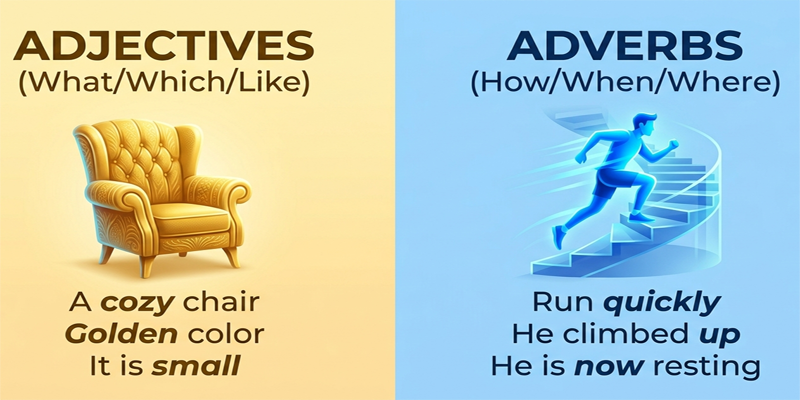
Adjectives and Adverbs in English:-
What Is an Adjective?
An adjective is a word that describes or modifies a noun or pronoun.
Examples
- Beautiful
- Tall
- Intelligent
- Blue
- Happy
Sentences
- She is a beautiful singer.
- Rahul bought a new car.
- The blue sky looked amazing.
Adjectives tell us more about a person, place, thing, or idea.
Types of Adjectives
1. Descriptive Adjectives
These describe the quality of a noun.
Examples
- Smart
- Honest
- Beautiful
Sentences
- She is an honest person.
- He is a smart student.
2. Quantitative Adjectives
These indicate quantity.
Examples
- Some
- Many
- Much
- Little
Sentences
- I have some money.
- There are many books.
3. Demonstrative Adjectives
These point to a specific noun.
Examples
- This
- That
- These
- Those
Sentences
- This book is interesting.
- Those houses are beautiful.
4. Possessive Adjectives
These show ownership.
Examples
- My
- Your
- His
- Her
- Their
Sentences
- This is my laptop.
- She forgot her purse.
5. Interrogative Adjectives
Used to ask questions.
Examples
- Which
- What
- Whose
Sentences
- Which color do you prefer?
- Whose bag is this?
6. Proper Adjectives
Derived from proper nouns.
Examples
- Indian
- American
- French
Sentences
- Indian culture is rich.
- He likes Italian food.
What Is an Adverb?
An adverb modifies:
- A verb
- An adjective
- Another adverb
Adverbs often answer questions like:
- How?
- When?
- Where?
- How often?
- To what extent?
Examples
- Quickly
- Slowly
- Carefully
- Very
- Always
Sentences
- She speaks fluently.
- They arrived late.
- He works hard.
Types of Adverbs
1. Adverbs of Manner
Tell us how something happens.
Examples
- Quickly
- Carefully
- Slowly
Sentences
- She sings beautifully.
- He drives carefully.
2. Adverbs of Time
Tell us when something happens.
Examples
- Yesterday
- Today
- Soon
- Now
Sentences
- I will call you tomorrow.
- She arrived early.
3. Adverbs of Place
Tell us where something happens.
Examples
- Here
- There
- Everywhere
Sentences
- Please come here.
- He looked everywhere.
4. Adverbs of Frequency
Tell us how often something happens.
Examples
- Always
- Often
- Never
- Usually
Sentences
- She always wakes up early.
- I rarely watch television.
5. Adverbs of Degree
Show intensity or extent.
Examples
- Very
- Quite
- Extremely
- Almost
Sentences
- He is very intelligent.
- The movie was extremely interesting.
Difference Between Adjectives and Adverbs
| Adjective | Adverb |
|---|---|
| Describes a noun or pronoun | Describes a verb, adjective, or adverb |
| Beautiful girl | Sings beautifully |
| Fast car | Runs fast |
| Happy child | Speaks happily |
Degrees of Comparison
Adjectives and some adverbs have three degrees of comparison.
1. Positive Degree
Shows quality without comparison.
Examples
- Tall
- Fast
- Intelligent
Sentence
- Rahul is tall.
2. Comparative Degree
Compares two persons or things.
Usually formed by adding -er or using more.
Examples
- Taller
- Faster
- More intelligent
Sentences
- Rahul is taller than Amit.
- She is more intelligent than her brother.
3. Superlative Degree
Compares more than two people or things.
Usually formed by adding -est or using most.
Examples
- Tallest
- Fastest
- Most intelligent
Sentences
- Mount Everest is the highest mountain.
- She is the most talented student.
Irregular Degrees of Comparison
| Positive | Comparative | Superlative |
|---|---|---|
| Good | Better | Best |
| Bad | Worse | Worst |
| Little | Less | Least |
| Many | More | Most |
| Far | Farther | Farthest |
Examples
- This book is better than that one.
- He is the best player in the team.
Position of Adjectives
Adjectives usually come before nouns.
Examples
- A beautiful flower
- A large house
They can also come after linking verbs.
Examples
- The flower is beautiful.
- The house is large.
Position of Adverbs
Adverbs can appear at different places in a sentence.
Beginning
- Suddenly, it started raining.
Middle
- She always studies hard.
End
- He runs quickly.
Common Mistakes
Mistake 1
❌ He runs quick.
✔ He runs quickly.
Mistake 2
❌ She is beautifully.
✔ She is beautiful.
Mistake 3
❌ He is more taller than me.
✔ He is taller than me.
Mistake 4
❌ This is the most best option.
✔ This is the best option.
Tips to Master Adjectives and Adverbs
Learn Common Adjective-Adverb Pairs
| Adjective | Adverb |
|---|---|
| Slow | Slowly |
| Quick | Quickly |
| Careful | Carefully |
| Happy | Happily |
Read English Content Daily
Books, blogs, and newspapers expose you to natural usage.
Practice Sentence Writing
Write five sentences daily using different adjectives and adverbs.
Use Degrees of Comparison in Daily Conversations
Examples:
- This phone is better than mine.
- He is the tallest boy in the class.
Frequently Asked Questions
Can an adjective modify a verb?
No. Adjectives modify nouns and pronouns.
Can an adverb modify an adjective?
Yes.
Example:
- She is very beautiful.
Here, “very” modifies the adjective “beautiful.”
Do all adverbs end with “-ly”?
No.
Examples:
- Fast
- Hard
- Well
- Late
These are adverbs without “-ly.”
Conclusion
Friends, in this post(Adjectives and Adverbs in English), we have learned about Adjectives and adverbs. They play a very important role in making your English very meaningful and expressive. The work of adjectives is to describe nouns and pronouns. Adverbs describe verbs and other adverbs. If you fully understand their positions, types, and degree of comparison, it would improve your writing, speaking, and comprehension for sure.
If you want to have a good grip on adjectives and adverbs, then you will have to practice them regularly with more and more English exposure. Soon you will naturally be using these adjectives and adverbs in your sentences. If you really want to be a confident English writer and speaker, then you would have to get a good command over these two valuable parts of speech in English grammar.
If you have any queries, you can write to us at support@a5theory.com; we will get back to you ASAP.
Hope! You would have enjoyed this post “Adjectives and Adverbs in English”.
Please feel free to give your important feedback in the comment section below.
Have a great time!