

Introduction
Hello Friends, in this blog post(Python Lists vs Tuples vs Dictionaries), I am going to tell you about the differences among lists, tuples, and dictionaries in Python.
These are the data structures most commonly used in Python, and beginners must be comfortable with these concepts before proceeding to advanced programming.
The basic work of these data structures is to store, manage, and organize program data efficiently.
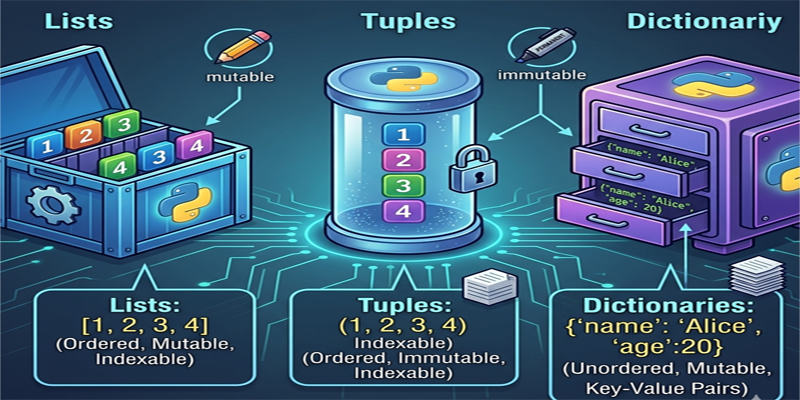
For beginners, it might be a little confusing to understand lists, tuples, and dictionaries at the starting point as they seem to be similar.
But they all have unique features and use cases that make them differ from each other.
In this blog, we will explain to you the differences between these three(Lists, Tuples, and Dictionaries) along…
… with examples and practical applications, which would be very easy to understand, especially for beginners.
What Are Data Structures in Python?
This is simply a technique to structure the data, or storage and organization of data in such a way that we can use it and manage it efficiently during programming.
Python offers various built-in data structures. Amongst all, lists, tuples, and dictionaries are the most used data structures
Python Lists
What Is a List?
A list is an ordered and changeable collection of items.
Lists are created using square brackets [].
Example
fruits = ["Apple", "Banana", "Mango"]Features of Lists
- Ordered collection
- Mutable (can be changed)
- Allows duplicate values
- Can store multiple data types
Modifying a List
Lists can be updated after creation.
Example:
fruits = ["Apple", "Banana"]

fruits.append("Mango")

print(fruits)
Output
['Apple', 'Banana', 'Mango']This flexibility makes lists very useful in everyday programming.
Python Tuples
What Is a Tuple?
A tuple is an ordered but unchangeable collection of items.
Tuples are created using parentheses ().
Example
colors = ("Red", "Green", "Blue")Features of Tuples
- Ordered collection
- Immutable (cannot be changed)
- Allows duplicate values
- Faster than lists in some cases
Trying to Modify a Tuple
Example:
colors = ("Red", "Green")

colors[0] = "Blue"
This produces an error because tuples cannot be modified.
When to Use Tuples
Tuples are useful when data should remain constant, such as:
- Coordinates
- Configuration settings
- Fixed records
Python Dictionaries
What Is a Dictionary?
A dictionary stores data in key-value pairs.
Dictionaries are created using curly braces {}.
Example
student = {
    "name": "Alex",
    "age": 20
}
Features of Dictionaries
- Stores data as key-value pairs
- Mutable and changeable
- Fast data access
- Keys must be unique
Accessing Dictionary Values
Example:
print(student["name"])Output
AlexDictionaries are extremely useful for storing structured information.
Python Lists vs Tuples vs Dictionaries:
Main Difference Between Lists, Tuples, and Dictionaries
| Feature | List | Tuple | Dictionary |
|---|---|---|---|
| Syntax | [] | () | {} |
| Ordered | Yes | Yes | Yes |
| Mutable | Yes | No | Yes |
| Duplicate Values | Allowed | Allowed | Keys not duplicated |
| Data Format | Single values | Single values | Key-value pairs |
Understanding these differences helps programmers choose the correct structure for different tasks.
When Should You Use Lists?
Use lists when:
- Data changes frequently
- You need to add or remove items
- Order matters
Examples
- To-do lists
- Shopping lists
- Student records
When Should You Use Tuples?
Use tuples when:
- Data should remain fixed
- Performance matters
- You want safer data storage
Examples
- GPS coordinates
- Fixed settings
- Database records
When Should You Use Dictionaries?
Use dictionaries when:
- You need key-value relationships
- Fast searching is required
- Structured data is needed
Examples
- User profiles
- Product information
- API responses
Real-Life Example
Using a List
tasks = ["Study", "Exercise", "Coding"]Using a Tuple
coordinates = (28.61, 77.20)Using a Dictionary
employee = {
    "name": "John",
    "department": "IT"
}
Each structure serves a different purpose.
Common Mistakes Beginners Make
1. Using the Wrong Structure
Beginners often use lists everywhere instead of selecting the appropriate structure.
2. Trying to Modify Tuples
Tuples are immutable and cannot be changed.
3. Confusing Dictionary Keys and Values
Keys identify data, while values store the actual information.
Best Practices
Choose the Right Structure
Use the structure that best fits the problem.
Keep Data Organized
Structured and meaningful data improves code readability.
Avoid Unnecessary Complexity
Simple and clean code is easier to maintain.
Why These Data Structures Are Important
Lists, tuples, and dictionaries are used in almost every Python project, including:
- Web applications
- Automation tools
- Data analysis
- Machine learning
- APIs and databases
Mastering these structures is essential for becoming a strong Python programmer.
What to Learn Next
After understanding these data structures, beginners should move on to:
- Loops with lists and dictionaries
- Functions
- File handling
- Object-oriented programming
- Modules and libraries
These concepts help in building advanced applications.
Conclusion
So, Friends, in this blog post(Python Lists vs Tuples vs Dictionaries), we have seen the comparative studies of lists, tuples, and dictionaries. These are known as the most powerful and widely used data structures in the Python language. At first glance, they seem to be similar, but each of them comes with a purpose and advantages along with its unique features.
Lists are flexible and changeable, tuples are fixed and secure, and dictionaries are ideal for structured key-value data. Understanding when and how to use these structures is an important step in learning Python programming effectively.
The only way to master these data structures is practice, so just learn them through practice and real-world projects. First, start by experimenting with different 2 structures, then combine them into programs, and slowly and simply try to build more complex applications.
In case of any queries, you can write to us at support@a5theory.com; we will get back to you ASAP.
Hope! You would have enjoyed this post(Python Lists vs Tuples vs Dictionaries).
Please feel free to give your important feedback in the comment section below.
Have a great time!