

Hello Friends, in this blog post(Why Do We Get Goosebumps), we are going to let you know the science of Goosebumps.
In general, goosebumps are connected to our emotions and chemical changes in our body.
Almost all of us have experienced goosebumps many times in our lives. |Why Do We Get Goosebumps|
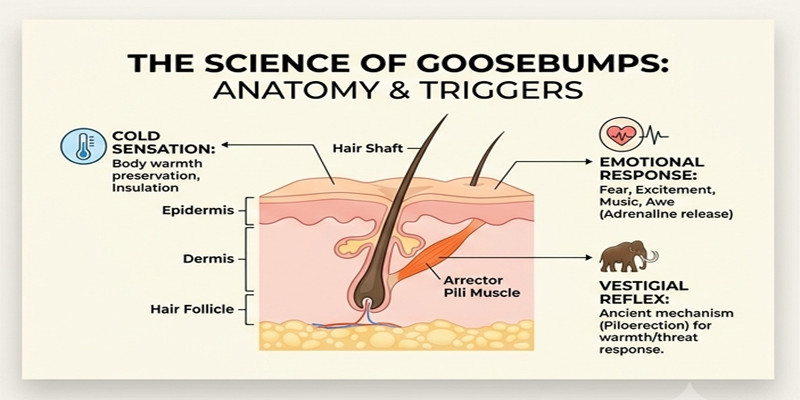
And when Goosebumps come, the hairs on our skin stand up like they are bumping from our body or skin.
There could be many individual causes for these goosebumps to occur, but we are telling you a few very common reasons responsible for goosebumps:
- Walking outside in a very cold season.
- Watching a scary or frightening movie.
- Hearing an incredible piece of music.
- Having a powerful emotional moment
All of the above listed reasons could cause goosebumps in us, where we see the tiny bumps all over our skin along with the skin hairs.
Now, there comes few questions to know, like:
- What makes our body create these goosebumps?
- Why tiny hairs on our skin stand up in case of fear?
- If goosebumps are useful, why do humans still have them when most of our bodies aren’t covered in thick fur?
To better understand the answers to all of the above questions, we will need to dive deep into the…
…fascinating world of nerves, skin, muscles, emotions, temperature, evolution, and regulation. |Why Do We Get Goosebumps|
What Are Goosebumps?
Goosebumps are tiny raised bumps that appear on the skin when the small muscles attached to our hair follicles contract.
The scientific term commonly used for this response is piloerection.
When these tiny muscles contract, they pull the hair follicles slightly upward.
This causes the surrounding skin to become raised.
The result is the familiar bumpy appearance. |Why Do We Get Goosebumps? |
Why Does Our Hair Stand Up?
Each hair on your body grows from a structure called a hair follicle.
Attached to many hair follicles is a tiny smooth muscle called the:
Arrector pili muscle
When this muscle contracts, it pulls the hair follicle into a more upright position.
At the same time, the skin around the follicle becomes raised.
That’s a goosebump. |Why Do We Get Goosebumps|
What Are Arrector Pili Muscles?
Arrector pili muscles are tiny involuntary muscles attached to hair follicles.
They are controlled by the autonomic nervous system, which means you don’t consciously control them.
You can’t normally decide:
“Raise the hair on my arms now.”
Your nervous system handles it automatically.
What Happens When You Get Goosebumps?
The process can be simplified like this:
Stimulus → Nervous system response → Tiny muscles contract → Hair rises → Skin forms bumps
For example:
Cold air → nervous system detects the situation → arrector pili muscles contract → hairs stand more upright → goosebumps appear
Why Do We Get Goosebumps When We Are Cold?
One important trigger is cold temperature.
When your body senses cold, the autonomic nervous system activates several responses designed to reduce heat loss and maintain body temperature.
Goosebumps can be one of those responses.
The hairs on the skin stand up.
In a furry animal, this can make the fur fluffier and potentially trap a layer of warm air close to the body.
But in humans, this effect is very small. |Why Do We Get Goosebumps|
Why Are Goosebumps More Useful for Animals?
Imagine a furry mammal in cold weather.
Its hair stands upright.
The fur becomes thicker and can trap more air.
That trapped air provides insulation.
This can help reduce heat loss.
Now imagine a human.
We have much less body hair.
Therefore, raising our hairs doesn’t create nearly as much insulation.
This is one reason scientists consider human goosebumps a remnant of an older evolutionary response.
What Is Evolution Doing Here?
Our ancestors had more body hair than modern humans.
A response that caused body hair to stand up may have been more useful when humans had thicker body hair.
As humans evolved and lost much of their body hair, the response remained.
The result is a fascinating example of how an old biological mechanism can continue to exist even after its original usefulness has become much smaller. |Why Do We Get Goosebumps|
Why Do We Get Goosebumps When We Are Scared?
Cold isn’t the only trigger.
Strong emotions can also produce goosebumps.
For example:
- Fear
- Excitement
- Surprise
- Awe
- Intense music
- Emotional memories
Why?
Because strong emotions can activate the sympathetic nervous system.
This is part of the body’s rapid-response system.
What Is the Sympathetic Nervous System?
The sympathetic nervous system is a major part of the autonomic nervous system.
It helps prepare the body for situations requiring rapid action.
You may have heard of the:
Fight-or-flight response
When your brain perceives danger or intense excitement, the sympathetic nervous system can increase:
- Heart rate
- Breathing rate
- Alertness
- Blood flow to muscles
It can also trigger goosebumps.
Why Would Fear Make Hair Stand Up?
For furry animals, making their fur stand up can make them appear larger.
Imagine a cat frightened by a dog.
Its fur may become puffed up.
This can make the animal appear bigger and potentially more threatening.
Humans don’t gain much visual advantage from this because our body hair is relatively sparse.
But the underlying nervous-system response remains. |Why Do We Get Goosebumps|
Can Goosebumps Make Us Look Bigger?
Technically, the hairs on our body may stand up slightly.
But the effect is tiny compared with what happens in furry animals.
You aren’t going to suddenly look twice your normal size because of goosebumps.
Why Do We Get Goosebumps During Emotional Music?
This is one of the most fascinating examples.
Some people experience goosebumps while listening to powerful music.
Researchers have studied this phenomenon because music can activate brain systems involved in:
- Emotion
- Reward
- Anticipation
- Memory
A powerful musical moment can trigger a strong autonomic response.
The result may include:
Goosebumps.
What Are “Chills”?
People sometimes use the word chills to describe a sudden emotional or physical sensation involving:
- Goosebumps
- Tingling
- Shivering
- A feeling of excitement
Chills aren’t always caused by cold.
Strong emotional experiences can produce similar sensations.
Can Happiness Cause Goosebumps?
Yes.
Goosebumps aren’t exclusively associated with fear.
People can experience them during:
- Exciting events
- Powerful music
- Inspirational speeches
- Emotional reunions
- Sporting victories
- Beautiful natural scenes
Strong positive emotions can activate the autonomic nervous system too.
Why Do We Get Goosebumps During a Movie?
A particularly frightening or emotionally powerful scene can activate the brain’s emotional systems.
The brain then communicates with the autonomic nervous system.
That response can affect:
- Heart rate
- Breathing
- Sweating
- Muscle activity
- Skin blood vessels
- Hair follicles
One visible result can be:
Goosebumps.
Can a Good Story Give You Goosebumps?
Absolutely.
The emotional response doesn’t require actual danger.
Your brain can respond strongly to imagined or symbolic situations.
That’s why a movie, book, song, or speech can sometimes trigger physical reactions.
Your brain knows the situation is fictional, but emotional and physiological responses can still occur.
Why Do We Sometimes Get Goosebumps When Someone Touches Us?
Touch can stimulate sensory nerves in the skin.
Depending on the situation, the nervous system may respond to the sensation.
If the touch is associated with surprise, excitement, fear, or another strong emotion, goosebumps may occur. |Why Do We Get Goosebumps|
Can Memories Cause Goosebumps?
Yes.
A powerful memory can trigger an emotional response.
The brain doesn’t need the original event to be happening again.
Remembering something emotionally significant can activate neural pathways associated with that experience.
That can sometimes produce physical reactions such as:
- Goosebumps
- Increased heart rate
- Sweating
- Changes in breathing
Why Do We Get Goosebumps When We Hear Something Amazing?
A feeling of awe can produce strong physiological responses.
For example, you might see:
- A spectacular mountain
- A breathtaking night sky
- A massive waterfall
- An extraordinary scientific discovery
Your brain may interpret the experience as highly significant.
The autonomic nervous system can respond.
And your skin may say:
“Wow!”
Before you even say it yourself. |Why Do We Get Goosebumps|
Are Goosebumps Controlled by the Brain?
Yes.
The brain processes information from the environment and from your internal state.
When certain stimuli are interpreted as important, threatening, exciting, or emotionally powerful, the autonomic nervous system can respond.
Signals ultimately reach the tiny muscles attached to hair follicles.
Those muscles contract.
Goosebumps appear.
Can We Control Goosebumps Voluntarily?
Most people cannot consciously produce goosebumps whenever they want.
However, a small number of people report being able to voluntarily trigger goosebumps.
This ability is sometimes called voluntary piloerection.
It appears to be uncommon.
Why Do Goosebumps Appear on the Arms?
The arms contain many hair follicles and are commonly exposed to changes in temperature and environmental stimuli.
Goosebumps can appear on many parts of the body where hair follicles are present.
Common areas include:
- Arms
- Legs
- Chest
- Back
- Neck
Can You Get Goosebumps on Your Face?
The response can occur in areas containing hair follicles, although it may be less obvious on the face.
Different areas of the body have different densities and types of hair.
Why Don’t We Get Goosebumps on Our Palms?
The palms of the hands don’t have typical hair follicles.
Therefore, they don’t develop goosebumps in the same way that hairy skin does.
The same applies to the soles of the feet. |Why Do We Get Goosebumps|
Why Do Goosebumps Look Like Tiny Mountains?
When the arrector pili muscles contract, they pull on the hair follicles.
This changes the shape of the surrounding skin.
The skin rises around each follicle.
Thousands of tiny raised areas can therefore appear together.
That’s why your skin looks like it has many tiny bumps.
Why Are They Called “Goosebumps”?
The name comes from the resemblance between human goosebumps and the appearance of the skin of a plucked goose.
The bumps on the skin can look somewhat similar to the skin texture of a goose after its feathers have been removed.
What Is the Scientific Name for Goosebumps?
The physiological response is commonly called:
Piloerection
Other terms include:
- Cutis anserina
- Horripilation
These terms describe the raising of hairs and the associated skin response.
Is Piloerection the Same as Shivering?
No.
They can happen at the same time, especially when you’re cold, but they are different responses.
Piloerection
Tiny muscles around hair follicles contract.
Shivering
Many skeletal muscles rapidly contract and relax, generating heat.
Shivering is much more important for producing body heat in humans.
Why Does Shivering Help Us Stay Warm?
Muscle contractions require energy.
Some of that energy is released as heat.
During shivering, many muscles contract rapidly.
This increases heat production.
That’s why your body may start shaking when you are very cold. |Why Do We Get Goosebumps|
Why Don’t Goosebumps Warm Humans Very Much?
Because modern humans have relatively little body hair compared with many other mammals.
The raised hairs cannot trap enough air to provide significant insulation.
Our major methods of maintaining body temperature include:
- Metabolic heat production
- Blood-flow regulation
- Sweating
- Shivering
- Behavioural changes
- Clothing and shelter
Goosebumps and Body Temperature
When you’re cold, your body tries to conserve heat.
Several responses can happen together.
For example:
Cold → sympathetic activation → skin blood vessels constrict → heat loss decreases
At the same time:
Cold → muscles may begin shivering → heat production increases
And:
Cold → arrector pili muscles contract → goosebumps appear
Goosebumps are therefore only one part of the body’s response to cold.
Why Does Our Skin Become Pale When We Are Cold?
Cold can cause blood vessels near the skin surface to constrict.
This reduces blood flow close to the surface and helps reduce heat loss.
Because less warm blood is reaching the skin, the skin can appear paler.
This is another example of the body’s temperature-regulation system.
Why Do We Sweat Instead of Getting Goosebumps When We Are Hot?
When you’re hot, the body needs to lose heat.
Sweating helps through evaporation.
Goosebumps are more closely associated with cold and certain emotional responses.
Therefore, the body uses different mechanisms depending on the thermal situation.
Why Does Fear Make Your Heart Beat Faster and Give You Goosebumps?
Both responses can be triggered by sympathetic nervous system activation.
During fear:
- The brain detects a potential threat.
- The sympathetic nervous system becomes active.
- Heart rate can increase.
- Breathing can change.
- Muscles become more prepared for action.
- Goosebumps may appear.
The body is essentially preparing itself for rapid response. |Why Do We Get Goosebumps|
Why Do Goosebumps Sometimes Happen Without Fear or Cold?
Because goosebumps aren’t controlled exclusively by temperature.
Other triggers include:
- Music
- Memories
- Excitement
- Awe
- Surprise
- Emotional experiences
The autonomic nervous system responds to many types of strong stimuli.
Can Goosebumps Tell Us About Our Emotions?
Sometimes.
If someone suddenly gets goosebumps while listening to music or watching an emotional scene, it can indicate a strong physiological response.
But goosebumps alone cannot tell us exactly what a person is feeling.
The same physical response can occur for different reasons.
Why Do Some People Get Goosebumps More Easily?
People differ in their sensitivity to:
- Cold
- Emotions
- Music
- Touch
- Stress
- Environmental changes
Individual nervous-system responses also vary.
Therefore, one person may get goosebumps frequently while another rarely notices them.
Why Do Goosebumps Disappear?
Once the triggering stimulus disappears, the autonomic nervous system returns toward its normal state.
The arrector pili muscles relax.
The hair returns to its normal position.
The skin becomes smooth again.
Goosebumps Are an Example of an Involuntary Response
One of the most interesting things about goosebumps is that you don’t have to consciously create them.
Your body can respond before you consciously think about the response.
This is because the autonomic nervous system controls many automatic functions. |Why Do We Get Goosebumps|
A Simple Goosebumps Experiment
You can observe how your body responds to temperature.
Try This Safely
Stand in a comfortable indoor environment.
Observe the skin on your forearm.
Then move briefly into a cooler environment.
Don’t expose yourself to extreme cold.
Observe whether:
- The tiny hairs become more visible
- Small bumps appear
- You feel colder
- Your skin changes appearance
This is a simple way to observe an involuntary physiological response.
An Interesting Music Experiment
Choose a piece of music that you find particularly powerful.
Listen carefully.
Pay attention to moments when the music suddenly changes.
You may notice:
- Tingling
- Chills
- Goosebumps
- Faster heartbeat
- Emotional reactions
Your brain can create a surprisingly strong physical response to sound alone.
Goosebumps and Music: Why Does This Happen?
Music can create anticipation.
For example, you may know that a powerful chorus or musical climax is approaching.
Your brain predicts what is coming.
When the expected moment arrives, reward and emotion-related brain systems can become strongly activated.
This may be accompanied by autonomic responses such as goosebumps. |Why Do We Get Goosebumps|
Why Is the Human Body So Interesting?
Goosebumps are a perfect example of how our bodies contain traces of our evolutionary history.
A response that may once have helped furry ancestors:
Hair standing up → more effective insulation or a larger appearance
still exists in humans:
Tiny muscles contract → small hairs rise → goosebumps appear
The original advantage may be much smaller today, but the biological mechanism remains.
Did You Know?
- The scientific term for goosebumps is piloerection.
- Tiny muscles called arrector pili cause hairs to stand up.
- These muscles are controlled involuntarily.
- Cold can trigger goosebumps.
- Fear and excitement can trigger them too.
- Powerful music can sometimes cause goosebumps.
- Goosebumps are more useful for furry animals than humans.
- Humans likely inherited the response from hairy ancestors.
- Shivering and goosebumps are different physiological responses.
- The palms and soles don’t develop typical goosebumps because they lack hair follicles.
Common Mistakes Students Make
❌ Thinking goosebumps are caused only by cold.
✔ Strong emotions such as fear, excitement, and awe can also trigger them.
❌ Thinking goosebumps themselves generate significant heat.
✔ In humans, their contribution to heat conservation is very small.
❌ Thinking goosebumps happen because blood becomes trapped under the skin.
✔ They primarily result from contraction of tiny muscles attached to hair follicles.
❌ Thinking goosebumps are consciously controlled.
✔ They are generally controlled by the autonomic nervous system.
❌ Thinking goosebumps and shivering are the same thing.
✔ Goosebumps involve hair-follicle muscles, while shivering involves rapid contractions of skeletal muscles.
❌ Thinking goosebumps always mean you’re frightened.
✔ They can also occur because of cold, excitement, music, memories, or awe.
Frequently Asked Questions (FAQs)
1. Why do we get goosebumps?
Goosebumps occur when tiny muscles attached to hair follicles contract, causing the hairs to stand up and the surrounding skin to become raised. |Why Do We Get Goosebumps? |
2. What causes goosebumps?
Cold, fear, excitement, surprise, strong emotions, music, and certain memories can trigger goosebumps.
3. What are arrector pili muscles?
They are tiny involuntary muscles attached to hair follicles that pull the hairs upright when they contract.
4. Why do we get goosebumps when scared?
Fear can activate the sympathetic nervous system, which can cause the arrector pili muscles to contract.
5. Why does music sometimes give us goosebumps?
Powerful music can activate brain systems involved in emotion, anticipation, and reward, producing an autonomic physical response.
6. Are goosebumps useful?
They probably provided more useful insulation and defensive signalling in furry ancestors. Their usefulness is much smaller in modern humans.
7. Are goosebumps and shivering the same?
No. Goosebumps involve tiny muscles around hair follicles, while shivering involves rapid skeletal-muscle contractions that generate heat.
8. Can we control goosebumps?
Most people cannot voluntarily produce them, although a small number of people appear able to trigger piloerection voluntarily.
9. Why don’t our palms get goosebumps?
The palms don’t have typical hair follicles and therefore don’t produce goosebumps in the usual way.
10. What is the scientific name for goosebumps?
The physiological response is called piloerection. |Why Do We Get Goosebumps|
Why This Topic Matters
Goosebumps may look like a tiny and insignificant reaction.
But behind those tiny bumps is a remarkable chain of events:
Environment or emotion → brain → autonomic nervous system → nerves → tiny muscles → hair follicles → goosebumps
It connects several important areas of biology:
- Human nervous system
- Skin
- Muscles
- Temperature regulation
- Emotions
- Evolution
And it teaches us something important about the human body:
Not everything our body does was designed specifically for the world we live in today.
Some responses are remnants of our evolutionary past.
Conclusion
Friends, in this blog post(Why Do We Get Goosebumps), we have learned how we get goosebumps on our skin. Having read this extensive blog post on goosebumps, next time you get goosebumps, you will have a clear understanding of what is actually happening beneath your skin. Here, tiny muscles that are attached to our hair follicles start contracting. When your nervous system detects something important, it could be fear, excitement, cold, music, or a powerful memory emotions. It causes the hairs on your skin to stand or rise along with the tiny bumps developed in your skin. Goosebumps cannot be considered only a strange skin reaction, as it has much more to research.
They are a tiny reminder of how our nervous system works, how our bodies respond to emotions, and how evolution continues to leave its fingerprints on the human body. |Why Do We Get Goosebumps|
Your skin may look simple—but sometimes, a tiny bump can tell an enormous evolutionary story.
If you have any queries, you can write to us at support@a5theory.com; we will get back to you ASAP.
Hope! You will enjoy this post, “Why Do We Get Goosebumps?”
Please feel free to give your feedback in the comment section below.
Have a great time!