

Introduction
Hello Friends, in this blog post(English Tenses Explained), I am going to discuss one of the most important topics of English Grammar, which you know as Tenses.
Tenses tell us the time of any action, when it actually happens. There are only three major possibilities for any action to happen. It can happen in the past, present, or future.
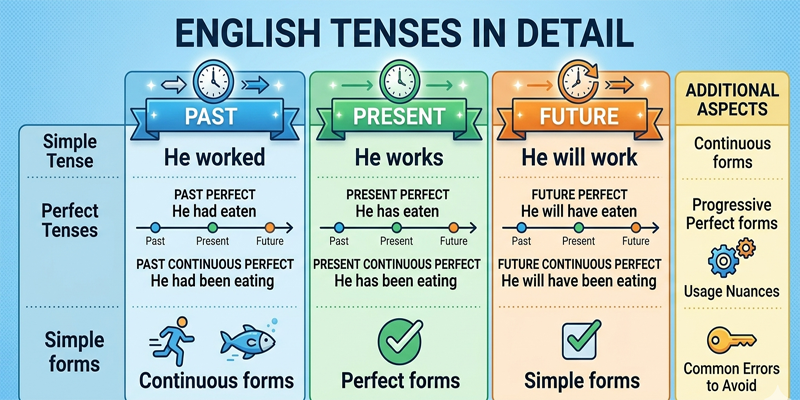
Most of the people find it difficult and confusing to learn the tenses. As there are a total of twelve types of tenses, four in each: present, past, and future.
But if you learn them deeply and totally understand their structure and purpose, then learning English would be very easy and joyful.
In this post, we are going to explain the rules, structures, examples, and common uses of all twelve tenses in English.
What Are Tenses in English?/English Tenses Explained
A tense is a verb in a grammatical form that indicates the time of an action or event.
Tenses are very helpful in answering questions such as:
- Did the action happen in the past?
- Is it happening now?
- Will it happen in the future?
English has three main time periods:
- Present Tense
- Past Tense
- Future Tense
Each of these is divided into four types:
- Simple
- Continuous
- Perfect
- Perfect Continuous
This gives us a total of 12 tenses.
Present Tenses
1. Simple Present Tense
Usage
Used for:
- Habits
- Daily routines
- Facts
- General truths
Structure
Subject + Verb (First Form) + Object
Examples
- I play cricket.
- She studies every day.
- The sun rises in the east.
Common Time Expressions
- Daily
- Usually
- Always
- Often
- Every day
2. Present Continuous Tense
Usage
Used for actions happening right now.
Structure
Subject + am/is/are + Verb + ing
Examples
- I am reading a book.
- She is cooking dinner.
- They are playing football.
Common Time Expressions
- Now
- At the moment
- Currently
3. Present Perfect Tense
Usage
Used for actions completed recently or actions that affect the present.
Structure
Subject + has/have + Past Participle (V3)
Examples
- I have finished my homework.
- She has visited Delhi.
- They have completed the project.
Common Time Expressions
- Already
- Yet
- Just
- Recently
4. Present Perfect Continuous Tense
Usage
Used for actions that started in the past and continue in the present.
Structure
Subject + has/have been + Verb + ing
Examples
- I have been studying for two hours.
- She has been working since this morning.
- They have been waiting for a long time.
Common Time Expressions
- Since
- For
Past Tenses
5. Simple Past Tense
Usage
Used for actions completed in the past.
Structure
Subject + Verb (Second Form) + Object
Examples
- I played cricket yesterday.
- She visited Jaipur last month.
- They watched a movie.
Common Time Expressions
- Yesterday
- Last week
- Last year
- Ago
6. Past Continuous Tense
Usage
Used for actions that were in progress at a specific time in the past.
Structure
Subject + was/were + Verb + ing
Examples
- I was studying at 8 PM.
- She was cooking dinner.
- They were playing football.
7. Past Perfect Tense
Usage
Used to show that one action was completed before another action in the past.
Structure
Subject + had + Past Participle (V3)
Examples
- I had finished my work before dinner.
- She had left before I arrived.
- They had completed the project earlier.
8. Past Perfect Continuous Tense
Usage
Used for actions that continued for some time before another past action.
Structure
Subject + had been + Verb + ing
Examples
- I had been studying for three hours before the exam.
- She had been working all day.
- They had been waiting for an hour.
Future Tenses
9. Simple Future Tense
Usage
Used for actions that will happen in the future.
Structure
Subject + will + Verb (First Form)
Examples
- I will visit Mumbai next week.
- She will call you tomorrow.
- They will start the project soon.
10. Future Continuous Tense
Usage
Used for actions that will be in progress at a specific future time.
Structure
Subject + will be + Verb + ing
Examples
- I will be studying tonight.
- She will be traveling tomorrow.
- They will be working at that time.
11. Future Perfect Tense
Usage
Used for actions that will be completed before a certain future time.
Structure
Subject + will have + Past Participle (V3)
Examples
- I will have completed the assignment by Monday.
- She will have reached home by 8 PM.
- They will have finished the work soon.
12. Future Perfect Continuous Tense
Usage
Used for actions that will continue up to a certain point in the future.
Structure
Subject + will have been + Verb + ing
Examples
- I will have been working here for five years next month.
- She will have been studying for three hours by noon.
- They will have been waiting for a long time.
Quick Summary Table
| Tense | Structure | Example |
|---|---|---|
| Simple Present | Subject + V1 | I play cricket |
| Present Continuous | Subject + am/is/are + V-ing | I am playing |
| Present Perfect | Subject + has/have + V3 | I have played |
| Present Perfect Continuous | Subject + has/have been + V-ing | I have been playing |
| Simple Past | Subject + V2 | I played |
| Past Continuous | Subject + was/were + V-ing | I was playing |
| Past Perfect | Subject + had + V3 | I had played |
| Past Perfect Continuous | Subject + had been + V-ing | I had been playing |
| Simple Future | Subject + will + V1 | I will play |
| Future Continuous | Subject + will be + V-ing | I will be playing |
| Future Perfect | Subject + will have + V3 | I will have played |
| Future Perfect Continuous | Subject + will have been + V-ing | I will have been playing |
Beginner‘s Common Mistakes
Use Of Wrong Verb Forms
Incorrect:
- She go to school.
Correct:
- She goes to school.
Confusion between Present Perfect and Past Simple
Incorrect:
- I have visited Delhi yesterday.
Correct:
- I visited Delhi yesterday.
Incorrect Use Of Continuous Tenses
Incorrect:
- I am knowing him.
Correct:
- I know him.
Important Advice to Master English Tenses
Learn One Group at a Time
You should try to focus on one type of tense first.
Like, if you start with the present, then make sure you learn it completely before gradually moving towards the past and future.
Practice Daily
Practice is very important to learn the tenses in a short period of time.
Make sure you practice at least five sentences of each tense daily.
Use Real-Life Situations
You should also try to learn to frame sentences about your daily routine and the events happening around you.
Focus on Structure
Initially, you can make sentences by seeing their structure or formula.
But after some time, these structures should be in your mind so that you can quickly frame a sentence by connecting the right structure from your memory.
Read and Listen to English
Books, articles, and conversations help you see tenses in action.
To achieve perfection in the English language, you should try to read books and articles as much as you can.
You can also listen to English conversations through audio or video tutorials.
And last but not least, you should try to have more and more conversations with the real peoples where ever you get these opportunities.
How Spoken English Improves With The Help Of Tenses
Having effective communication tenses plays a very important role. Listeners get a big help to understand:
- When something happened
- Whether it is happening now
- Whether it will happen in the future
If you want your English to be professional, accurate, and sound natural, then you must use the right tense at the right place.
Conclusion
Friends, in this post(English Tenses Explained), we have seen the English tenses in detail. If anyone studies them one by one systematically, then all the tenses are easy to understand and get a command over them.
If you really want to be a confident English pro who can speak, write, and read fluently, then you will have to learn all the rules, structures, and common uses of each tense. You will have to be very consistent in practicing English in your daily conversations.
Tenses are one of the important foundations for learning the English language. Once you get a good command of tenses, they prove to be a great help in learning the other grammar concepts or topics.
If you have any queries, you can write to us at support@a5theory.com; we will get back to you ASAP.
Hope! You would have enjoyed this post(English Tenses Explained).
Please feel free to give your important feedback in the comment section below.
Have a great time!