

Introduction
Hello Friends, in this blog post(Subject-Verb Agreement Rules), we are going to discuss one of the interesting and important topics of the English language that is: Subject-Verb Agreement.
As per this agreement, in a sentence, the subject and the verb must agree in number.
A singular subject should have a singular verb, and in the same manner, a plural subject should have a plural verb.
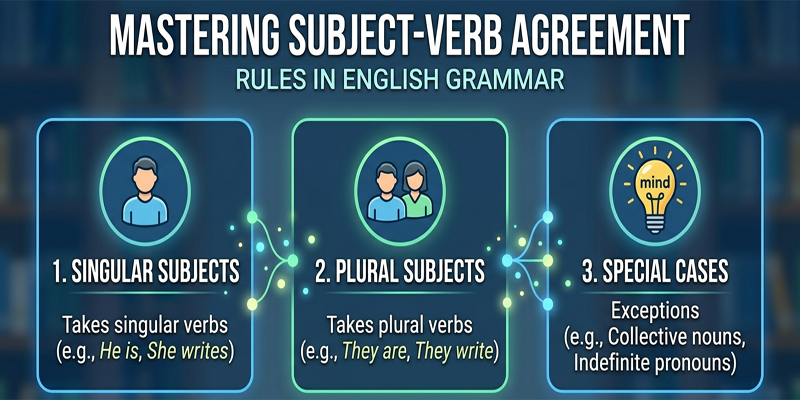
Beginners often make this mistake by focusing only on the noun close to the verb rather than identifying and understanding the actual subject.
So if you understand this subject-verb agreement with full clarity, then it will definitely improve your grammar, writing, and spoken English effectively.
In this post, we will see and explore the most important subject-verb agreement rules with their rules and examples.
Additionally, we will provide you with a few practical tips.
What Is Subject-Verb Agreement?
Subject-Verb Agreement refers to the grammatical rule that the verb must match the subject in number and person.
Examples
✔ She plays football.
✔ They play football.
In the first sentence, the subject “She” is singular, so the verb becomes “plays.”
In the second sentence, the subject “They” is plural, so the verb remains “play.”
Why Is Subject-Verb Agreement Important?
Correct subject-verb agreement helps:
- Improve grammatical accuracy
- Make sentences clearer
- Enhance writing quality
- Improve spoken English
- Avoid common grammar mistakes
Incorrect agreement can make even simple sentences sound awkward or incorrect.
Subject-Verb Agreement Rules:-
Rule 1: Singular Subject Takes a Singular Verb
When the subject is singular, use a singular verb.
Examples
- Rahul works in a bank.
- She writes beautifully.
- The dog barks loudly.
Incorrect
- Rahul work in a bank.
Correct
- Rahul works in a bank.
Rule 2: Plural Subject Takes a Plural Verb
When the subject is plural, use a plural verb.
Examples
- The students study hard.
- They play cricket.
- The dogs bark loudly.
Incorrect
- The students studies hard.
Correct
- The students study hard.
Rule 3: Two Subjects Joined by “And” Usually Take a Plural Verb
When two subjects are connected by and, they usually require a plural verb.
Examples
- Rahul and Amit are friends.
- Tea and coffee are available.
- My brother and sister live in Delhi.
Incorrect
- Rahul and Amit is friends.
Correct
- Rahul and Amit are friends.
Rule 4: Subjects Joined by “Or” or “Nor”
When subjects are connected by or or nor, the verb agrees with the subject closest to it.
Examples
- Rahul or his friends are coming.
- His friends or Rahul is coming.
- Neither the teacher nor the students are present.
This rule often confuses learners, so pay close attention to the subject nearest the verb.
Rule 5: Collective Nouns
Collective nouns refer to a group but are often treated as singular.
Examples
- The team is winning.
- The committee has made a decision.
- The family lives in Mumbai.
In American English, collective nouns are usually singular.
Rule 6: Indefinite Pronouns Are Usually Singular
Words such as:
- Everyone
- Someone
- Anyone
- Nobody
- Everybody
take singular verbs.
Examples
- Everyone is happy.
- Somebody has called.
- Nobody knows the answer.
Incorrect
- Everyone are happy.
Correct
- Everyone is happy.
Rule 7: “Each” and “Every” Take Singular Verbs
When a sentence contains each or every, use a singular verb.
Examples
- Each student has a notebook.
- Every child enjoys the game.
- Each of the players is ready.
Rule 8: Uncountable Nouns Take Singular Verbs
Uncountable nouns represent things that cannot be counted individually.
Examples
- Water is essential.
- Information is important.
- Furniture is expensive.
Incorrect
- Information are useful.
Correct
- Information is useful.
Rule 9: Titles and Names Are Singular
Book titles, movie titles, and names are usually treated as singular.
Examples
- “The Lord of the Rings” is a famous novel.
- Mathematics is my favorite subject.
- Physics is challenging.
Even though some words may appear plural, they often take singular verbs.
Rule 10: Amounts, Distances, and Time as a Single Unit
When an amount, distance, or period of time is considered one unit, use a singular verb.
Examples
- Five kilometers is a long distance.
- Ten years is a long time.
- One thousand rupees is enough.
Rule 11: There Is / There Are
The verb should agree with the subject that follows.
Examples
- There is a book on the table.
- There are many books on the table.
- There is a problem.
Incorrect
- There are a book on the table.
Correct
- There is a book on the table.
Rule 12: Subjects with “Along With,” “As Well As,” and “Together With”
These phrases do not make the subject plural.
Examples
- Rahul, along with his friends, is coming.
- The teacher, as well as the students, is present.
- The manager, together with his staff, has arrived.
The verb agrees with the main subject, not the accompanying phrase.
Quick Summary Table
| Subject Type | Correct Verb |
|---|---|
| Singular Subject | Singular Verb |
| Plural Subject | Plural Verb |
| Subjects joined by “and” | Plural Verb |
| Subjects joined by “or/nor” | Nearest Subject |
| Collective Nouns | Usually Singular |
| Each/Every | Singular Verb |
| Indefinite Pronouns | Singular Verb |
| Uncountable Nouns | Singular Verb |
| Titles and Subjects | Singular Verb |
Common Subject-Verb Agreement Mistakes Beginners Often Make
Mistake 1
❌ The list of items are on the desk.
✔ The list of items is on the desk.
The subject is “list,” not “items.”
Mistake 2
❌ Everyone have completed the assignment.
✔ Everyone has completed the assignment.
Mistake 3
❌ Neither the teacher nor the students is present.
✔ Neither the teacher nor the students are present.
Advice to Master Subject-Verb Agreement
Identify the Subject First
The first thing should be to identify the subject before choosing the verb.
Ignore Extra Words
Phrases between the subject and verb can be distracting.
Example:
- The bouquet of flowers is beautiful.
The subject is “bouquet,” not “flowers.”
Regular Practice
Create your own sentences and check whether the subject and verb agree.
You must practice English daily if you want to strengthen it.
Try to make your own sentence and then check for the correct subject and verb agreement.
English Content Reading
You should make a good habit of reading English, whether you read articles, newspapers, or short or long stories.
This would be a great help in understanding grammar rules naturally and automatically through daily practice and observation.
How Subject-Verb Agreement Improves Your Spoken English
Correct subject-verb agreement makes your English efficient in many ways, like:
- More professional
- Easier to understand
- Grammatically correct
- More natural and fluent
With proper agreement between subject and verb, you are definitely going to improve your communication…
… to the next level while you speak in a workplace, interview, classroom, or casual conversation.
Conclusion
Friends, in this blog post(Subject-Verb Agreement Rules), we have understood Subject-Verb Agreement in detail with appropriate examples. In English grammar, it is one of the most fundamental rules. They make sure that the subject and verb work correctly together in a proper combination. This ensures clarity and accuracy in a sentence.
However, a few rules seem to be difficult to understand at first. But having regular practice and paying proper attention to sentence structure could help you gain command over it. If you want a good command over your written as well as spoken English, then pay proper attention to understanding singular and plural subjects, collective nouns, indefinite pronouns, and special agreement cases
It is a fact that if you master basic grammar concepts effectively, it will soon lead you towards strong grammar mastery. And in English communication, subject-verb agreement is considered one of the most effective foundation blocks.
If you have any queries, you can write to us at support@a5theory.com; we will get back to you ASAP.
Hope! You would have enjoyed this post(Subject-Verb Agreement Rules).
Please feel free to give your important feedback in the comment section below.
Have a great time!