

Introduction
Hello Friends, in this blog post(Punctuation Rules in English Writing), we are going to discuss punctuation rules in English grammar.
They are just like traffic signals, which are used to manage the flow of traffic on the road.
In the same manner, punctuation marks are used to take a pause or stop while writing sentences.
However, they can also be practised as a reflection in spoken English to make your communication much better.
Punctuation marks are used to express pauses, questions, emotions, and the relationship between the ideas and thoughts.
Sometimes it may be very confusing to understand even a simple sentence without the use of punctuation marks.
Look at these two sentences:
- Let’s eat, Grandma.
- Let’s eat Grandma.
A single comma makes a greater impact on its meaning!
For impactful and clean communication, it is very important to have knowledge of punctuation marks.
They are very helpful in writing emails, essays, blog posts, or professional documents, etc.
So in this post, we are going to see all important punctuation marks along with their uses and examples.
We will also have a look at common mistakes that are usually made by beginners.
Why Is Punctuation Important?
Proper punctuation helps:
- Improve clarity.
- Avoid misunderstandings.
- Make writing professional.
- Organise ideas effectively.
- Enhance readability.
Good punctuation is just as important as grammar.
Punctuation Rules in English Writing:-
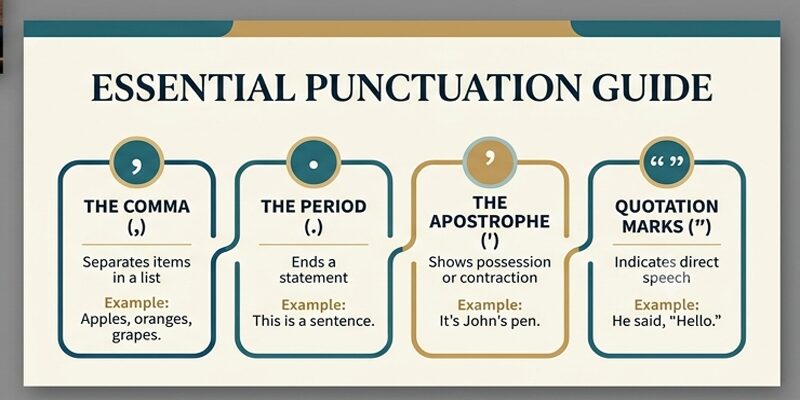
1. Full Stop (.)
A full stop marks the end of a complete statement.
Examples
- She is a teacher.
- I enjoy reading books.
- They arrived late.
Common Mistake
Incorrect
❌ I love music
Correct
✔ I love music.
2. Question Mark (?)
A question mark is used at the end of a direct question.
Examples
- Where do you live?
- What is your name?
- Are you ready?
Common Mistake
Incorrect
❌ Where are you going.
Correct
✔ Where are you going?
3. Exclamation Mark (!)
An exclamation mark expresses strong feelings, surprise, excitement, or emotion.
Examples
- Wow!
- What a beautiful day!
- Congratulations!
Use Sparingly
Too many exclamation marks can make writing look unprofessional.
Incorrect
❌ Amazing!!!!!
Better
✔ Amazing!
4. Comma (,)
The comma is one of the most frequently used punctuation marks.
A. Separating Items in a List
Examples
- I bought apples, bananas, oranges, and grapes.
- She speaks English, Hindi, and French.
B. Joining Independent Clauses
Examples
- I was tired, so I went to bed.
- She studied hard, and she passed the exam.
C. After Introductory Phrases
Examples
- After dinner, we watched a movie.
- In the morning, I go for a walk.
Common Mistake
Incorrect
❌ Although it was raining we went outside.
Correct
✔ Although it was raining, we went outside.
5. Apostrophe (‘)
The apostrophe is mainly used to show possession and contractions.
A. Possession
Examples
- Rahul’s car
- The girl’s book
- Children’s toys
B. Contractions
Examples
- It’s = It is
- Don’t = Do not
- They’re = They are
- Can’t = Cannot
Common Mistake
Incorrect
❌ Its raining.
Correct
✔ It’s raining.
6. Quotation Marks (” “)
Quotation marks are used to indicate direct speech or exact words.
Examples
- Rahul said, “I am happy.”
- She asked, “Where are you going?”
Titles of Short Works
Examples
- “The Last Leaf”
- “Stopping by Woods on a Snowy Evening”
7. Colon (:)
A colon introduces a list, explanation, or quotation.
Examples
- I need three things: water, food, and medicine.
- He had one goal: to become a doctor.
Common Mistake
Incorrect
❌ My hobbies are, reading, writing, and painting.
Better
✔ My hobbies are: reading, writing, and painting.
8. Semicolon (;)
A semicolon connects closely related independent clauses.
Examples
- She loves reading; her sister enjoys writing.
- I was tired; however, I completed the project.
When to Use a Semicolon
Use a semicolon when two complete sentences are closely related but do not require a conjunction.
9. Hyphen (-)
Hyphens join words together.
Examples
- Well-known author
- Twenty-one students
- Part-time job
10. Parentheses ( )
Parentheses add extra information.
Examples
- Rahul (my best friend) lives in Delhi.
- The meeting starts at 10 AM (sharp).
11. Dash (—)
Dashes emphasise information or indicate a sudden break.
Examples
- She finally understood the truth—the project was cancelled.
- There was only one thing left—hope.
12. Ellipsis (…)
Ellipsis indicates omitted words or a pause.
Examples
- Well… I am not sure.
- “To be or not to be…”
Common Punctuation Mistakes
Mistake 1: Missing Commas
Incorrect
❌ After dinner we went shopping.
Correct
✔ After dinner, we went shopping.
Mistake 2: Confusing Its and It’s
Incorrect
❌ Its a beautiful day.
Correct
✔ It’s a beautiful day.
Mistake 3: Using Multiple Exclamation Marks
Incorrect
❌ Fantastic!!!!
Better
✔ Fantastic!
Mistake 4: Misplacing Apostrophes
Incorrect
❌ The boy’s are playing.
Correct
✔ The boys are playing.
Mistake 5: Missing Quotation Marks
Incorrect
❌ She said, I am tired.
Correct
✔ She said, “I am tired.”
Punctuation and Professional Writing
Proper punctuation improves:
- Emails
- Blog posts
- Reports
- Essays
- Business communication
Poor punctuation can change meanings and make writing appear careless.
Tips to Master Punctuation
Read Quality Content
Books, newspapers, and blogs expose you to proper punctuation usage.
Keep Sentences Simple
Simple sentences reduce punctuation errors.
Proofread Your Writing
Always review your work before publishing or sending it.
Use Grammar Tools
Writing tools can help identify punctuation mistakes.
Practice Daily
Write short paragraphs and focus on punctuation marks.
Frequently Asked Questions
What is the most commonly used punctuation mark?
The period (full stop) and comma are the most frequently used punctuation marks.
Why are commas important?
Commas improve readability and prevent misunderstandings.
Can punctuation change the meaning of a sentence?
Yes.
Example:
- Let’s eat, Grandpa.
- Let’s eat Grandpa.
The comma completely changes the meaning.
Conclusion
Friends, in this blog post(Punctuation Rules in English Writing), we have gone through a very interesting English grammar topic: punctuation marks. To make your written communication organised, meaningful, and clear, punctuation marks play a very important role. However it’s proper use in oral communication also makes it impactful and attractive. Punctuation marks are very helpful in writing emails, essays, blog posts, or social media content, etc. Using Punctuation marks, your message is well conveyed to the readers accurately and effectively.
If you get a sound command of full stops, commas, question marks, apostrophes, quotation marks, colons, semicolons, and other punctuation marks, it is surely going to improve your writing skills and make your communication effective and more professional.
Always keep this in mind! Punctuation is not just to memorization of few rules; rather, it is an impactful way to express your thoughts at ease.
If you have any queries, you can write to us at support@a5theory.com; we will get back to you ASAP.
Hope! You would have enjoyed this post(Punctuation Rules in English Writing).
Please feel free to give your important feedback in the comment section below.
Have a great time!