

Introduction
Hello Friends, in this blog post(British English vs American English), we are going to let you know the differences between British and American English.
As we know, English is an international language and is being used across the world by people.
But you will be surprised to know that it is not the same English that is being spoken everywhere.
The two most common and popular English varieties are British English (BrE) and American English (AmE). |British English vs American English|
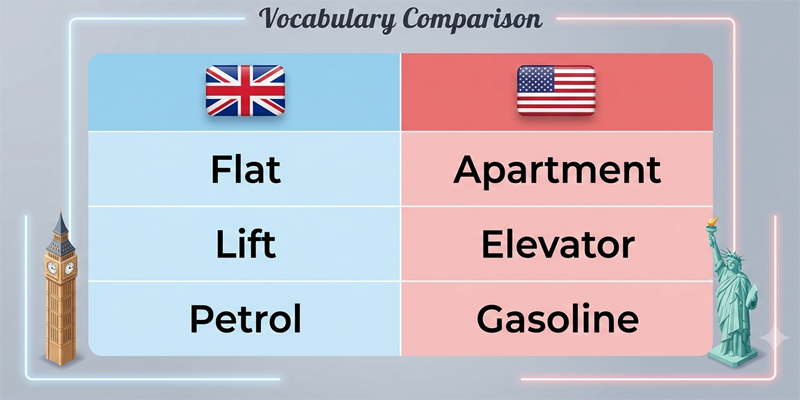
However, both of these variations of English use the same grammar and have mutual understanding.
But if we talk about the vocabulary, spelling, pronunciation, punctuation, and even some grammar rules, they have some differences up to a certain extent.
These differences could create confusion among beginners. And even you would have felt confusion to write some words sometimes, like:
colour or color, lift or elevator, or holiday or vacation.
You should not worry much about these English variations, as they both are correct. But you should be aware of the key differences between them.
It helps you to be consistent with one variation when you choose a specific English style.
In this post(British English vs American English), we are going to let you know the extensive key differences between British and American English.
We will also explore a lot of practical examples that would definitely help you to communicate confidently.
What Are British English and American English?
British English (BrE)
British English is the standard form used in:
- United Kingdom
- Ireland (alongside Irish English)
- Many Commonwealth countries
- International examinations such as IELTS
American English (AmE)
American English is commonly used in:
- United States
- Most American companies
- Hollywood movies
- Technology companies
- International business
- Many online platforms
Both forms are accepted globally.
Which English Should You Learn?
The answer depends on your goals.
Choose British English if you are:
- Preparing for IELTS.
- Planning to study or work in the UK.
- Following British educational resources.
Choose American English if you are:
- Preparing for careers in multinational tech companies.
- Learning from American media.
- Working with US-based clients or organizations.
For most learners, either version is acceptable as long as you stay consistent.
Major Differences Between British and American English
The main differences include:
- Spelling
- Vocabulary
- Pronunciation
- Grammar
- Punctuation
- Date and time formats
Let’s explore each one.
Spelling Differences
Many words are spelled differently.
| British English | American English |
|---|---|
| Colour | Color |
| Favourite | Favorite |
| Honour | Honor |
| Centre | Center |
| Theatre | Theater |
| Programme | Program (except TV programmes in British English) |
| Defence | Defense |
| Licence (noun) | License |
| Travelling | Traveling |
| Jewellery | Jewelry |
The pronunciation often remains similar even when the spelling changes.
Vocabulary Differences
Many everyday objects have different names.
| British English | American English |
|---|---|
| Lift | Elevator |
| Flat | Apartment |
| Biscuit | Cookie |
| Lorry | Truck |
| Holiday | Vacation |
| Petrol | Gasoline (Gas) |
| Autumn | Fall |
| Football | Soccer |
| Torch | Flashlight |
| Dustbin | Trash Can |
Understanding these differences helps you avoid confusion while traveling or communicating internationally.
Grammar Differences
Although the grammar is largely the same, a few differences exist.
Present Perfect
British English often prefers the present perfect.
BrE
I have just finished my work.
American English may also use the simple past.
AmE
I just finished my work.
Both are correct within their respective varieties.
Collective Nouns
British English may treat collective nouns as singular or plural.
The team are playing well.
American English usually treats them as singular.
The team is playing well.
Past Tense Forms
Some verbs have different past participles.
| British English | American English |
|---|---|
| Learnt | Learned |
| Dreamt | Dreamed |
| Burnt | Burned |
| Spoilt | Spoiled |
Both forms are generally understood.
Pronunciation Differences
Pronunciation varies between British and American English.
Examples include:
| Word | British | American |
|---|---|---|
| Advertisement | ad-VER-tis-ment | AD-ver-tize-ment |
| Schedule | SHED-yool | SKED-jool |
| Tomato | tuh-MAH-to | tuh-MAY-to |
| Privacy | PRIV-uh-see | PRY-vuh-see |
Neither pronunciation is more correct than the other.
Date, Time, and Number Formats
Dates
British English:
15 July 2026
American English:
July 15, 2026
Time
British English commonly uses the 24-hour clock in formal settings.
American English generally prefers the 12-hour clock with AM/PM.
Numbers
Large numbers are written similarly, but formatting styles may vary slightly in business documents.
Common Mistakes Learners Make
❌ Mixing British and American spellings in the same document.
❌ Switching between colour and color.
❌ Using British vocabulary with American spelling.
❌ Changing pronunciation randomly.
Choose one style and use it consistently.
Tips for Learning Either Version
- Decide which version suits your goals.
- Read books and articles in that variety.
- Watch movies or news from the same region.
- Use a dictionary that matches your chosen style.
- Don’t worry if you occasionally encounter the other version—understanding both is useful.
Frequently Asked Questions
Which English is easier to learn?
Neither is objectively easier. The choice depends on your learning goals, preferred resources, and plans.
Can I mix British and American English?
It’s best to avoid mixing them in formal writing. Choose one variety and remain consistent throughout a document.
Which version is used in international business?
Both are widely accepted. Many global companies use American English, while British English remains common in education, international organizations, and many Commonwealth countries.
Key Takeaways
- British English and American English are both correct.
- They differ mainly in spelling, vocabulary, pronunciation, and some grammar.
- Choose the version that aligns with your goals.
- Be consistent in your writing and speaking.
- Understanding both varieties makes communication easier worldwide.
Conclusion
Friends, in this post(British English vs American English), we have seen the differences between British and American English. They are two different variations of the same language, which is widely accepted across the globe. You can see their differences in vocabulary, spelling, grammar, and pronunciation, which are quite noticeable. They both follow the same core structure and are mutually understood very easily.
Which English version or variation is good should not be your cup of coffee. You should always focus on learning one consistently, along with getting aware of the others. By using this flexibility in language, you can easily communicate in this language confidently in professional, academic, and your day-to-day life across the world. |British English vs American English|
If you have any queries, you can write to us at support@a5theory.com; we will get back to you ASAP.
Hope! You would have enjoyed this post(British English vs American English).
Please feel free to give your important feedback in the comment section below.
Have a great time!