

Hello Friends, in this blog post(Heat and Temperature), we are going to let you know about the science behind heat and temperature.
You often experience this heat and temperature effect in your daily life too. |Heat and Temperature|
Like in the summer afternoon, it is very hard and uncomfortable to walk on the concrete barefoot due to the extremely hot ground.
And also in a winter morning, when we touch a hot cup of tea or coffee, we feel warmth spreading through our hand within a second.
Similarly, when we keep our ice-cream outside on a sunny day, it quickly melts.
Have you ever wondered? What are the causes behind these changes?
Heat and temperature seem to be very closely related concepts, but they are very different from each other, and your answer lies in them.
These two words are often used interchangeably by people, though their meaning in science is completely different.
In this post(Heat and Temperature), we are going to explore the concepts of heat and temperature in detail, including what they actually are…
… the difference between them, how heat travels, and how these concepts have importance in our daily lives.
What Is Heat?
Heat is a form of energy that flows from a hotter object to a colder object because of a temperature difference.
Heat always moves naturally from a warmer body to a cooler one until both reach the same temperature.
For example:
- A hot cup of coffee cools down because heat flows into the surrounding air.
- An ice cube melts because it absorbs heat from the environment.
SI Unit of Heat
The SI unit of heat is the Joule (J).
Heat is also sometimes measured in calories, especially in food and nutrition.
What Is Temperature?
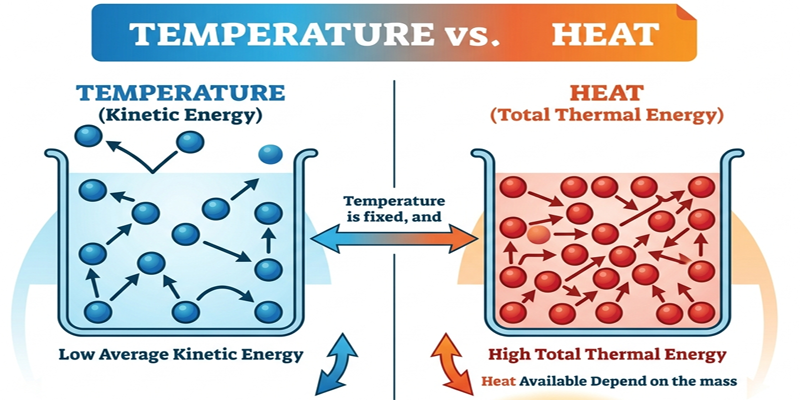
Temperature is the measure of how hot or cold an object is.
It tells us the average kinetic energy (motion) of the particles inside a substance.
Simply put:
- Higher temperature = Faster-moving particles
- Lower temperature = Slower-moving particles
Common Temperature Scales
- Celsius (°C)
- Fahrenheit (°F)
- Kelvin (K) – the SI unit of temperature
Examples:
- Freezing point of water: 0°C
- Boiling point of water: 100°C
- Normal human body temperature: 37°C
Difference Between Heat and Temperature
| Heat | Temperature |
|---|---|
| A form of energy | A measure of hotness or coldness |
| Measured in Joules | Measured in °C, °F, or K |
| Flows from hot to cold | Does not “flow” |
| Depends on the amount of substance | Does not depend on the amount of substance |
| Can change temperature | Indicates the thermal state |
Simple Example
Imagine two buckets of water:
- Bucket A: 5 liters at 50°C
- Bucket B: 50 liters at 50°C
Both have the same temperature, but Bucket B contains more heat energy because it has much more water.
How Does Heat Transfer?
Heat travels in three main ways.
1. Conduction
Conduction is the transfer of heat through direct contact.
It mainly occurs in solids.
Examples
- A metal spoon becomes hot when left in a cup of tea.
- Ironing clothes.
- Cooking on a metal pan.
Metals are good conductors of heat, while wood and plastic are poor conductors (insulators).
2. Convection
Convection is the transfer of heat through the movement of liquids or gases.
When a fluid is heated, it becomes lighter and rises. Cooler fluid moves down to replace it, creating a continuous circulation called a convection current.
Examples
- Boiling water.
- Sea breeze and land breeze.
- Heating a room with a heater.
3. Radiation
Radiation is the transfer of heat through electromagnetic waves.
It does not require any material medium.
Examples
- Heat from the Sun reaching Earth.
- Feeling warmth from a fire without touching it.
- Infrared heaters.
Conductors and Insulators
Good Conductors
These allow heat to pass through easily.
Examples:
- Copper
- Aluminium
- Iron
- Silver
Good Insulators
These slow down the transfer of heat.
Examples:
- Wood
- Plastic
- Rubber
- Glass
- Wool
- Air
That’s why cooking utensils often have plastic or wooden handles.
Expansion Due to Heat
Most substances expand when heated and contract when cooled.
Everyday Examples
- Railway tracks have small gaps to allow expansion.
- Bridges use expansion joints.
- Electric wires sag more during summer.
- Metal jar lids become easier to open after warming them.
Measuring Temperature
Temperature is measured using a thermometer.
Types of Thermometers
- Clinical thermometer – Measures body temperature.
- Laboratory thermometer – Used in experiments.
- Digital thermometer – Fast and accurate.
- Infrared thermometer – Measures temperature without touching the object.
Heat in Everyday Life
Heat plays an important role in many daily activities.
Cooking Food
Heat cooks food by changing its physical and chemical properties.
Refrigerators
A refrigerator removes heat from inside the cabinet and releases it outside.
Air Conditioners
Air conditioners cool a room by transferring heat from indoors to the outside.
Solar Water Heaters
They use sunlight to heat water without electricity.
Thermal Flasks
A thermos bottle reduces heat transfer, keeping drinks hot or cold for longer.
States of Matter and Heat
Heat can change the state of matter.
Melting
Solid → Liquid
Example:
Ice → Water
Freezing
Liquid → Solid
Example:
Water → Ice
Evaporation
Liquid → Gas
Example:
Wet clothes drying in the sun.
Condensation
Gas → Liquid
Example:
Water droplets forming on a cold bottle.
Sublimation
Solid → Gas (without becoming liquid)
Examples:
- Camphor
- Dry ice
- Naphthalene balls
Science Around You
You experience heat and temperature every day:
- Tea cools down if left uncovered.
- Ice cream melts in summer.
- Black clothes feel hotter because they absorb more sunlight.
- White clothes feel cooler because they reflect more sunlight.
- Desert temperatures rise quickly during the day and fall rapidly at night.
Did You Know?
- The Sun’s surface has a temperature of about 5,500°C, while its core reaches around 15 million°C.
- The coldest possible temperature is called Absolute Zero (0 Kelvin or –273.15°C), where particle motion is at its minimum.
- Water is unusual because it expands when it freezes, which is why ice floats on water.
- Space itself is extremely cold, but astronauts can still experience intense heat from direct sunlight.
Try This at Home (Safe Experiment)
Which Spoon Gets Hot Faster?
You’ll Need:
- One metal spoon
- One wooden spoon
- A cup of hot (not boiling) water
Steps:
- Place both spoons in the hot water.
- Wait for 2–3 minutes.
- Carefully touch the handles.
Observation:
The metal spoon becomes warm much faster than the wooden spoon.
Reason:
Metal is a good conductor of heat, while wood is a poor conductor.
Common Mistakes Students Make
❌ Thinking heat and temperature are the same.
✔ Heat is energy; temperature measures hotness.
❌ Believing cold flows from one object to another.
✔ Heat always flows from the hotter object to the colder one.
❌ Assuming all materials conduct heat equally.
✔ Metals conduct heat well, while materials like wood and plastic act as insulators.
Frequently Asked Questions (FAQs)
1. Is heat the same as temperature?
No. Heat is energy transferred due to a temperature difference, while temperature measures how hot or cold something is.
2. Why does a metal spoon become hot in tea?
Because heat travels through the metal by conduction.
3. Why does ice float on water?
Ice is less dense than liquid water because water expands when it freezes.
4. Why do we wear light-colored clothes in summer?
Light colors reflect more sunlight, so they absorb less heat.
5. Can heat travel through space?
Yes. Heat travels through space by radiation, which does not require air or any other medium.
Why This Topic Matters
Understanding heat and temperature helps explain:
- Why food cooks.
- How refrigerators and air conditioners work.
- Why weather changes.
- How engines stay cool.
- Why buildings and bridges need expansion joints.
- How renewable technologies like solar water heaters operate.
These concepts form the foundation of thermodynamics and are widely used in engineering, medicine, environmental science, and everyday technology.
Conclusion
Friends, in this post(Heat and Temperature), we have understood the concepts of heat and temperature. Being closely connected, they have different meanings as per science. Heat is a form of energy in transit, whereas temperature defines how hot or cold an object is. These concepts nearly touch every aspect of our modern life, whether it is cooking meals, electricity generation, cooling rooms, or boiling water.
If you want to see a better correlation between the science taught in the classroom and these amazing processes happening around you every day, you should have to understand this that how heat moves through conduction, convection, and radiation. |Heat and Temperature|
If you have any queries, you can write to us at support@a5theory.com; we will get back to you ASAP.
Hope! You would have enjoyed this post.
Please feel free to give your important feedback in the comment section below.
Have a great time!