

Hello Friends, in this blog post(Light Explained), we are going to let you know about a very interesting science topic that is “Light“.
You would be noticing this every day: when you wake up in the morning and open your eyes,…
… you probably see your room, sunlight coming through your window, or the people around you.
And the thing that actually makes you capable of seeing such things through your eyes is light.
If light did not exist, our world would be completely dark. |Light Explained|
Without light, we could never be able to see colors, drive vehicles, read books, watch television, or even enjoy a beautiful rainbow after the rain.
One of the greatest wonders of nature is light. It behaves in fascinating ways, travels very fast, and…
… has always been very helpful to scientists in unlocking many secrets of the universe and nature.
In this post(Light Explained), we are going to explore light in detail. |Light Explained|
We will discover many interesting facts related to its traveling, reflection effect, lens work, and the appearance of rainbows, along with its own definition.
What Is Light?
Light is a form of energy that enables us to see objects.
It is a type of electromagnetic wave, which means it can travel through space without needing air, water, or any other material.
The biggest natural source of light for Earth is the Sun.
Other sources include:
- Electric bulbs
- LED lights
- Candles
- Fire
- Lightning
- Stars
- Lasers
Natural and Artificial Sources of Light
Natural Sources
These occur naturally in nature.
Examples:
- Sun
- Stars
- Lightning
- Fireflies
Artificial Sources
These are created by humans.
Examples:
- Electric bulbs
- LED lamps
- Tube lights
- Torches
- Vehicle headlights
How Fast Does Light Travel?
Light is the fastest thing known in the universe.
Its speed in a vacuum is approximately:
299,792 kilometers per second
(about 300,000 km/s)
To understand how fast that is:
- Light reaches Earth from the Sun in about 8 minutes 20 seconds.
- It could travel around Earth more than 7 times in just one second.
How Does Light Travel?
Light travels in straight lines.
This property is called rectilinear propagation of light.
You can observe this when sunlight enters a room through a small hole or when a flashlight shines in a straight beam.
Transparent, Translucent, and Opaque Objects
Light behaves differently depending on the material.
Transparent Objects
Allow almost all light to pass through.
Examples:
- Clean glass
- Pure water
- Air
Translucent Objects
Allow only some light to pass through.
Examples:
- Frosted glass
- Butter paper
- Thin curtains
Objects behind them appear blurred.
Opaque Objects
Do not allow light to pass through.
Examples:
- Wood
- Brick
- Metal
- Stone
These objects form shadows.
What Is Reflection?
Reflection is the bouncing back of light when it strikes a surface.
Every time you look into a mirror, you’re seeing reflection.
Laws of Reflection
Reflection follows two simple rules:
First Law
The angle of incidence equals the angle of reflection.
Angle of Incidence = Angle of Reflection
Second Law
The incident ray, reflected ray, and the normal all lie in the same plane.
Types of Reflection
Regular Reflection
Occurs on smooth surfaces.
Examples:
- Mirror
- Calm water
- Polished metal
Produces a clear image.
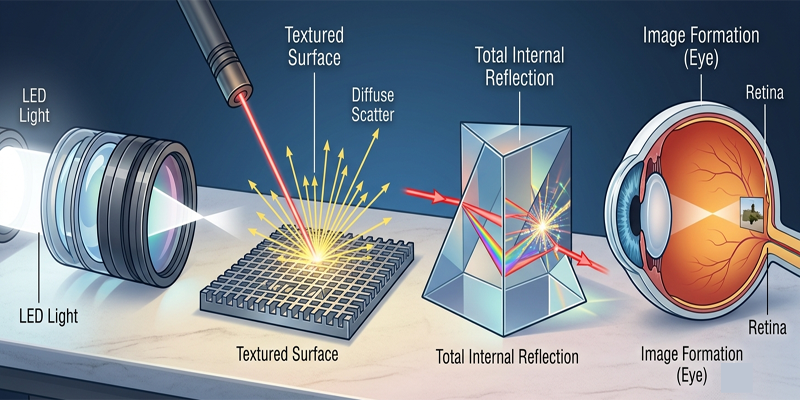
Diffuse Reflection
Occurs on rough surfaces.
Examples:
- Wall
- Paper
- Road
Light scatters in many directions, allowing us to see objects from different angles.
What Is Refraction?
Refraction is the bending of light when it passes from one transparent medium to another.
This happens because light changes speed in different materials.
Examples:
- Air to water
- Water to glass
- Glass to air
Everyday Examples of Refraction
- A pencil looks bent in a glass of water.
- A swimming pool appears shallower than it actually is.
- Fish in water appear closer to the surface.
- Diamonds sparkle because light bends and reflects multiple times inside them.
What Is Dispersion?
Dispersion is the splitting of white light into seven colors.
This happens because each color bends by a different amount.
The seven colors are remembered by the acronym VIBGYOR:
- Violet
- Indigo
- Blue
- Green
- Yellow
- Orange
- Red
How Is a Rainbow Formed?
A rainbow forms when sunlight enters tiny water droplets in the atmosphere.
Inside each droplet:
- Light is refracted.
- It is reflected internally.
- It is refracted again as it exits.
This process separates white sunlight into the seven beautiful colors of the rainbow.
Mirrors
A mirror reflects light to form images.
Plane Mirror
Produces:
- Virtual image
- Upright image
- Same size as the object
Examples:
- Bathroom mirror
- Dressing mirror
Concave Mirror
Curves inward.
Uses:
- Car headlights
- Solar cookers
- Shaving mirrors
- Dentist mirrors
Convex Mirror
Curves outward.
Uses:
- Rear-view mirrors in vehicles
- Security mirrors in shops
- Road safety mirrors
Convex mirrors provide a wider field of view.
Lenses
A lens bends light through refraction.
Convex Lens
Thicker at the center.
Uses:
- Magnifying glass
- Camera
- Human eye
- Telescope
- Microscope
Concave Lens
Thinner at the center.
Uses:
- Correcting short-sightedness (myopia)
- Door viewers (peepholes)
- Optical instruments
The Human Eye
The human eye works much like a camera.
Main parts include:
- Cornea
- Iris
- Pupil
- Lens
- Retina
- Optic nerve
The eye lens focuses light onto the retina, where images are formed. The optic nerve then sends signals to the brain, allowing us to see.
Light in Everyday Life
Light plays an important role in almost everything we do.
Examples include:
- Reading books
- Watching television
- Taking photographs
- Driving at night
- Solar panels generating electricity
- Fiber-optic internet communication
- Medical lasers used in surgery
- Barcode scanners in supermarkets
Science Around You
Look around your home, and you’ll find light everywhere.
- Mirrors help us see ourselves.
- Glass windows let sunlight enter.
- LED bulbs save electricity.
- Cameras capture images using lenses.
- Spectacles help correct vision.
- Solar calculators work using sunlight.
Did You Know?
- The Moon does not produce its own light; it reflects sunlight.
- Lightning is hotter than the surface of the Sun.
- The colors we see depend on the wavelengths of light reflected by objects.
- Fiber-optic cables carry information using pulses of light at incredibly high speeds.
- Some deep-sea creatures produce their own light through a process called bioluminescence.
Try This at Home (Safe Experiment)
Make a Simple Rainbow
You’ll Need
- A glass of water
- A small mirror
- Sunlight
- A white sheet of paper
Steps
- Fill the glass with water.
- Place the mirror partly inside the water.
- Let sunlight fall on the mirror.
- Hold the white paper where the reflected light falls.
Observation
You will see tiny bands of rainbow colors on the paper.
Reason
The water and mirror help disperse white sunlight into different colors.
Common Mistakes Students Make
❌ Thinking light always needs air to travel.
✔ Light can travel through the vacuum of space.
❌ Believing the Moon produces its own light.
✔ The Moon reflects sunlight.
❌ Assuming mirrors create light.
✔ Mirrors only reflect existing light.
❌ Thinking all mirrors produce the same type of image.
✔ Different mirrors produce different kinds of images.
Frequently Asked Questions (FAQs)
1. Why can we see objects?
Because light reflects from objects into our eyes.
2. Why is the sky blue?
Tiny particles in the atmosphere scatter blue light more than other colors, making the sky appear blue.
3. Why does a pencil appear bent in water?
Due to refraction, as light changes direction when moving between water and air.
4. Why do we see our image in a mirror?
Because light reflects from the mirror into our eyes.
5. Can light travel in space?
Yes. Unlike sound, light does not need a material medium and can travel through the vacuum of space.
Why This Topic Matters
Understanding light helps explain:
- How cameras work.
- Why spectacles improve vision.
- How telescopes explore distant galaxies.
- How microscopes reveal tiny organisms.
- How fiber-optic communication powers the internet.
- How solar panels generate electricity.
- Why rainbows appear after rain.
These concepts are essential in physics, medicine, astronomy, photography, telecommunications, and modern technology.
Conclusion
Friends, in this post(Light Explained), we have learned a few amazing facts about light. Light not only helps us see things but also offers a vast perspective. It is one of the most powerful forms of energy, and it helps our mind to understand the vast universe properly. In a few decades, light has been the heart of many amazing scientific discoveries and technological innovations, whether it is the formation of rainbows, reflection in mirrors, eyesight correction, or sending information through fibre-optic cables.
If you want to build a strong optics foundation, then you must know the concept of light behaviour through reflection, refraction, and dispersion. |Light Explained|
If you have any queries, you can write to us at support@a5theory.com; we will get back to you ASAP.
Hope! You would have enjoyed this post(Light Explained).
Please feel free to give your important feedback in the comment section below.
Have a great time!