

Hello Friends, in this blog post(Magnetism Made Simple), we are going to explore another interesting science topic that is “Magnet”.
Most of us definitely would have played some games with the magnet piece, where we would try to…
… pull the iron nails and other iron equipment without actually touching them with the help of our magnet.
It would be really fascinating to make some magic with the magnet while we had no scientific idea or concepts behind it in our childhood days. |Magnetism Made Simple|
Have you ever thought about such things, how they are happening, like:
- What makes refrigerator magnets stick to the door?
- How does a compass always point north?
- How do giant cranes lift heavy scrap metal using magnets?
We can answer all the questions above only with the help of a natural force called magnetism.
Being invisible, magnetism plays an important role in our daily lives. |Magnetism Made Simple|
Many technologies run on magnetic power every day. For example, MRI machines, high-speed trains, electric motors, and loudspeakers.
In this post(Magnetism Made Simple), we are going to explain what magnetism actually is and how it works.
We will also discuss the role of this invisible force in our modern science and technology, and will find the reason behind some objects being magnetic. |Magnetism Made Simple|
What Is Magnetism?
Magnetism is a force of attraction or repulsion produced by magnets or moving electric charges.
Unlike pushing or pulling an object directly, magnetic force acts without physical contact.
This makes magnetism a non-contact force, just like gravity.
What Is a Magnet?
A magnet is an object that produces a magnetic field and attracts certain materials such as iron, nickel, and cobalt.
Every magnet has two poles:
- North Pole (N)
- South Pole (S)
These poles always exist together.
Even if a magnet is cut into two pieces, each piece forms a new magnet with its own north and south poles.
Types of Magnets
1. Natural Magnets
These occur naturally.
Example:
- Lodestone (a naturally magnetized mineral)
2. Artificial Magnets
These are made by humans.
Examples:
- Bar magnet
- Horseshoe magnet
- Ring magnet
- Disc magnet
- Cylindrical magnet
Artificial magnets are stronger and more useful for practical applications.
Magnetic Poles
Magnets have two poles:
- North Pole
- South Pole
Rules of Magnetic Poles
✔ Like poles repel each other.
- North–North → Repel
- South–South → Repel
✔ Unlike poles attract each other.
- North–South → Attract
This simple rule explains why magnets either stick together or push apart.
What Is a Magnetic Field?
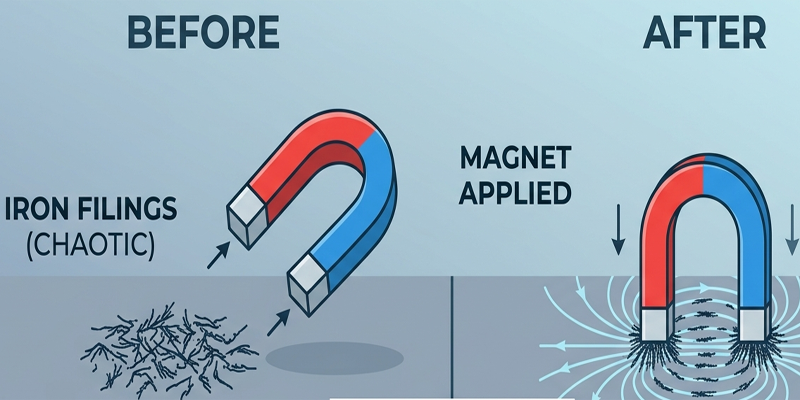
A magnetic field is the invisible region around a magnet where magnetic force can be felt.
Although we cannot see magnetic fields directly, we can observe them using iron filings.
When iron filings are sprinkled around a magnet, they arrange themselves into beautiful curved patterns showing the magnetic field lines.
Properties of Magnetic Field Lines
Magnetic field lines:
- Start from the north pole.
- Enter the south pole outside the magnet.
- Never cross one another.
- Are closer together where the magnetic field is stronger.
Magnetic Materials
Not every material is attracted to magnets.
Magnetic Materials
These are strongly attracted by magnets.
Examples:
- Iron
- Nickel
- Cobalt
- Steel
Non-Magnetic Materials
These are not attracted to magnets.
Examples:
- Wood
- Plastic
- Glass
- Rubber
- Paper
- Aluminium (very weakly magnetic under normal conditions)
Permanent Magnets
A permanent magnet remains magnetic for a long time.
Examples:
- Refrigerator magnets
- Compass needle
- Magnetic toys
Temporary Magnets
These become magnetic only under certain conditions.
Examples:
- Iron nail placed near a strong magnet
- Electromagnets
What Is an Electromagnet?
An electromagnet is a magnet created by passing electric current through a coil of wire, usually wrapped around an iron core.
Unlike permanent magnets, an electromagnet works only while electric current flows.
Where Are Electromagnets Used?
Electromagnets are found in many devices.
Examples:
- Electric bells
- Loudspeakers
- Electric motors
- MRI machines
- Cranes used in scrap yards
- Relays and switches
One of their biggest advantages is that they can be switched on and off.
Earth’s Magnetic Field
Did you know that Earth itself behaves like a giant magnet?
Earth has its own magnetic field that extends far into space.
This magnetic field:
- Protects us from harmful charged particles from the Sun.
- Helps birds, turtles, and some animals navigate during migration.
- Allows compasses to point roughly toward the geographic north.
Without Earth’s magnetic field, life on our planet would be much more difficult.
How Does a Compass Work?
A compass contains a small magnetized needle.
Because Earth has a magnetic field, the needle aligns itself with it.
One end points toward magnetic north, helping travelers, sailors, hikers, and pilots determine direction.
Magnetism and Electricity
Electricity and magnetism are closely related.
- A moving electric current produces a magnetic field.
- A changing magnetic field can produce an electric current.
This relationship forms the basis of electromagnetism, one of the most important areas of physics.
It is the principle behind:
- Electric generators
- Electric motors
- Transformers
- Wireless charging
- Induction cooktops
Everyday Uses of Magnets
Magnets are everywhere around us.
At Home
- Refrigerator doors
- Cupboard latches
- Speakers
- Mobile phones
- Headphones
In Hospitals
- MRI scanners
- Medical instruments
In Transportation
- Electric trains
- High-speed maglev trains
- Electric vehicle motors
In Industries
- Sorting metals
- Heavy lifting cranes
- Recycling plants
- Manufacturing machines
In Computers and Electronics
- Hard disk drives
- Electric motors
- Sensors
- Microphones
Science Around You
Look around your home, and you’ll likely find magnets in:
- Refrigerator magnets
- Earphones
- Bluetooth speakers
- Mobile phone covers
- Door locks
- Fans
- Washing machines
- Mixer grinders
Magnetism quietly powers many everyday devices.
Did You Know?
- The strongest permanent magnets are often made from neodymium, a rare-earth magnetic material.
- Birds such as pigeons are believed to use Earth’s magnetic field to help navigate over long distances.
- MRI (Magnetic Resonance Imaging) machines use very powerful magnets to create detailed images of the inside of the human body.
- The Sun also has a magnetic field, which plays a major role in sunspots and solar storms.
- Every second, Earth is protected from billions of charged particles by its magnetic field.
Try This at Home (Safe Experiment)
Make a Simple Compass
You’ll Need
- A sewing needle
- A small magnet
- A bowl of water
- A small piece of cork or foam
Steps
- Stroke the needle in one direction with the magnet about 30–40 times.
- Push the needle through the cork or place it carefully on the foam.
- Float it on the water.
Observation
The needle slowly turns and settles in a north–south direction.
Reason
The needle has become magnetized and aligns itself with Earth’s magnetic field.
Common Mistakes Students Make
❌ Thinking magnets attract every metal.
✔ Magnets strongly attract only certain materials such as iron, nickel, cobalt, and many types of steel.
❌ Believing magnets have only one pole.
✔ Every magnet has both a north pole and a south pole.
❌ Assuming Earth’s magnetic north and geographic north are the same.
✔ They are close but not identical, which is why compass readings sometimes require correction in precise navigation.
❌ Thinking magnetism and electricity are unrelated.
✔ They are closely connected through electromagnetism.
Frequently Asked Questions (FAQs)
1. Why do magnets attract iron?
Iron contains regions called magnetic domains that can align with an external magnetic field, causing attraction.
2. Can a magnet lose its strength?
Yes. Heat, strong impacts, or improper storage can reduce the strength of some magnets over time.
3. Why doesn’t a magnet attract wood or plastic?
These materials do not respond strongly to magnetic fields.
4. Why do compass needles always point north?
Because the magnetized needle aligns with Earth’s magnetic field.
5. What is the difference between a permanent magnet and an electromagnet?
A permanent magnet is always magnetic, while an electromagnet becomes magnetic only when electric current flows through it.
Why This Topic Matters
Understanding magnetism helps explain:
- How electric motors work.
- How generators produce electricity.
- How MRI scanners help doctors diagnose diseases.
- How compasses guide navigation.
- How loudspeakers produce sound.
- How recycling plants separate iron from waste.
- How maglev trains move with minimal friction.
Magnetism is one of the fundamental forces behind modern technology and engineering.
Conclusion
Friends, in this blog post(Magnetism Made Simple), we have learned various important facts about magnetism. It is a in visible force capable of transforming the modern world. Its role in our life is much bigger than our realization. Magnetism helps us in many fields like advanced transportation systems, medical equipment, compasses for direction, electric motor and, etc.
By understanding magnetic fields, magnetic poles, electromagnets, and Earth’s magnetic field, students build a strong foundation for future topics such as electricity, electronics, and electromagnetism. |Magnetism Made Simple|
If you want to build a strong foundation in some advanced topics like electronics, electricity, and electromagnetism, you must understand the concepts of magnetic fields, magnetic poles, electromagnets, and Earth’s magnetic field mindfully. |Magnetism Made Simple|
The next time you place a magnet on a refrigerator or use headphones to listen to music, you’ll know that an invisible force is quietly making it all possible.
You are definitely going to remember this invisible force of magnetism as a main reason when using headphones to listen to music or placing a magnet on a refrigerator.
If you have any queries, you can write to us at support@a5theory.com; we will get back to you ASAP.
Hope! You would have enjoyed this post(Magnetism Made Simple).
Please feel free to give your important feedback in the comment section below.
Have a great time!