

Hello Friends, in this blog post(How Is Electricity Generated), I am going to let you know the amazing journey of electricity, which has been a compulsory necessity for all of us.
If we talk on a broader scale, then we use or see the use of this electricity every day till we are awake.
Like when you wake up in the morning, you usually plug in your mobile charger, and it starts charging as you turn on the switch. |How Is Electricity Generated|
When you switch on the LED light of your room, the LED light glows quickly and lights our room.
If you feel humid or warm, then you probably turn on the fan or AC. Most of us make our morning tea or coffee using an electric kettle.
And perhaps we enjoy this drink by turning on our laptop or television for a while.
Has this idea ever struck your mind:
Where is all this electricity coming from?
Always remember this: electricity is not generated at your home or any switchboard.
It is basically generated in a giant power plant which could be situated many hundred kilometer away from your house.
Then it starts an amazing journey through an extensive network of transmission lines, substations, transformers, and distribution cables to your home.
In this post(How Is Electricity Generated), we are going to discuss the generation of electricity, the working of different power plants, electricity route to our home.
We will also explore the future aspects of power generation with new and advanced updates and discoveries. |How Is Electricity Generated|
What Is Electricity Generation?
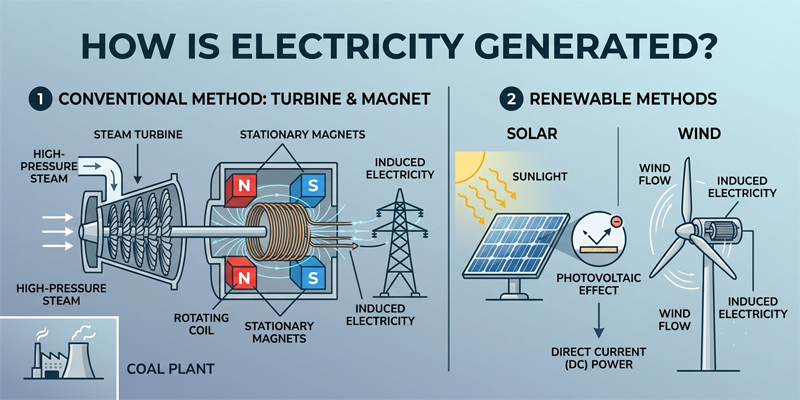
Electricity generation is the process of converting one form of energy into electrical energy.
Since electricity cannot be mined or collected directly from nature in large quantities, we produce it by converting other energy sources such as:
- Heat
- Water
- Wind
- Sunlight
- Nuclear energy
- Ocean tides
- Biomass
- Geothermal heat
Almost every power plant uses the same basic principle:
Rotate a turbine, which spins a generator that produces electricity.
The main difference lies in what rotates the turbine.
The Science Behind Electricity Generation
The principle behind modern electricity generation was discovered by the English scientist Michael Faraday in 1831.
He discovered electromagnetic induction, which states:
Moving a conductor through a magnetic field—or changing the magnetic field around it—produces an electric current.
This principle is still used in almost every large power station around the world.
Main Types of Power Plants
Today, electricity is generated using several different sources of energy.
1. Thermal Power Plant
How It Works
A thermal power plant burns fuel to produce heat.
Common fuels include:
- Coal
- Natural gas
- Oil
Step-by-Step Process
- Fuel is burned inside a boiler.
- Water turns into high-pressure steam.
- Steam rotates a turbine.
- The turbine spins a generator.
- The generator produces electricity.
- Steam is cooled and recycled.
Advantages
✔ Produces large amounts of electricity
✔ Reliable throughout the year
✔ Suitable for continuous power supply
Disadvantages
✖ Air pollution
✖ Greenhouse gas emissions
✖ Coal mining impacts the environment
2. Hydroelectric Power Plant
Hydroelectricity uses the energy of flowing water.
How It Works
- Water is stored behind a dam.
- Water flows through large pipes.
- It spins turbines.
- Turbines rotate generators.
- Electricity is produced.
Examples include major hydroelectric dams around the world and in India.
Advantages
- Renewable
- No direct air pollution
- Low operating cost
Disadvantages
- High construction cost
- Can affect ecosystems and nearby communities
- Depends on rainfall and water availability
3. Solar Power Plant
Solar energy converts sunlight directly into electricity using photovoltaic (PV) cells.
Unlike thermal and hydro plants, solar panels have no moving turbines.
Advantages
- Renewable
- Silent operation
- Low maintenance
- No fuel required
Disadvantages
- Depends on sunlight
- Lower output during cloudy weather
- Requires large land areas for utility-scale projects
4. Wind Power Plant
Wind turbines convert the kinetic energy of moving air into electricity.
How It Works
- Wind turns the blades.
- The blades rotate a shaft.
- The shaft spins a generator.
- Electricity is produced.
Advantages
- Clean energy
- Renewable
- No fuel cost
Disadvantages
- Wind is not constant.
- Large open areas are required.
- Turbines can produce noise.
5. Nuclear Power Plant
Nuclear power plants use heat released during nuclear fission.
In fission, atoms such as uranium split apart, releasing enormous amounts of energy.
This heat:
- Boils water.
- Produces steam.
- Rotates turbines.
- Generates electricity.
Advantages
- Produces huge amounts of electricity
- Very low greenhouse gas emissions during operation
- Reliable base-load power
Disadvantages
- Radioactive waste must be managed carefully.
- High construction costs.
- Strict safety systems are essential.
6. Biomass Power Plant
Biomass plants generate electricity using organic materials such as:
- Crop waste
- Wood
- Animal waste
- Food waste
The biomass is burned—or converted into biogas—to produce heat, which ultimately drives turbines or engines connected to generators.
7. Geothermal Power Plant
Deep inside Earth lies enormous heat.
Geothermal plants use underground hot water or steam to rotate turbines and generate electricity.
This source is available only in regions with suitable geothermal resources.
8. Tidal and Wave Power
The oceans also contain usable energy.
Power plants can harness:
- Ocean tides
- Sea waves
Although still limited in many parts of the world, these technologies have significant long-term potential in suitable coastal regions.
Which Energy Sources Are Renewable?
Renewable energy sources are naturally replenished.
| Renewable | Non-Renewable |
|---|---|
| Solar | Coal |
| Wind | Oil |
| Hydro | Natural Gas |
| Biomass | Uranium (for nuclear fuel) |
| Geothermal | — |
| Tidal | — |
Renewable energy is becoming increasingly important because it helps reduce pollution and dependence on fossil fuels.
What Is a Generator?
A generator is the heart of most power plants.
Its job is to convert mechanical energy into electrical energy.
Inside a generator:
- Magnets rotate around coils (or coils rotate within magnetic fields).
- The changing magnetic field induces electric current.
- This electricity is then sent to the power grid.
How Does Electricity Reach Your Home?
Once electricity is generated, it begins a long journey.
Step 1 – Power Plant
Electricity is generated.
↓
Step 2 – Step-Up Transformer
Voltage is increased to reduce energy loss during transmission.
↓
Step 3 – High-Voltage Transmission Lines
Electricity travels over long distances.
↓
Step 4 – Grid Substations
Voltage is reduced for regional distribution.
↓
Step 5 – Local Distribution Transformer
Voltage is lowered further for homes and businesses.
↓
Step 6 – Electricity Meter
Measures the electricity you use.
↓
Step 7 – Your Home
Electricity powers lights, fans, appliances, and electronic devices.
Why Is High Voltage Used for Transmission?
Electricity loses energy as heat while traveling through wires.
By transmitting electricity at high voltage and relatively low current, power companies reduce these losses and improve efficiency over long distances.
India’s Electricity Mix
India generates electricity from a combination of:
- Coal-based thermal power
- Hydroelectric power
- Solar energy
- Wind energy
- Nuclear power
- Natural gas
- Biomass
In recent years, the share of renewable energy has grown rapidly as the country expands its clean energy capacity.
Future of Electricity Generation
The future of electricity is moving toward cleaner, smarter, and more efficient systems.
Emerging technologies include:
- Floating solar farms
- Offshore wind farms
- Green hydrogen
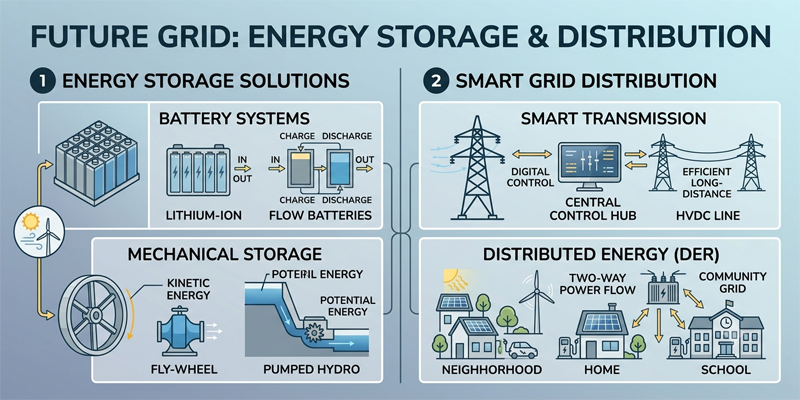
- Battery energy storage systems
- Smart grids
- Vehicle-to-grid charging
- Advanced nuclear reactors
- Fusion energy (under research)
Science Around You
Electricity powers nearly every part of modern life.
Examples include:
- Homes
- Schools
- Hospitals
- Factories
- Railways
- Airports
- Mobile phone towers
- Data centers
- Electric vehicles
Did You Know?
- A large steam turbine in a power plant can rotate at about 3,000 revolutions per minute (rpm) in many 50 Hz systems.
- The Sun provides Earth with far more energy each hour than humanity uses in an entire year.
- Modern wind turbines can be taller than many skyscrapers.
- Hydroelectric plants can respond quickly to changes in electricity demand.
- Electricity travels through transmission systems at nearly the speed of light, while the electrons themselves drift much more slowly.
Try This at Home (Safe Experiment)
Make a Mini Water Wheel
You’ll Need
- Plastic spoons
- Bottle cap
- Wooden stick
- Running tap water
Steps
- Attach the spoons around the bottle cap to form a small wheel.
- Mount it on the stick so it can spin freely.
- Place it under a gentle stream of running water.
Observation
The flowing water rotates the wheel.
What It Demonstrates
This is the same basic principle used in hydroelectric power plants—moving water can produce rotational motion, which can then be converted into electricity using a generator.
Common Mistakes Students Make
❌ Thinking electricity is “created” inside wires.
✔ Wires carry electricity; generators produce it.
❌ Believing every power plant burns coal.
✔ Many plants use water, sunlight, wind, nuclear energy, or biomass.
❌ Assuming solar panels work only in very hot weather.
✔ Solar panels require sunlight, not high temperatures. In fact, they often operate more efficiently in cooler conditions with strong sunlight.
❌ Thinking renewable energy never has limitations.
✔ Renewable sources are cleaner, but some depend on weather or location.
Frequently Asked Questions (FAQs)
1. Which power plant produces the most electricity worldwide?
Thermal power plants fueled by coal and natural gas currently generate a large share of the world’s electricity, though renewable energy is expanding rapidly.
2. Why can’t electricity be stored easily on a large scale?
Electricity is usually generated when needed. Large-scale storage is possible using batteries, pumped-storage hydropower, and other technologies, but it remains technically and economically challenging compared with storing fuels.
3. Why do power stations use turbines?
Turbines convert the energy of steam, water, or wind into mechanical rotation that drives generators.
4. Which is the cleanest source of electricity?
Solar, wind, hydro, and geothermal power generally produce very low direct greenhouse gas emissions during operation. Each has its own environmental considerations.
5. Can a home generate its own electricity?
Yes. Many homes use rooftop solar panels, often with batteries or a grid connection.
Why This Topic Matters
Understanding electricity generation helps explain:
- Where household electricity comes from.
- How renewable energy works.
- Why power cuts occur.
- Why transformers are necessary.
- How countries meet growing energy demands.
- Why clean energy is becoming increasingly important.
This knowledge is valuable for students, engineers, policymakers, and anyone interested in how the modern world functions.
Conclusion
Friends, in this post(How Is Electricity Generated), we have seen a fascinating journey of electricity. It travels a long distance from a big power plant to your home through generators, transformers, transmission lines, and substations. Then you can see its magic in your daily life. It makes your life much easier, as we are very much dependent on electricity in today’s time, whether it is just to take the air through a fan and charing our mobile phones.
Electricity is generated from different sources like flowing water, coal, sunlight, wind, biomass, or nuclear energy. In our modern civilization, it has been just important like our blood to our body. It is very important to understand the concept of electricity generation as the world is moving toward cleaner and smarter energy systems. |How Is Electricity Generated|
The next time you turn on a switch, you’ll know the fascinating science behind that simple action. |How Is Electricity Generated|
If you have any queries, you can write to us at support@a5theory.com; we will get back to you ASAP.
Hope! You would have enjoyed this post(How Is Electricity Generated).
Please feel free to give your important feedback in the comment section below.
Have a great time!