

Hello Friends, in this blog post(How Do Aeroplanes Fly), we are going to share very important and amazing information about aeroplanes.
No one misses a chance to see a big aeroplane carrying many passengers passing over in the sky.
In today’s modern times, airplane also become very advanced and have the latest updated technology.
They can carry hundreds of passengers along with their luggage, and still they rise and fly smoothly into the sky.
Without falling down, they can travel very long distances of thousands of kilometers across the continents. |How Do Aeroplanes Fly|
It is very obvious to be very curious and have some fascinating questions about aeroplanes like:
- How can such a heavy airplane fly?
- Why doesn’t it simply fall to the ground?
- What do airplane wings actually do?
- How do engines help an airplane fly?
- How do pilots control such a huge airplane?
The answers lie in one of the most exciting applications of physics. |How Do Aeroplanes Fly|
To get clarification of all these questions, you must understand some of the most amazing applications of physics.
In this post(How Do Aeroplanes Fly), we are going to explore the science of flight in a very simple way.
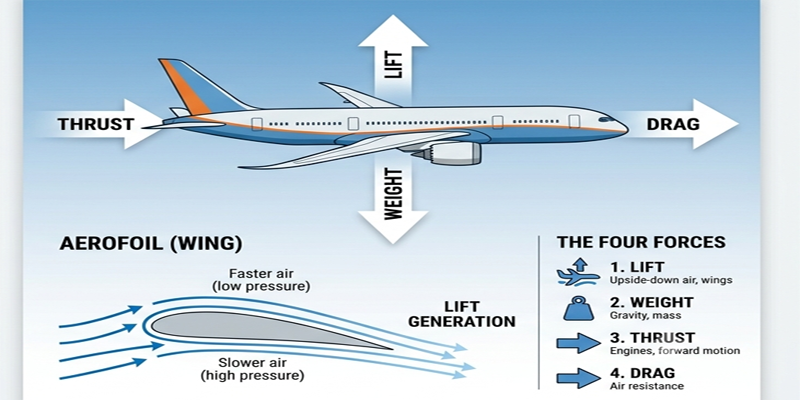
What Is an Aeroplane?
An aeroplane (aeroplane) is a powered aircraft designed to fly by generating lift with its wings.
Unlike birds, airplanes cannot flap their wings. Instead, they use carefully designed wings, powerful engines, and the principles of physics to remain in the air.
The Four Forces of Flight
Every flying aircraft is affected by four main forces.
These forces must remain balanced for safe flight.
1. Lift
Lift is the upward force that pushes the airplane into the air.
It is produced mainly by the wings.
2. Weight (Gravity)
Gravity pulls the airplane downward toward Earth.
The heavier the aircraft, the greater the downward force.
3. Thrust
Thrust is the forward force produced by the aircraft’s engines.
It moves the airplane through the air.
4. Drag
Drag is the air resistance that slows the airplane down.
Aircraft are designed with streamlined shapes to reduce drag.
Simple Rule
For an airplane to fly:
- Lift must be greater than or equal to weight.
- Thrust must overcome drag.
The Secret of Airplane Wings
The most important part of an airplane is its wing.
Aircraft wings are not flat.
They have a special curved shape called an airfoil.
This shape is carefully designed to produce lift.
What Is Lift?
Lift is the upward force that allows an airplane to leave the ground and stay in the air.
Lift is created because air flows around the wings while the airplane moves forward.
How Is Lift Produced?
Scientists explain lift using several complementary ideas. Two of the most important are:
1. Pressure Difference (Bernoulli’s Principle)
The curved upper surface of the wing helps create lower air pressure above the wing than below it.
This pressure difference contributes to an upward lifting force.
2. Newton’s Third Law
The wing also deflects air downward.
According to Newton’s Third Law:
For every action, there is an equal and opposite reaction.
Since the wing pushes air downward, the air pushes the wing upward.
Together, these effects explain how lift is generated.
Why Doesn’t the Airplane Fall?
An airplane is always affected by gravity.
However, as long as:
- The wings produce enough lift, and
- The engines provide enough thrust,
the aircraft remains in controlled flight.
If lift decreases too much, the airplane begins to descend until the pilot restores the proper flying conditions or lands.
How Do Airplane Engines Work?
The engine’s main job is not to keep the airplane in the air.
Its job is to produce thrust, moving the aircraft forward so the wings can generate lift.
Without forward motion, normal fixed-wing aircraft cannot produce enough lift for sustained flight.
Types of Aircraft Engines
1. Propeller Engines
A rotating propeller pulls or pushes the airplane forward.
Commonly used in:
- Training aircraft
- Small private airplanes
2. Jet Engines
Jet engines compress air, mix it with fuel, burn the mixture, and expel hot gases at high speed.
The fast-moving exhaust produces thrust.
Jet engines are used in:
- Commercial airliners
- Military aircraft
- Cargo planes
How Does an Airplane Take Off?
Take-off happens in several stages.
Step 1
The engines accelerate the aircraft along the runway.
↓
Step 2
Speed increases steadily.
↓
Step 3
As more air flows over the wings, lift increases.
↓
Step 4
When lift becomes sufficient, the pilot gently raises the nose.
↓
Step 5
The aircraft leaves the ground and begins climbing.
What Happens During Landing?
Landing is essentially the reverse of take-off.
The pilot:
- Reduces engine thrust.
- Gradually descends.
- Uses flaps to increase lift at lower speeds and allow a slower approach.
- Touches down on the runway.
- Uses wheel brakes, spoilers, and often reverse thrust (on many jet aircraft) to slow down safely.
What Are Flaps?
Flaps are movable sections on the rear edge of the wings.
They help aircraft:
- Generate more lift at lower speeds.
- Take off from shorter runways.
- Land more safely.
How Do Pilots Control an Airplane?
Airplanes have movable control surfaces.
Ailerons
Located on the wings.
Control rolling (banking left or right).
Elevator
Located on the tail.
Controls climbing and descending by changing the aircraft’s pitch.
Rudder
Located on the vertical tail.
Controls left and right yaw.
Together, these controls allow the pilot to steer the airplane smoothly in three dimensions.
Why Are Airplanes So Safe?
Commercial aviation is one of the safest modes of transport.
Aircraft safety includes:
- Multiple backup systems.
- Highly trained pilots.
- Strict maintenance schedules.
- Advanced weather forecasting.
- Air traffic control.
- Continuous aircraft inspections.
- Sophisticated navigation systems.
Every commercial aircraft undergoes extensive testing before entering service.
Why Are Airplanes White?
Many airlines paint their aircraft white because:
- White reflects sunlight, reducing heat.
- Small cracks and leaks are easier to spot.
- Paint fades less in sunlight.
- White paint is generally lighter than multiple colored paint layers.
Can an Airplane Fly with One Engine?
Yes—many commercial twin-engine airplanes are designed and certified to continue flying safely on one engine after an engine failure, allowing them to divert and land safely under appropriate procedures.
Pilots train regularly for such situations.
Why Do Our Ears Pop During Flight?
As the airplane climbs or descends, cabin air pressure changes.
This creates a pressure difference across the eardrum.
Yawning, swallowing, or chewing gum helps equalize the pressure.
Science Around You
The science of flight is used in many machines besides airplanes.
Examples include:
- Helicopters
- Drones
- Gliders
- Hot-air balloons (different principle)
- Fighter jets
- Cargo aircraft
- Spaceplanes (during atmospheric flight)
Did You Know?
- Some modern passenger aircraft can cruise at around 900 km/h.
- Commercial airplanes typically fly at altitudes of about 10–12 km.
- Birds inspired many early aviation pioneers.
- The wings of modern aircraft are designed to flex slightly during flight, helping absorb aerodynamic forces.
- Airplanes can safely fly through many clouds, though pilots avoid dangerous thunderstorms whenever possible.
Try This at Home (Safe Experiment)
Paper Airplane Challenge
You’ll Need
- One sheet of paper
Steps
- Fold a paper airplane.
- Throw it gently.
- Fold a second airplane with slightly wider wings.
- Compare how both airplanes fly.
Observation
Different wing shapes affect distance, stability, and flight time.
What It Demonstrates
Wing design plays a major role in how air flows and how lift is generated.
Common Mistakes Students Make
❌ Thinking engines alone keep airplanes in the air.
✔ Engines provide thrust. The wings generate most of the lift.
❌ Believing airplanes “float.”
✔ Airplanes fly because lift balances weight while thrust overcomes drag.
❌ Assuming heavier airplanes cannot fly.
✔ Even very heavy aircraft can fly if they generate enough lift and thrust.
❌ Thinking airplanes stop flying when engines stop.
✔ A fixed-wing airplane can still glide for a considerable distance, giving pilots time to plan a safe landing, though it cannot continue level flight indefinitely without sufficient thrust.
Frequently Asked Questions (FAQs)
1. Why don’t airplanes fall from the sky?
Because the wings generate lift while the engines provide thrust to keep air flowing over the wings.
2. What creates lift?
Lift is produced by airflow around the wing, including pressure differences and the wing deflecting air downward.
3. Why do airplanes have wings instead of flat plates?
The airfoil shape is much more effective at producing lift efficiently.
4. Why do airplanes fly so high?
Higher altitudes usually have thinner air, reducing drag and improving fuel efficiency while often providing smoother flight.
5. Can airplanes fly in rain?
Yes. Commercial aircraft are designed to operate safely in rain. However, severe thunderstorms may be avoided because of turbulence, lightning, hail, and strong wind shear.
Why This Topic Matters
Understanding flight helps explain:
- How airplanes stay in the air.
- How drones and gliders fly.
- Why wing shape is important.
- How pilots control aircraft.
- Why aviation is considered one of the safest forms of travel.
- How physics is applied in real-world engineering.
The science of flight combines physics, engineering, meteorology, and technology into one of humanity’s greatest achievements.
Conclusion
Friends, in this post(How Do Aeroplanes Fly), we have gone through a very important aspect of physics behind a flying airplane. An airplane does not fly by any kind of magic; rather, it is due to the use of some scientific principles in a very careful manner. Airplanes can carry many passengers as well as luggage across the globe due to a proper force balancing of four flight forces, specially designed wings, engines, and a control system.
Our science and engineering have shown a powerful and ultimate strength in the aviation industry, from the very first successful passenger flight to advanced jetliners flying today in the sky. |How Do Aeroplanes Fly|
You would know the fascinating science or physics that keeps an airplane flying in the sky when you see an airplane passing over your head. |How Do Aeroplanes Fly|
If you have any queries, you can write to us at support@a5theory.com; we will get back to you ASAP.
Hope! You would have enjoyed this post(How Do Aeroplanes Fly).
Please feel free to give your important feedback in the comment section below. Have a great time!