

Hello Friends, in this blog post(Why Is the Sky Blue), we are going to discuss a few amazing facts related to science, such as the blue color of the sky, red sunsets, and colorful rainbows.
You must have also noticed the blue color of the sky while looking up on a clear day. |Why Is the Sky Blue|
Have you ever thought about the reason behind such events like:
- Why does the sky not look white if the sunlight is actually white?
- During sunset and sunrise, why does it turn to pink, orange, or red?
- What actually creates a beautiful rainbow after the rain?
If you really understand the answers to all these amazing questions, then you must understand the interaction between Earth’s atmosphere and sunlight.
Nature creates the beautiful and amazing light show above our heads every day. |Why Is the Sky Blue|
If you properly understand the science behind it, it will definitely change the way you look at the sky again. |Why Is the Sky Blue|
What Is Sunlight?
Although sunlight appears white, it is actually a combination of many different colors.
When white light passes through a prism, it splits into seven colors known as VIBGYOR:
- Violet
- Indigo
- Blue
- Green
- Yellow
- Orange
- Red
Each color has a different wavelength.
- Violet and blue have shorter wavelengths.
- Red has the longest wavelength among the visible colors.
This difference in wavelength plays a key role in the color of the sky.
What Is Earth’s Atmosphere?
Earth is surrounded by a layer of gases called the atmosphere.
It contains:
- Nitrogen (about 78%)
- Oxygen (about 21%)
- Argon
- Carbon dioxide
- Water vapor
- Dust and tiny particles
As sunlight enters the atmosphere, it collides with these tiny particles and gas molecules.
What Is Scattering of Light?
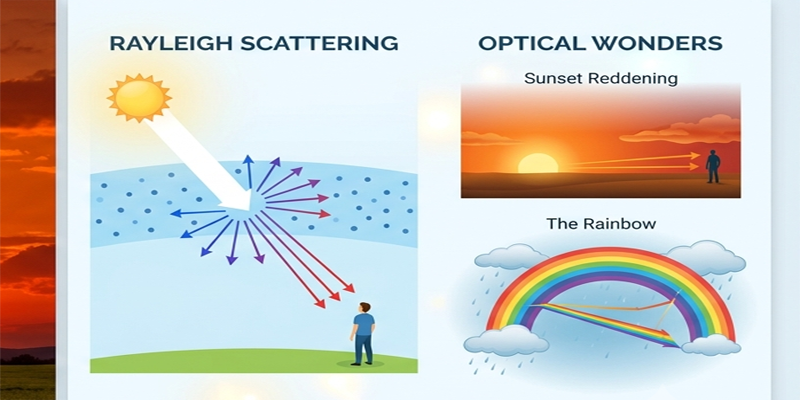
Scattering means the spreading of light in different directions after it interacts with particles.
Not all colors scatter equally.
Colors with shorter wavelengths, such as blue and violet, scatter much more than colors with longer wavelengths like red.
This phenomenon is known as Rayleigh Scattering, named after the British scientist Lord Rayleigh.
Why Is the Sky Blue?
When sunlight enters Earth’s atmosphere:
- White sunlight contains all visible colors.
- Air molecules scatter the shorter wavelengths more strongly.
- Blue light is scattered in all directions across the sky.
- Our eyes receive this scattered blue light from every direction.
As a result, the sky appears blue during the day.
If Violet Scatters More Than Blue, Why Isn’t the Sky Violet?
This is one of the most common science questions.
There are several reasons:
- The Sun emits slightly less violet light than blue light.
- The upper atmosphere absorbs some violet light.
- Human eyes are more sensitive to blue light than violet.
Together, these factors make the sky appear predominantly blue instead of violet.
Why Does the Sky Look Dark in Space?
Astronauts in space see a black sky, even when the Sun is shining.
This is because space has almost no atmosphere.
Without air molecules to scatter sunlight, the sky remains black.
Why Are Sunrises and Sunsets Red?
At sunrise and sunset, the Sun is close to the horizon.
Its light must travel through a much thicker layer of Earth’s atmosphere.
During this longer journey:
- Most blue and violet light is scattered away.
- Red, orange, and yellow light continue more directly toward our eyes.
This is why the Sun and the surrounding sky often appear:
- Orange
- Red
- Pink
- Golden
Why Are Some Sunsets More Colorful Than Others?
Several factors affect sunset colors, including:
- Dust in the atmosphere
- Water vapor
- Pollution
- Smoke from wildfires
- Clouds
Fine particles can enhance reds and oranges, while heavy pollution may dull the colors.
How Is a Rainbow Formed?
A rainbow appears when sunlight interacts with tiny water droplets in the air.
Inside each droplet:
- Sunlight enters and slows down.
- The light bends (refraction).
- White light separates into different colors (dispersion).
- The light reflects inside the droplet.
- It bends again as it exits.
The result is the familiar arc of seven colors.
Why Is a Rainbow Curved?
Rainbows appear as arcs because each raindrop sends a particular color toward your eyes at a specific angle.
Millions of droplets together create a circular pattern.
From the ground, we usually see only the upper part of this circle.
From an airplane, under the right conditions, people can sometimes see an almost complete circular rainbow.
Can We Touch a Rainbow?
No.
A rainbow is not a physical object.
It is an optical phenomenon created by sunlight and water droplets.
As you move, the droplets sending light to your eyes change, so the rainbow seems to move too.
Why Does the Moon Sometimes Look Orange?
When the Moon is near the horizon, its light passes through more of Earth’s atmosphere.
Just like sunlight at sunset, shorter wavelengths are scattered away, allowing more red and orange light to reach our eyes.
Why Do Clouds Look White?
Clouds contain millions of tiny water droplets or ice crystals.
These particles are much larger than air molecules and scatter all visible colors of sunlight almost equally.
When all colors are scattered together, the clouds appear white.
Thicker clouds block more sunlight and therefore appear gray or dark.
What Causes a Halo Around the Sun or Moon?
Sometimes you may notice a bright ring around the Sun or Moon.
This halo forms when light passes through tiny ice crystals in high-altitude clouds.
The ice crystals refract the light, creating a circular halo.
Science Around You
The science of light scattering can be observed every day.
Examples include:
- Blue sky
- Red sunsets
- Pink sunrises
- Rainbows
- White clouds
- Orange Moon near the horizon
- Halos around the Sun or Moon
Nature constantly demonstrates the principles of optics.
Did You Know?
- Sunlight takes about 8 minutes and 20 seconds to travel from the Sun to Earth.
- A rainbow is different for every observer because it depends on the position of your eyes relative to the Sun and the raindrops.
- After heavy rain, double rainbows can sometimes appear. In a double rainbow, the color order of the second arc is reversed.
- Pilots often enjoy spectacular sunrise and sunset views above the clouds.
- On some planets with different atmospheres, the sky may appear in colors other than blue.
Try This at Home (Safe Experiment)
Make Your Own Rainbow
You’ll Need
- A glass prism (or a CD can produce colorful patterns)
- Sunlight
- A white sheet of paper
Steps
- Place the prism in direct sunlight.
- Adjust its angle slowly.
- Hold the white paper where the light falls.
Observation
You will see sunlight split into different colors.
What It Demonstrates
White light is made up of many colors, and they separate because different wavelengths bend by different amounts.
Common Mistakes Students Make
❌ Thinking the sky is blue because it reflects the oceans.
✔ The sky is blue because of Rayleigh scattering, not because of ocean reflection.
❌ Believing sunsets are red because the Sun changes color.
✔ The Sun’s light remains essentially the same; the atmosphere scatters the shorter wavelengths before the light reaches your eyes.
❌ Assuming rainbows are physical objects.
✔ A rainbow is an optical effect created by sunlight and water droplets.
❌ Thinking space has a blue sky.
✔ Space appears black because it lacks an atmosphere to scatter sunlight.
Frequently Asked Questions (FAQs)
1. Why is the sky blue?
Because air molecules scatter blue light more strongly than most other visible colors.
2. Why are sunsets red?
At sunset, sunlight travels through a thicker layer of atmosphere, scattering away more blue light and leaving more red and orange light to reach us.
3. Why does the sky look black from space?
There is almost no atmosphere in space to scatter sunlight.
4. Why can’t we reach the end of a rainbow?
A rainbow depends on your viewing position. As you move, the rainbow’s apparent position changes.
5. Why do clouds sometimes appear gray?
Thick clouds block and scatter more sunlight, so less light reaches your eyes from below, making them appear gray.
Why This Topic Matters
Understanding the color of the sky helps explain:
- Why the sky is blue.
- Why sunsets are colorful.
- How rainbows form.
- Why astronauts see a black sky.
- How Earth’s atmosphere interacts with sunlight.
- The importance of light scattering in atmospheric science and astronomy.
These concepts connect physics, Earth science, meteorology, and astronomy.
Conclusion
Friends, in this post(Why Is the Sky Blue), we have understood the reason behind the blue color of the sky as well as other color appearances like sunsets, sunrises, and rainbows in the sky. You can not only see a blue sky, colorful sunsets, and beautiful rainbows just as the natural wondors rather; you can also see it as the most amazing demonstration of the fascinating behavior of light. Once sunlight hits the Earth’s atmosphere, the light is scattered all around the place and creates distinct and beautiful natural sights.
If you really want to make a strong grip on the scientific principles behind all this light and color behavior of nature, then you must understand the concept of scattering, refraction, and dispersion. |Why Is the Sky Blue|
Once you are aware of the science behind bright blue skies and glowing sunsets, it will change the way you see these natural events in the sky, and already know the science behind it. |Why Is the Sky Blue|
If you have any queries, you can write to us at support@a5theory.com; we will get back to you ASAP.
Hope! You would have enjoyed this post(Why Is the Sky Blue).
Please feel free to give your important feedback in the comment section below.
Have a great time!