

Hello Friends, in this blog post(Why Does Ice Float on Water), we are going to let you know the reason why ice floats on water.
Most of you must have noticed this in your childhood when you add a few ice cubes to a glass of water; instead of sinking, it starts floating on the water’s surface.
If you have not performed this experiment at home, it could be a very interesting and fun one for you. |Why Does Ice Float on Water|
So, it is a very normal and obvious thing because it has been seen thousands of times by people.
But if you see it with the goggles of science, then there are many unusual & amazing activities happening here.
This has been observed for many substances; their solid form is much denser than the liquid form.
If we put a solid piece of iron in liquid iron, then it will immediately sink. |Why Does Ice Float on Water|
So, the behaviour of water is totally different here than that of iron.
Since Ice is less dense than liquid water, ice floats, and this is a fact.
This unusual and remarkable property of water has a very close and incredible association with life on Earth. |Why Does Ice Float on Water|
But have you ever tried to discover why this happens?
So, in this post(Why Does Ice Float on Water), we are going to explain to you the main reason behind all this with the help of the molecular-level structure of both.
What Is Density?
Before understanding why ice floats, we need to understand density.
Density tells us how much mass is packed into a given volume.
The formula is:
Density = Mass ÷ Volume
If the same amount of matter occupies more space, its density is lower.
If it is packed into less space, its density is higher. |Why Does Ice Float on Water|
Why Does Ice Float?
An object floats in water when its average density is lower than that of the surrounding water.
The density of liquid water near its maximum-density temperature is about:
1 g/cm³
The density of ordinary ice is about:
0.92 g/cm³
Since ice is less dense than liquid water, it floats.
That’s the simple answer.
But the really interesting question is:
Why is ice less dense than water?
Water Is Made of H₂O Molecules
Every water molecule contains:
- Two hydrogen atoms
- One oxygen atom
So its chemical formula is:
H₂O
Water molecules are extremely small, but their arrangement changes dramatically when water freezes.
And this arrangement is the key to understanding why ice floats.
What Happens When Water Freezes?
When liquid water cools, its molecules move more slowly.
At sufficiently low temperatures, the molecules become arranged into a more organized structure.
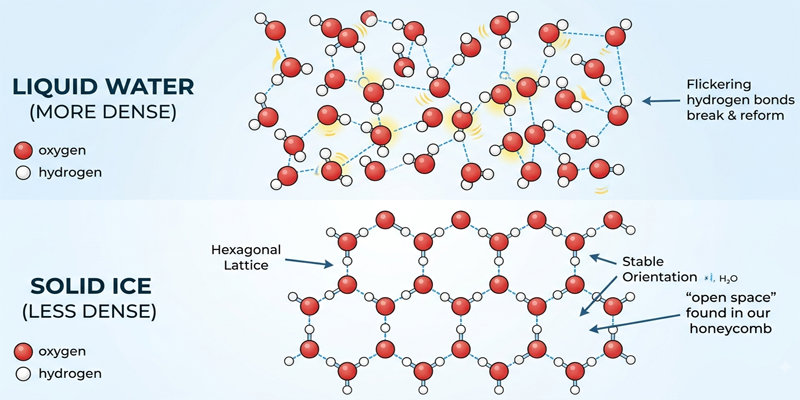
In ordinary ice, water molecules form a relatively open crystal structure.
This structure contains spaces between molecules.
As a result, the same amount of water occupies more volume when it becomes ice.
And when volume increases while mass stays essentially the same:
Density decreases.
The Role of Hydrogen Bonds
Water molecules attract one another through a special intermolecular interaction called a hydrogen bond.
Hydrogen bonding is extremely important in determining many of water’s unusual properties.
In ice, hydrogen bonds help hold water molecules in an ordered arrangement.
This arrangement creates a more open structure than the constantly rearranging structure found in liquid water. |Why Does Ice Float on Water|
Why Doesn’t Liquid Water Have the Same Structure?
Liquid water is constantly moving.
Its molecules are not locked into one fixed crystal arrangement.
Hydrogen bonds continuously form, break, and rearrange.
This allows molecules to move closer together than they can in the more rigid structure of ordinary ice.
Therefore, liquid water can be denser than ice.
Why Does Water Expand When It Freezes?
This is one of water’s most unusual properties.
When most liquids freeze, their molecules become more closely packed.
Water is different.
As water freezes into ordinary ice, its molecular arrangement creates additional space.
Therefore:
Liquid water → Ice
Volume increases
Density decreases
This is why a filled, sealed container of water can be damaged when the water freezes and expands.
Why Can a Plastic Bottle of Water Bulge in the Freezer?
Suppose you fill a bottle almost completely with water and put it in a freezer.
As the water freezes, its volume increases.
If there isn’t enough room for expansion, pressure can build inside the container.
The bottle may bulge or even break.
This is a direct demonstration of the unusual expansion of water during freezing. |Why Does Ice Float on Water|
Why Does Water Have Maximum Density Around 4°C?
This is one of the most fascinating facts about water.
Liquid water reaches its maximum density at about 4°C under normal atmospheric pressure.
As water cools from higher temperatures toward 4°C, it becomes denser.
But when it cools below approximately 4°C, its structure begins to become increasingly influenced by the more open arrangement associated with ice.
As a result:
4°C water is denser than 0°C water.
This strange behavior has enormous consequences for lakes and aquatic ecosystems.
Why Don’t Lakes Freeze From the Bottom?
Imagine a lake during winter.
The surface water becomes colder.
At first, the colder water becomes denser and sinks.
This continues until much of the lake approaches around 4°C.
Further cooling of the surface water below 4°C makes it less dense.
That colder water stays near the surface.
Eventually, ice forms at the top.
Because ice is less dense, it floats.
So the lake tends to freeze from the top downward, rather than from the bottom upward.
Why Is Floating Ice So Important for Life?
Imagine if ice were denser than water.
It would sink.
During winter, more ice could accumulate at the bottom of lakes.
Over time, this could potentially allow lakes to freeze much more extensively or completely in cold conditions.
But because ice floats, the surface ice forms a layer above the liquid water.
That ice layer can also act as an insulating barrier, slowing further heat loss from the water underneath.
This helps aquatic organisms survive cold winters. |Why Does Ice Float on Water|
Ice Is Like a Blanket for a Lake
Ice is a relatively poor conductor of heat compared with liquid water and many solids.
When a layer of ice forms at the surface, it can reduce the rate at which heat escapes from the water below.
The result is something like a protective blanket:
Cold air
⬇️
Ice layer
⬇️
Liquid water
⬇️
Aquatic life
The water beneath the ice can remain liquid even when the air above is well below freezing.
Why Is the Water Under the Ice Usually Liquid?
The water beneath floating ice doesn’t necessarily remain at exactly 4°C everywhere.
Temperature varies with depth and conditions.
But the important point is that the unusual density behavior of water and the insulating effect of surface ice help prevent the entire body of water from freezing rapidly from top to bottom.
This creates a much more suitable environment for aquatic organisms.
What Would Happen If Ice Sank?
This is an interesting thought experiment.
Suppose ice were denser than water.
Then newly formed ice would sink.
More ice could form at the surface and sink downward.
Cold conditions could cause repeated freezing throughout the water column.
Many lakes and ponds in cold regions could behave very differently.
The consequences for aquatic ecosystems could be enormous.
The fact that ice floats is therefore not merely a fun scientific fact.
It is one of the reasons Earth’s aquatic environments can support life through cold seasons.
Why Does Ice Feel So Cold?
Ice is usually at or below the freezing point of water.
When you touch it, heat flows from your warmer hand into the colder ice.
The ice absorbs thermal energy.
Your skin therefore loses heat, producing the sensation of cold.
This is another example of heat transfer:
Warm object → Cold object
Does Ice Always Stay at 0°C?
No.
Ice can be colder than 0°C.
For example, ice stored in a freezer may reach temperatures well below 0°C.
The melting point of ice is approximately 0°C at standard atmospheric pressure, but its actual temperature can be lower.
What Happens When Ice Melts?
When ice receives enough heat, it begins changing from solid to liquid.
The temperature of melting ice can remain around its melting point while the phase change is occurring.
The energy being absorbed is associated with the change of state.
This energy is called latent heat of fusion.
What Is Latent Heat?
When a substance changes state, energy can be absorbed or released without an immediate corresponding change in temperature.
For melting:
Ice + Heat → Water
The energy required to melt ice at its melting point is called the latent heat of fusion.
The same concept applies to many other phase changes. |Why Does Ice Float on Water|
Why Does Salt Melt Ice?
You may have heard of putting salt on icy roads.
Salt lowers the freezing point of water.
When salt dissolves in the thin layer of liquid water on ice, it creates a saltwater solution whose freezing point is lower than that of pure water.
This can help melt ice when temperatures are within the appropriate range.
The same principle is used in some ice-making and cooling applications.
Why Doesn’t Salt Make Ice Melt Instantly in Every Situation?
The effect depends on temperature and concentration.
At sufficiently low temperatures, ordinary road salt becomes much less effective.
Different salts also have different properties.
So the idea that “salt always melts ice” is an oversimplification.
Why Does Ice Become Slippery?
A thin layer of water can form at or near the surface of ice.
Pressure, friction, temperature, and surface effects can all influence slipperiness.
It is not accurate to explain ice slipperiness simply by saying:
“Pressure alone melts the ice.”
The actual physics is more complicated.
Why Does Ice Have a Crystal Structure?
In ordinary ice, water molecules arrange themselves into an organized structure due largely to hydrogen bonding.
This structure is crystalline.
Different forms of ice can have different crystal structures under different pressures and temperatures.
Scientists have identified many different phases of ice.
So “ice” is actually a much more scientifically interesting material than it appears.
Are All Types of Ice the Same?
No.
Earth’s familiar ice is called Ice Ih.
Under extreme pressures and temperatures, water can form other crystalline phases known as different types of ice.
Some of these forms exist under conditions far removed from everyday life.
This is one reason water remains a fascinating subject in physics and chemistry. |Why Does Ice Float on Water|
Why Is Water So Important for Life?
Water has an extraordinary combination of properties.
It:
- Exists naturally as solid, liquid, and gas on Earth
- Dissolves many substances
- Has a high specific heat capacity
- Has unusual density behavior
- Forms hydrogen bonds
- Supports chemical reactions essential for life
- Helps regulate Earth’s climate
Its unusual behavior when freezing is just one part of its importance.
Water and Earth’s Climate
Water can absorb and store substantial amounts of thermal energy.
Oceans, lakes, rivers, clouds, ice, and atmospheric water all influence Earth’s climate.
Ice and snow also reflect a significant portion of incoming sunlight.
This reflects the broader importance of water in Earth’s climate system.
What Is the Difference Between Ice and Liquid Water?
| Ice | Liquid Water |
|---|---|
| Solid | Liquid |
| Molecules have a more organized structure | Molecules move and rearrange continuously |
| Less dense than liquid water | Denser than ordinary ice |
| Has a fixed shape | Takes the shape of its container |
| Floats on liquid water | Forms the surrounding liquid |
A Simple Experiment
You can observe the floating property of ice very easily. |Why Does Ice Float on Water? |
You’ll Need
- A transparent glass
- Water
- A few ice cubes
Steps
- Fill a glass with water.
- Add a few ice cubes.
- Observe them floating.
- Mark the approximate water level.
- Wait until the ice melts.
- Observe the water level again.
What Will You Notice?
The ice floats because its density is lower than that of liquid water.
When the ice melts, the resulting water occupies a smaller volume than the original floating ice because the liquid is denser.
This provides a simple demonstration of the unusual density relationship between ice and water.
A More Interesting Observation
Try placing an ice cube in:
- Plain water
- Salt water
Observe how much of the ice cube remains above the surface.
Because floating depends on the density of the surrounding liquid, changing the water’s density can affect how much of the ice remains submerged.
This connects directly to the physics of buoyancy.
The Connection With Archimedes’ Principle
Why does anything float?
A floating object displaces liquid.
The liquid exerts an upward buoyant force on the object.
According to Archimedes’ principle, the buoyant force is equal to the weight of the fluid displaced by the submerged part of the object.
An object floats when the buoyant force balances its weight.
Because ice is less dense than water, only part of an ice cube needs to be submerged to displace enough water to support its weight.
Why Is Most of an Iceberg Underwater?
Have you ever heard the phrase:
“Only the tip of the iceberg is visible.”
It comes from real physics.
Because ice is only somewhat less dense than seawater, a large portion of an iceberg remains underwater.
The exact fraction depends on the density of the ice and the surrounding seawater.
This is why icebergs can be enormous beneath the surface even when only part of them is visible.
Why Does Seawater Behave Slightly Differently?
Seawater contains dissolved salts and other substances.
These change its density and freezing behavior compared with pure water.
Seawater generally freezes at a temperature below 0°C.
Its density also differs from that of freshwater.
This is important when studying oceans, sea ice, and Earth’s climate.
Did You Know?
- Ice is less dense than liquid water.
- Water reaches maximum density at approximately 4°C.
- Ice floats because its density is lower than that of liquid water.
- Water expands when it freezes.
- Hydrogen bonding helps create the open structure of ordinary ice.
- Floating ice can help insulate the liquid water beneath it.
- Icebergs have most of their volume below the water surface.
- Water’s unusual properties are extremely important for life on Earth.
Common Mistakes Students Make
❌ Thinking all solids are denser than their liquids.
✔ Most substances behave that way, but water is a famous exception.
❌ Thinking ice floats because it contains air bubbles.
✔ Ordinary pure ice is intrinsically less dense than liquid water because of its molecular structure. Air bubbles can affect the overall density of particular pieces of ice, but they are not the fundamental reason ice floats.
❌ Thinking water freezes from the bottom upward.
✔ In many lakes, ice forms at the surface first because of water’s unusual density behavior.
❌ Thinking water is densest at 0°C.
✔ Freshwater reaches its maximum density at approximately 4°C under normal atmospheric pressure.
❌ Thinking ice cannot exist below 0°C.
✔ Ice can be cooled to temperatures well below 0°C.
Frequently Asked Questions (FAQs)
1. Why does ice float on water?
Ice floats because it is less dense than liquid water. |Why Does Ice Float on Water|
2. Why is ice less dense than water?
Hydrogen bonding creates a relatively open molecular structure in ordinary ice, leaving more space between molecules.
3. At what temperature is water most dense?
Freshwater reaches its maximum density at approximately 4°C under normal atmospheric pressure.
4. Why do lakes freeze from the top?
As surface water cools below about 4°C, it becomes less dense and stays near the surface, where it can eventually freeze.
5. Why doesn’t all the water in a lake freeze?
Floating ice forms an insulating surface layer, while the density behavior of water helps keep deeper water liquid under many winter conditions.
6. Does water expand when it freezes?
Yes. Under ordinary conditions, water expands by roughly 9% when it freezes into ice.
7. Why are icebergs dangerous for ships?
A large portion of an iceberg remains underwater because ice is less dense than seawater. The visible part can therefore represent only a fraction of its total volume.
Why This Topic Matters
Ice floating on water may seem like an ordinary observation.
But behind that simple ice cube is an incredible combination of:
- Molecular structure
- Hydrogen bonding
- Density
- Buoyancy
- Thermodynamics
- Heat transfer
- Environmental science
- Ecology
One unusual property of one very common substance has helped shape life on our planet.
Conclusion
Friends, in this blog post(Why Does Ice Float on Water), we have completely discovered the reason why ice floats on water. It will definitely change your way of looking next time you drop an ice cube in a glass of water. The title itself shows an amazing physics and chemistry demonstration over here.
The molecules of ice form a more open structure, and it causes ice to occupy more space; because of this, it becomes less dense than liquid water. So this shows the unusual behaviour of water at its freezing state. And this is a simple example of floating ice on water. |Why Does Ice Float on Water|
And this fact has far-reaching consequences that we have seen in our simple water glass and ice cube experiment. Floating ice helps lakes and ponds retain liquid water underneath during cold periods, providing a more stable environment for aquatic life. |Why Does Ice Float on Water|
It helps provide a more stable and safe environment for aquatic life. During the cold season, a layer of thick or thin ice covers the lakes and ponds and retains the water underneath it.
This situation left us with a question: why does ice float on water? And it leads us to much more powerful discoveries. Simple substance unusual behaviour becomes the cause of possible life on Earth. |Why Does Ice Float on Water|
If you have any queries, you can write to us at support@a5theory.com; we will get back to you ASAP.
Hope! You will enjoy this post, “Why Does Ice Float on Water“.
Please feel free to give your feedback in the comment section below.
Have a great time!