

Hello Friends, in this blog post(Why Do We Sneeze), we are going to let you know the science behind sneezing.
Achii!….Achoo!….
We are well aware of these sounds we hear during sneezing.
In general, you may sneeze once or twice because of some sudden irritation from inside or outside. |Why Do We Sneeze|
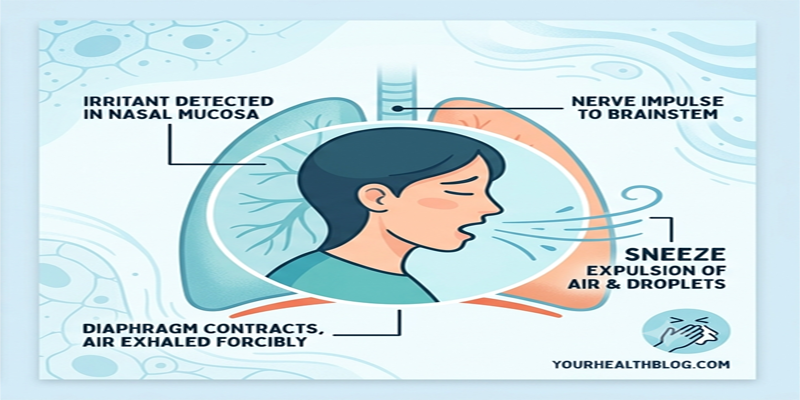
But when you get a cold attack, you may have many un-stopable sneezing, looks like your nose has launched a sneezing fire.
Many times, you could be curious to know the answers to a few questions related to sneezing, like:
- Why do we actually sneeze?
- Why does dust create a sudden impact on our nose?
- Why do some people sneez during looking at bright sunlight?
- Why do we have a chain sneeze without any stop sometimes?
- How does our sneeze, considered a small action, produce a powerful burst of air?
The sneezing reflex, which is a most interesting protective mechanism of our body, will help us to understand the answers to all the above questions in a better way. |Why Do We Sneeze|
What Is a Sneeze?
A sneeze is a powerful, involuntary expulsion of air through the nose and mouth.
It is a reflex action triggered when the nasal passages are irritated.
The body rapidly coordinates:
- Nerves
- Brain
- Breathing muscles
- Diaphragm
- Chest muscles
- Throat
- Nose
The result is a sudden burst of air designed to help remove irritating material from the respiratory tract.
Why Do We Sneeze?
The primary purpose of sneezing is protection.
Your nose is one of the first places where the outside environment interacts with your respiratory system.
It encounters:
- Dust
- Pollen
- Smoke
- Strong smells
- Tiny particles
- Microorganisms
- Other irritants
When the nasal passages detect something irritating, the nervous system can trigger a sneeze.
Is Sneezing a Reflex Action?
Yes.
Sneezing is an involuntary reflex.
You don’t normally decide:
“I will sneeze now.”
Instead, sensory receptors detect irritation and send signals through nerves to the brain.
The brain then coordinates the sneeze. |Why Do We Sneeze? |
What Happens Inside Your Nose Before a Sneeze?
Imagine a tiny particle of dust entering your nose.
Special sensory receptors in the nasal lining detect irritation.
Signals travel through nerves toward the brain.
The brain processes the signal and coordinates a rapid response involving respiratory muscles.
Then:
Achoo!
Which Nerve Is Involved in Sneezing?
The trigeminal nerve plays an important role in detecting irritation in the nose.
It carries sensory information from the face and nasal region toward the brain.
This information contributes to the sneeze reflex.
How Does the Brain Control a Sneeze?
The sneeze reflex involves coordinated activity in the brainstem.
The brain receives sensory information from the nose and coordinates the sequence of muscle contractions needed to produce the sneeze.
It is remarkably fast.
Several muscles have to work together almost perfectly. |Why Do We Sneeze|
What Happens During a Sneeze?
A simplified sequence is:
Irritation → sensory nerve activation → brainstem response → deep inhalation → pressure buildup → powerful exhalation → sneeze
During this process, muscles in the chest, abdomen, diaphragm, throat, and face work together.
Why Do We Take a Breath Before Sneezing?
Before the explosive part of the sneeze, you generally inhale.
This helps fill the lungs.
The respiratory muscles then generate pressure that can be released rapidly.
This contributes to the powerful airflow of the sneeze. |Why Do We Sneeze|
Why Is a Sneeze So Powerful?
A sneeze involves rapid movement of air through the respiratory tract.
Muscles in the chest and abdomen contract strongly.
Pressure builds inside the respiratory system.
The air is then expelled rapidly through the nose and mouth.
This helps move irritating material away from the nasal passages.
Does a Sneeze Really Travel Very Fast?
A sneeze can generate a rapid burst of air, but popular claims that sneezes always travel at a specific extremely high speed are often exaggerated.
The speed varies depending on:
- Individual anatomy
- Force of the sneeze
- Airway conditions
- Measurement method
What matters biologically is that sneezing produces a strong airflow capable of moving mucus and particles.
Why Do We Close Our Eyes When We Sneeze?
Many people naturally close their eyes during a sneeze.
This is part of the coordinated reflex response.
However, it is a myth that your eyes would automatically pop out if you sneezed with them open.
Your eyes are securely held in their sockets by muscles, connective tissues, and surrounding structures.
Can You Sneeze With Your Eyes Open?
Yes.
It is possible for some people to keep their eyes open during a sneeze.
Closing the eyes is common but not an absolute requirement for the sneeze to occur. |Why Do We Sneeze? |
Why Does the Nose Tingle Before a Sneeze?
The tingling sensation is related to activation of sensory nerves in the nasal lining.
As irritation increases, the sensation can become stronger.
Eventually, the nervous system may trigger the sneeze reflex.
Why Can’t We Always Stop a Sneeze?
Once the sneeze reflex has progressed far enough, it can be difficult to interrupt.
The brain has already begun coordinating the muscular sequence.
You may sometimes suppress a sneeze, but doing so forcefully is not recommended.
Is It Safe to Hold in a Sneeze?
It is generally better to sneeze naturally rather than forcefully blocking the nose and mouth.
A sneeze generates pressure inside the respiratory system.
Suddenly preventing the normal release of that pressure can redirect forces into surrounding structures.
Rare injuries have been reported after forcefully suppressing sneezes.
A safer approach is to sneeze into a tissue or your elbow rather than trying to stop it completely.
Why Do We Sneeze When We Have a Cold?
A cold can irritate the lining of the nose.
Viruses can trigger inflammation and increase mucus production.
The irritated nasal passages activate sensory nerves.
This can produce repeated sneezing.
Sneezing can therefore be one of the body’s responses to respiratory infection. |Why Do We Sneeze|
Why Does Dust Make Us Sneeze?
Dust contains tiny particles.
When these particles enter the nose, they can irritate the nasal lining.
The sensory nerves detect the irritation.
The sneeze reflex is then activated.
Your body is essentially saying:
“Get this out of here!”
Why Does Pepper Make Us Sneeze?
Pepper contains chemical compounds that can stimulate sensory receptors in the nasal passages.
These receptors can activate the trigeminal nerve.
The result can be:
Achoo!
Why Does Perfume Sometimes Make Us Sneeze?
Strong fragrances can irritate the nasal passages in some people.
Certain chemicals can stimulate sensory receptors even when they aren’t physically damaging the tissue.
The resulting irritation can trigger sneezing. |Why Do We Sneeze|
Why Do Allergies Cause Sneezing?
Allergies occur when the immune system reacts strongly to substances that are usually harmless.
Common examples include:
- Pollen
- Dust mites
- Animal dander
- Mould
During an allergic response, chemicals such as histamine can contribute to inflammation and irritation of the nasal passages.
This can lead to:
- Sneezing
- Runny nose
- Itchy nose
- Watery eyes
Why Do We Sneeze Repeatedly During an Allergy?
If an allergen continues to irritate the nasal passages, the sensory and immune response may continue.
The sneeze reflex can therefore be triggered repeatedly.
This is why someone with allergies may sneeze several times in succession.
Why Do Some People Sneeze Three or Four Times?
There is no universal number of sneezes.
Some people sneeze once.
Others sneeze several times.
Possible reasons include:
- Amount of irritation
- Sensitivity of the nasal passages
- Allergies
- Inflammation
- Individual reflex differences
Multiple sneezes may simply mean that the initial irritation hasn’t been completely cleared.
Why Do Some People Sneeze in Bright Sunlight?
This is one of the strangest sneeze-related phenomena.
Some people sneeze when suddenly exposed to bright light, especially sunlight.
This is called the:
Photic sneeze reflex
It is also known as ACHOO syndrome in popular scientific terminology.
What Is the Photic Sneeze Reflex?
The photic sneeze reflex is a tendency to sneeze after exposure to bright light.
It affects a significant minority of people.
Scientists believe it may involve interactions between sensory pathways associated with vision and those involved in the sneeze reflex.
The exact mechanism is still being studied.
Why Does Looking at the Sun Make Some People Sneeze?
Bright light strongly stimulates the visual system.
The optic nerve carries visual information toward the brain.
Scientists have proposed that intense stimulation may somehow influence nearby neural pathways involved in the trigeminal system.
The precise mechanism is not completely understood.
Importantly:
Never stare directly at the Sun to test this.
Directly looking at the Sun can damage your eyes. |Why Do We Sneeze|
Why Do We Sneeze After Walking From a Dark Room Into Sunlight?
This is a classic example of the photic sneeze reflex.
A sudden increase in brightness may trigger the response in people who have this sensitivity.
The sudden transition appears to matter more than simply being exposed to light continuously.
Is the Photic Sneeze Reflex Genetic?
Evidence suggests that genetics may play a role.
The tendency can run in families.
However, the exact genetic mechanisms are complex and are still being studied.
Why Do Some People Never Sneeze in Sunlight?
Not everyone has the photic sneeze reflex.
It appears to be an individual characteristic.
Some people experience it frequently.
Others never experience it. |Why Do We Sneeze? |
Can Sneezing Spread Germs?
Yes.
Sneezing can release droplets and respiratory particles containing microorganisms if a person is infected.
Some particles can travel through the air.
This is one reason respiratory infections can spread through close contact.
Why Should We Sneeze Into Our Elbow?
Covering your mouth and nose when sneezing reduces the spread of respiratory droplets and particles.
Using the inside of your elbow is often better than using your hands because hands frequently touch surfaces and objects.
If you use a tissue, dispose of it properly and clean your hands afterward.
Does Sneezing Remove All Germs From the Nose?
No.
A sneeze can help remove some mucus and particles, but it doesn’t sterilize the nasal passages.
Respiratory infections involve complex interactions between microorganisms and the body’s immune system. |Why Do We Sneeze|
Why Does Sneezing Sometimes Make Our Eyes Water?
Sneezing involves muscles and nerves around the face.
The reflex can also influence tear production.
Nasal irritation and inflammation can stimulate pathways connected with the eyes.
This is why sneezing and watery eyes commonly occur together, particularly during allergies.
Why Does Our Nose Run After Sneezing?
Sneezing often occurs alongside increased mucus production.
Mucus helps trap particles and protect the respiratory tract.
During a cold or allergy, inflammation can increase mucus production significantly.
Why Does Sneezing Sometimes Make Your Whole Body Move?
A sneeze involves rapid, coordinated contractions of multiple muscles.
These include muscles involved in:
- Breathing
- Chest movement
- Abdominal pressure
- Face and throat movement
The sudden force can make your head or upper body move. |Why Do We Sneeze|
Can Sneezing Affect Your Heartbeat?
A sneeze can temporarily change pressure inside the chest and alter autonomic activity.
This may produce brief changes in heart rhythm or the sensation that your heart “skipped” a beat.
Your heart does not normally stop during a sneeze.
The popular statement that your heart stops when you sneeze is a myth.
Does Your Heart Really Stop When You Sneeze?
No.
Your heart continues beating.
The pressure changes associated with sneezing can slightly alter the heart’s rhythm or the way you perceive your heartbeat.
But your heart does not simply stop. |Why Do We Sneeze|
Why Do People Say “Bless You” After a Sneeze?
The tradition of saying something like “Bless you” after a sneeze comes from cultural and historical beliefs.
Different societies have developed different responses to sneezing.
It is a cultural tradition rather than a biological necessity.
Can We Sneeze While Sleeping?
Sneezing is generally suppressed during certain stages of sleep because sensory and motor activity changes.
People are therefore much less likely to sneeze while deeply asleep.
If a strong irritant is present, however, it may contribute to waking or partial arousal.
Can You Sneeze Without a Nose?
The nose is the primary sensory region involved in the normal sneeze reflex.
However, the sneeze response is a coordinated nervous-system event, and the exact response can vary depending on a person’s anatomy and circumstances.
Why Do We Sneeze More During Allergy Season?
When airborne allergens such as pollen become more abundant, sensitive people can experience increased exposure.
The immune system responds to these allergens.
The nasal passages become inflamed.
Sneezing becomes more frequent.
This is why seasonal allergies can produce repeated sneezing episodes. |Why Do We Sneeze|
Why Does Cold Air Sometimes Make Us Sneeze?
Cold, dry air can irritate the nasal passages in some people.
The change in temperature and humidity can stimulate sensory nerves.
This can trigger sneezing even without an infection or allergy.
Can Emotional Stress Cause Sneezing?
Stress can affect many body systems.
Although stress isn’t considered a universal direct cause of sneezing, changes in breathing, nasal sensitivity, and autonomic activity may influence symptoms in some individuals.
The relationship varies from person to person.
Is Sneezing Good for Us?
In general, sneezing is a protective reflex.
It helps move irritating material out of the nasal passages.
But repeated sneezing caused by allergies or infection can become uncomfortable and may indicate that the underlying irritation needs attention.
A Simple Science Observation
You can observe the sneeze reflex without deliberately exposing yourself to irritants.
Notice what happens when you naturally experience:
- A sneeze
- A cold morning
- A strong smell
- Seasonal allergies
Pay attention to the sequence:
Nasal sensation → urge to sneeze → deep breath → sudden sneeze → relief
Your body has just performed a highly coordinated reflex without conscious instruction.
Did You Know?
- Sneezing is an involuntary protective reflex.
- The trigeminal nerve plays an important role in detecting nasal irritation.
- The brainstem coordinates the sneeze response.
- Dust, pollen, smoke, and strong smells can trigger sneezing.
- Allergies can cause repeated sneezing.
- Some people sneeze when exposed to bright light.
- The photic sneeze reflex is also called ACHOO syndrome.
- Your heart does not stop when you sneeze.
- Suppressing a sneeze forcefully can rarely cause injury.
- Sneezing helps clear irritating material from the nasal passages.
Common Mistakes Students Make
❌ Thinking sneezing happens only because of a cold.
✔ Allergies, dust, smoke, strong smells, and other irritants can also cause sneezing.
❌ Thinking your heart stops when you sneeze.
✔ Your heart continues beating; its rhythm may change very briefly.
❌ Thinking everyone’s eyes must close during a sneeze.
✔ Closing the eyes is common, but it is not an absolute requirement.
❌ Thinking sneezing always means you are sick.
✔ Healthy people sneeze too.
❌ Thinking all sneezes are caused by germs.
✔ Many sneezes are caused by non-infectious irritants or allergies.
❌ Thinking you should always suppress a sneeze.
✔ It is generally safer to let the sneeze happen while covering your nose and mouth appropriately.
Frequently Asked Questions (FAQs)
1. Why do we sneeze?
We sneeze mainly to help clear irritants from the nasal passages. |Why Do We Sneeze|
2. What causes sneezing?
Dust, pollen, smoke, strong smells, infections, allergies, cold air, and other irritants can trigger sneezing.
3. Why do we sneeze several times?
The irritation may not have been completely removed, or the nasal passages may remain sensitive.
4. Why do some people sneeze in sunlight?
Some people have the photic sneeze reflex, in which sudden exposure to bright light can trigger sneezing.
5. Does your heart stop when you sneeze?
No. The heart continues beating, although its rhythm or the sensation of the heartbeat can briefly change.
6. Why do we close our eyes when sneezing?
Closing the eyes is part of the coordinated sneeze response for many people, but it isn’t necessary for sneezing.
7. Is it dangerous to hold in a sneeze?
Forcefully blocking a sneeze can create high pressure and has rarely caused injuries. It is safer to sneeze into a tissue or your elbow.
8. Why do allergies cause sneezing?
Allergens can trigger an immune response that inflames and irritates the nasal passages, activating the sneeze reflex.
9. Why does pepper make us sneeze?
Compounds in pepper can stimulate sensory receptors in the nose and trigger the sneeze reflex.
10. What is ACHOO syndrome?
ACHOO syndrome is the popular name for the photic sneeze reflex, a tendency to sneeze after sudden exposure to bright light. |Why Do We Sneeze|
Why This Topic Matters
A sneeze may last only a fraction of a second, but it involves a remarkable chain of events:
Irritant → sensory receptors → trigeminal nerve → brainstem → respiratory muscles → rapid airflow → sneeze
It demonstrates how the nervous system protects the body automatically.
You don’t need to think about removing dust from your nose.
Your body detects the problem and reacts.
That is one of the most fascinating features of human biology:
Many of our most important protective systems operate without conscious control.
Conclusion
Friends, in this post(Why Do We Sneeze), we have explored the science behind a very natural process that happens to almost all of us: sneezing. It might look like a very simple process with a sound of Achii! or Achoo, but it is, in fact, a highly coordinated biological event. very first a irritant entering your nose is detected by sensory nerves. Then the signal gets transmitted to the brain; muscles throughout the respiratory system are well coordinated by the brain, and it eventually creates pressure.
And then you get this Achii!…Achoo! Though sneezing might look like a little bizarre or uncomfortable action, it plays an important role in clearing all the irritating material from your nasal passages. There are many sneezing reflexes that have already been explained by science; however, there are some strange facts that some people also sneeze due to some other reason, like looking at the bright sunlight, thinking about something very amazing, or being thrilled or excited. So, many questions are still to be investigated by researchers. |Why Do We Sneeze|
So the next time you sneeze, remember this fact:
That tiny “Achii!” is a remarkably fast protective action being performed by your nervous system.
If you have any queries, you can write to us at support@a5theory.com; we will get back to you ASAP.
Hope! You will enjoy this post, “Why Do We Sneeze?”
Please feel free to give your feedback in the comment section below.
Have a great time!