

Hello Friends, in this blog post(Why Do We Yawn), we’ll explain the science behind yawning.
Yawning is a very natural action that is generally considered a sign of feeling lazy, sleepy, tired, etc.
It can happen at any time while sitting in a class or meeting, listening to a lecture or speech, or even sitting at home.
You must have felt this scenario in your classroom. |Why Do We Yawn|
When you are sitting in a class while your teacher is explaining an interesting topic.
And you are also completely fine and attentive. Then suddenly, someone sitting beside you yawns! And a moment later, you also yawn.
It gradually increases and spreads to some other students in the class- not all, but not fewer.
This seems to be a biological infection that is spreading in the entire class.
But Yawning is not a biological infection at all; rather, it is the most common and mysterious behaviour of humans and many animals.
We all have it, yet scientists still cannot find an exact explanation for this that is universally accepted.
So, there remain some curious questions that our minds ask most often, like:
- Why do we yawn?
- So what happens inside the body during a yawn?
- Why do we yawn when we’re tired?
- Why can we yawn even when we’re not sleepy?
- Why does seeing someone else yawn sometimes make us yawn?
In this post(Why Do We Yawn), we’ll dive deep into the science of yawning with some supported scientific theories.
What Is a Yawn?
A yawn is a coordinated, usually involuntary action involving:
- Opening the mouth widely
- Taking a deep breath
- Expanding the jaw
- Stretching facial muscles
- Changing the position of the tongue and throat
- Then slowly closing the mouth
Yawning is not simply “taking a big breath.”
It involves a coordinated sequence of movements controlled by the nervous system.
Why Do We Yawn?
The honest scientific answer is:
We don’t know exactly.
Scientists have proposed several explanations.
Yawning may be related to:
- Changes in alertness
- Transitions between sleep and wakefulness
- Brain-state regulation
- Arousal
- Social behaviour
- Brain temperature regulation
No single explanation completely explains every situation in which humans yawn.
Why Do We Yawn When We Are Tired?
Yawning is commonly associated with tiredness.
When you’re becoming sleepy, your brain is transitioning toward a different state of activity.
Yawning may be associated with this change in alertness.
This is why you might yawn:
- Before going to bed
- After waking up
- During a boring lecture
- While relaxing
- When you’re mentally tired
Why Do We Yawn After Waking Up?
Yawning isn’t limited to sleepiness.
People often yawn shortly after waking.
This suggests that yawning may be associated with transitions between different states of alertness, rather than simply being a signal that you’re tired.
The body is shifting from sleep toward wakefulness. |Why Do We Yawn|
Why Do We Yawn Before Going to Sleep?
The opposite transition can also produce yawning.
As the brain moves from wakefulness toward sleep, yawning may occur.
This is one reason yawning is often associated with bedtime.
Is Yawning Caused by Lack of Oxygen?
This is one of the most common explanations you’ll hear:
“We yawn because our body needs more oxygen.”
It sounds logical.
But modern research does not support this as a complete explanation.
Normal breathing already provides oxygen to the body, and simply increasing oxygen availability does not reliably prevent yawning.
So:
Yawning is not simply an oxygen shortage response.
Does Yawning Increase Oxygen in the Body?
A yawn involves a deep inhalation, but the main reason for yawning is not considered to be correcting an oxygen shortage.
The relationship between yawning and breathing is more complicated than:
Low oxygen → yawn → more oxygen. |Why Do We Yawn|
Why Does a Yawn Feel Like a Deep Breath?
During a yawn, you usually inhale deeply.
The mouth opens widely, and the respiratory muscles coordinate a large breath.
This creates the characteristic sensation of taking a very deep breath.
But the purpose of that deep breath remains an area of scientific investigation.
What Happens to the Brain During a Yawn?
Yawning involves neural circuits that coordinate:
- Facial muscles
- Jaw muscles
- Respiratory muscles
- Throat muscles
The brain sends signals that coordinate these actions.
Yawning is therefore a complex neurological behaviour rather than a simple reflex of the lungs.
Does Yawning Affect the Brain?
Possibly.
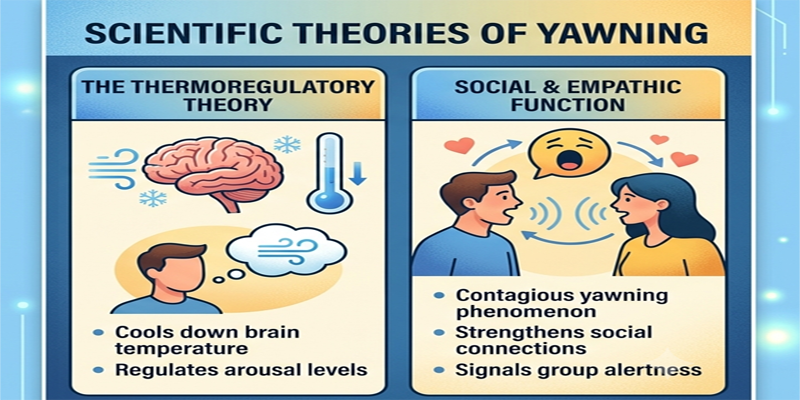
One interesting hypothesis suggests that yawning may help regulate brain temperature.
The idea is that yawning changes blood flow around the head and involves a deep inhalation, potentially influencing heat exchange.
However, brain cooling is still an area of research and is not considered a complete explanation for all yawning. |Why Do We Yawn|
What Is Brain Temperature Regulation?
The brain functions within a relatively narrow temperature range.
Because the brain is metabolically active, it produces heat.
The body has mechanisms to regulate temperature.
Some researchers have proposed that yawning could contribute to regulating brain temperature under certain conditions.
But this theory does not explain every yawn.
Why Do We Yawn More in a Boring Class?
This is a classic experience for students.
You’re sitting quietly.
Your body isn’t physically exhausted.
Yet suddenly:
Yawn.
One possibility is that reduced stimulation lowers your level of alertness.
Yawning may be associated with transitions in arousal and attention.
So the yawn might reflect a change in brain state rather than simple physical tiredness.
Does Boredom Cause Yawning?
Boredom itself may not directly “cause” yawning.
Instead, boring situations often involve:
- Low stimulation
- Reduced attention
- Reduced alertness
- Relaxation
These states are commonly associated with yawning.
Why Do We Yawn When We Are Nervous?
Interestingly, yawning can also occur during stressful or high-alert situations.
Some people yawn before:
- Exams
- Public speaking
- Sports competitions
- Performances
- Important events
This suggests yawning isn’t simply a “sleepy behaviour.”
It may be connected to changes in arousal or the nervous system.
Why Do Athletes Sometimes Yawn Before Competition?
Athletes have been observed yawning before important performances.
One possible explanation is that yawning may be associated with transitions in arousal.
Before competition, the nervous system may be moving from a resting state toward a highly alert state.
Yawning may occur during this transition. |Why Do We Yawn|
Is Yawning a Reflex?
Yawning is generally considered an involuntary behaviour with strong reflex-like characteristics.
It can happen automatically.
However, people can sometimes voluntarily imitate or initiate a yawn.
Can We Make Ourselves Yawn?
Yes.
You can intentionally open your mouth and imitate the physical action.
Interestingly, this may sometimes trigger a genuine yawn.
The relationship between voluntary and involuntary yawning is still fascinating to researchers.
Why Is Yawning Contagious?
Now we reach one of the strangest parts.
You see someone yawn.
You read the word “yawn.”
You think about yawning.
And suddenly—
You yawn.
This is called:
Contagious yawning. |Why Do We Yawn|
What Is Contagious Yawning?
Contagious yawning is when seeing, hearing, reading about, or even thinking about yawning increases the likelihood that you will yawn.
It has been studied extensively because it may involve brain systems related to:
- Social behaviour
- Attention
- Imitation
- Empathy
- Awareness of others
Why Does Seeing Someone Yawn Make Us Yawn?
Scientists don’t have one definitive answer.
One possibility is that humans automatically respond to certain behaviours performed by others.
Another possibility is that contagious yawning is connected with social synchronization.
However, the exact mechanism remains under investigation.
Is Contagious Yawning Related to Empathy?
There is some evidence linking contagious yawning with social and emotional processing.
However, the relationship is not simple.
It would be incorrect to say:
“If you don’t catch a yawn, you lack empathy.”
Human behaviour is much more complicated than that.
Can Animals Catch Yawns From Each Other?
Yes.
Contagious yawning has been observed in several animal species.
Researchers have reported contagious yawning or similar behaviour among certain:
- Primates
- Dogs
- Other social animals
This makes the phenomenon particularly interesting from an evolutionary perspective.
Can Dogs Catch Human Yawns?
Some studies have found that dogs may yawn in response to human yawns.
However, results can vary depending on the conditions and the individual animal.
Scientists continue to study whether this reflects social bonding, attention, imitation, or another mechanism. |Why Do We Yawn|
Why Do We Yawn When Someone We Know Yawns?
Social relationships may influence contagious yawning.
Some research has investigated whether yawning is more contagious between individuals who are socially connected.
However, the phenomenon is complex and should not be interpreted as a simple measure of friendship or empathy.
Can Reading About Yawning Make You Yawn?
Yes.
And if you have already yawned while reading this article, you’ve just experienced the phenomenon yourself.
Thinking about yawning can increase awareness of the behaviour and may make a yawn more likely.
Why Does Thinking About Yawning Trigger a Yawn?
The brain constantly monitors our behaviour and bodily sensations.
When you focus attention on yawning, you may activate neural representations associated with the behaviour.
This can increase the likelihood of actually yawning.
It is similar to how thinking about certain actions can make you more aware of the muscles and sensations involved.
Why Do We Sometimes Yawn After Seeing Someone Yawn on Video?
Your brain can respond to observed actions even when the person performing them is not physically present.
Watching a video provides visual information that may activate systems involved in recognising and responding to biological actions.
This can sometimes trigger contagious yawning.
Why Do We Yawn When We Read the Word “Yawn”?
Because yawning is partly influenced by attention and expectation.
Once the brain starts thinking about the behaviour, you become more aware of the urge to yawn.
And yes, this sentence may have made you yawn again.
Why Do We Yawn in Groups?
If one person yawns, others may notice it.
Seeing the yawn can increase the chance of another person yawning.
This creates the familiar chain:
Person 1 → Person 2 → Person 3 → Person 4
And suddenly everyone is yawning.
Why Do Babies Yawn?
Babies yawn too.
Yawning occurs early in development and isn’t dependent on social imitation.
This suggests that the basic yawning mechanism is biologically built into the nervous system.
Do Animals Yawn?
Yes.
Yawning has been observed in many vertebrates.
Animals that yawn include:
- Mammals
- Birds
- Reptiles
- Fish
The exact function may differ between species. |Why Do We Yawn?|
Why Do Animals Yawn?
Scientists have proposed several possibilities.
Yawning may be associated with:
- Sleep transitions
- Alertness
- Stress
- Social behaviour
- Thermoregulation
Different species may yawn for different reasons.
Does Yawning Mean You Need More Sleep?
Not necessarily.
Yawning is commonly associated with tiredness, but it can occur when you’re:
- Excited
- Nervous
- Bored
- Relaxed
- Transitioning between sleep and wakefulness
So:
Yawning ≠ automatically sleepy. |Why Do We Yawn|
Why Do We Yawn Even After Getting Enough Sleep?
Because sleepiness isn’t the only possible trigger.
Changes in alertness, environment, emotion, attention, and social cues can influence yawning.
That’s why a well-rested person can still yawn.
Can Lack of Sleep Increase Yawning?
Yes.
Sleep deprivation commonly increases sleepiness and fatigue.
Since yawning is associated with transitions in alertness, people who haven’t slept enough may yawn more frequently.
Why Do We Yawn During Long Lectures?
Long periods of sitting quietly can reduce stimulation and alertness.
If you’re tired as well, the effect can be stronger.
This combination makes yawning particularly common during:
- Lectures
- Meetings
- Long journeys
- Reading
- Watching slow presentations
Does Yawning Improve Alertness?
This is an interesting possibility.
Some researchers have suggested that yawning may help shift the brain toward a different level of alertness.
However, evidence doesn’t support the simple idea that every yawn acts like a biological “reset button.”
Its exact effect on alertness is still being investigated.
Does Yawning Stretch the Jaw?
Yes.
A yawn involves a wide opening of the mouth and stretching of muscles around:
- Jaw
- Face
- Throat
This may explain why a large yawn can sometimes feel like a stretch for the entire face.
Why Do Our Eyes Water When We Yawn?
A large yawn can affect muscles and tissues around the eyes.
The facial movements can also put pressure around the tear-producing and tear-draining structures.
As a result, some people develop watery eyes during a big yawn. |Why Do We Yawn|
Why Do We Sometimes Hear a Crack in Our Jaw When Yawning?
Opening the mouth widely can move the temporomandibular joints, commonly called the TMJ.
If the joint or surrounding structures make a clicking sound, you may hear a small crack or pop.
Occasional painless clicking can occur, although persistent pain or locking should be discussed with a healthcare professional.
Why Does Yawning Stretch the Whole Body?
Sometimes a yawn is accompanied by stretching.
This combination is particularly common after waking.
The behaviour may help transition the body from inactivity toward movement and alertness.
Is Yawning the Same as Taking a Deep Breath?
No.
A yawn includes a deep inhalation, but it is a coordinated behavioural sequence involving the jaw, face, throat, and respiratory system.
A normal deep breath doesn’t involve the same full-body pattern. |Why Do We Yawn|
Why Does Yawning Feel Good?
A yawn can involve stretching of the jaw, face, and respiratory muscles.
The deep breath may also produce a noticeable change in breathing sensation.
This can feel relaxing, especially when you’re tired or transitioning toward sleep.
Can Yawning Reduce Stress?
Yawning isn’t a proven treatment for stress.
However, yawning can occur during changes in arousal and may be accompanied by relaxation.
If you notice yourself yawning before a stressful event, it doesn’t necessarily mean you’re becoming sleepy.
Why Do We Yawn When We See Someone Yawning But Not When We See Them Blink?
Blinking is extremely common and usually happens too quickly to attract much attention.
Yawning is visually distinctive.
The brain may also have specialised mechanisms for recognising and responding to certain social behaviours.
Contagious yawning therefore appears to involve more than simply copying every movement we see.
A Simple Science Experiment
Here’s a fun experiment you can conduct without any special equipment.
Step 1
Ask several friends or family members to sit together.
Step 2
Without explaining the purpose, observe whether anyone naturally yawns.
Step 3
If someone yawns, watch what happens to the others.
Step 4
Later, mention the word “yawn” and observe whether anyone starts yawning.
Don’t force anyone to yawn.
The goal is simply to observe how attention and social behaviour can influence a common human response. |Why Do We Yawn? |
Another Interesting Experiment
For one day, keep track of when you yawn.
Record:
- Time
- What you were doing
- How tired you felt
- Whether someone else had just yawned
- Whether you were bored, relaxed, nervous, or excited
After a few days, look for patterns.
You may discover that your yawning isn’t limited to bedtime.
Did You Know?
- Humans aren’t the only animals that yawn.
- Yawning can occur when we’re tired, relaxed, excited, or nervous.
- Yawning can happen during transitions between sleep and wakefulness.
- The common belief that yawning happens because of low oxygen is not a complete scientific explanation.
- Seeing another person yawn can trigger contagious yawning.
- Reading or thinking about yawning can sometimes make you yawn.
- Babies yawn too.
- Many animals show yawning behaviour.
- Yawning may have a connection with brain temperature regulation, but this is still being investigated.
- Scientists still don’t have one universally accepted explanation for why humans yawn.
Common Mistakes Students Make
❌ Thinking yawning always means you’re sleepy.
✔ Yawning can also occur during excitement, nervousness, boredom, relaxation, and changes in alertness.
❌ Thinking yawning happens because the body lacks oxygen.
✔ This is an old explanation and doesn’t fully match modern scientific evidence.
❌ Thinking contagious yawning proves empathy.
✔ Social and emotional processes may be involved, but contagious yawning is much more complicated.
❌ Thinking yawning is just taking a deep breath.
✔ A yawn involves coordinated activity of the jaw, face, throat, respiratory muscles, and nervous system.
❌ Thinking only humans yawn.
✔ Yawning occurs in many animal species.
❌ Thinking scientists have completely solved the mystery of yawning.
✔ Several theories exist, but the exact biological purpose remains uncertain.
Frequently Asked Questions (FAQs)
1. Why do we yawn?
Scientists don’t have one definitive answer. Yawning may be connected with changes in alertness, sleep transitions, brain regulation, and social behaviour. |Why Do We Yawn|
2. Why do we yawn when tired?
Yawning commonly occurs during transitions toward sleep or reduced alertness.
3. Why is yawning contagious?
Seeing, hearing, reading about, or thinking about yawning can increase the likelihood of yawning. The exact mechanism is still being studied.
4. Is yawning caused by lack of oxygen?
Not simply. The old idea that yawning primarily corrects low oxygen levels is not supported as a complete explanation.
5. Why do we yawn after waking?
Yawning can occur during the transition from sleep to wakefulness and may be associated with changes in alertness.
6. Can animals yawn?
Yes. Yawning occurs in many animal species.
7. Can dogs catch a human yawn?
Some studies suggest that dogs may respond to human yawns, although the exact reason and strength of the effect remain subjects of research.
8. Why do our eyes water when we yawn?
The large facial movements associated with yawning can affect tissues around the eyes and sometimes stimulate tear flow.
9. Can we control yawning?
You can sometimes suppress or imitate a yawn, but spontaneous yawning is largely involuntary.
10. Do scientists know exactly why we yawn?
No. Scientists have several hypotheses, but no single explanation accounts for every type of yawning.
Why This Topic Matters
Yawning looks simple.
But behind one ordinary yawn is a fascinating network involving:
Brain → nerves → muscles → breathing → alertness → social behaviour
It also demonstrates something important about science.
Sometimes researchers can observe a behaviour for centuries and still not completely understand its purpose.
We know how yawning happens much better than we know why evolution produced it.
That difference between “how” and “why” is one of the most interesting parts of scientific discovery.
Conclusion
Friends, in this blog post(Why Do We Yawn), we got to know the science behind the yawning process. Yawning is a very natural process, and we all have it almost every day; still, it is a very mysterious activity to date. We have learned that it is a joint coordination of the nervous system, brain, respiratory muscles, face, and jaw. And sleep transitions, changes in alertness, stress, boredom, and some other situations are very common with which it is associated.
Yawning can spread in surroundings, so it can also be contagious. But why all this exactly happens is still a big question. Brain temperature, alertness, social behaviours, and evolutionary biology are some explanations that have been proposed by scientists from time to time. But none of them explain this yawning activity completely. |Why Do We Yawn|
So the next time someone yawns, and you suddenly feel a yawn coming yourself, remember this fact:
Your brain might have just responded to another person’s behaviour without you deciding to copy them consciously. |Why Do We Yawn|
And if you’ve yawned while reading this article…
Congratulations—you’ve just been part of the experiment. 😄
If you have any queries, you can write to us at support@a5theory.com; we will get back to you ASAP.
Hope! You will enjoy this post, “Why Do We Yawn?“
Please feel free to give your feedback in the comment section below.
Have a great time!