

Hello Friends, in this blog post, we are going to discuss Emergency Provisions in India within the Constitution.
Numerous powers and responsibilities are provided to different institutions by the Constitution in India, which is known as a democratic republic governed by the Constitution.
In normal times, these powers operate under the normal constitutional system.
But some special powers are used in some situations when the country faces some serious challenges, like:
- Serious war situations
- A State government cannot function according to the Constitution
- Financial stability of the country is under threat
To tackle these serious situations, the Constitution provides some extraordinary powers, which are collectively known as Emergency Provisions.
Part XVIII of the Constitution, Articles 352 to 360, fully describes these emergency provisions.
So, under exceptional circumstances threatening constitutional governance or the country, the Union government is allowed to exercise these additional powers.
Though these emergency powers are not unlimited, parliamentary checks, procedures, in appropriate cases, and judicial reviews are provided by the Constitution.
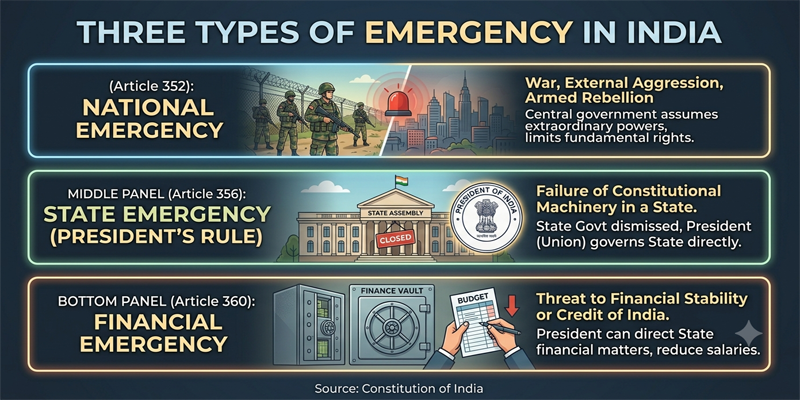
India has three constitutional types of emergency:
- National Emergency — Article 352
- President’s Rule in a State — Article 356
- Financial Emergency — Article 360
In an emergency, there could be conflict or imbalance between union & states, and, in some circumstances, there could be a lack of enforcement of fundamental rights.
So it is very important to understand these provisions in a proper manner.
In this post, we are going to explore Emergency Provisions in India in an easy-to-understand language.
What Is an Emergency Under the Indian Constitution?
An emergency is an extraordinary constitutional situation in which the normal functioning of government requires special measures.
The important point is that declaring an emergency does not mean that the Constitution itself disappears. Instead, the Constitution provides special rules for dealing with exceptional circumstances.
Different emergencies have different purposes.
| Type of Emergency | Article | Main Situation |
|---|---|---|
| National Emergency | Article 352 | War, external aggression or armed rebellion |
| President’s Rule | Article 356 | Failure of constitutional machinery in a State |
| Financial Emergency | Article 360 | Threat to financial stability or credit |
These provisions(Emergency Provisions in India) must be understood separately because their effects are very different.
National Emergency: Article 352
A National Emergency can be proclaimed under Article 352 when the security of India or any part of India is threatened by:
- War
- External aggression
- Armed rebellion
The Constitution originally used the expression “internal disturbance.” The 44th Constitutional Amendment replaced it with the narrower expression “armed rebellion.”
This change was important because it made it more difficult to use Article 352 for ordinary internal political or social disturbances.
Who Declares a National Emergency?
The President of India formally issues the Proclamation of Emergency.
However, the President cannot simply declare an emergency based on personal discretion. The Union Cabinet must communicate its decision to the President in writing.
This safeguard was introduced through the 44th Amendment.
The proclamation must then be placed before both Houses of Parliament for approval.
How Long Can a National Emergency Continue?
Parliament must approve the proclamation within one month.
Once approved, it can continue for six months at a time, but further continuation requires parliamentary approval.
Therefore, a National Emergency does not automatically continue indefinitely without parliamentary involvement.
The Lok Sabha also has a constitutional role in bringing an emergency to an end if it disapproves of the proclamation or its continuation.
What Happens During a National Emergency?
A National Emergency can significantly change the normal balance of power between the Union and the States.
Parliament Can Legislate on State Subjects
Normally, subjects in the State List are primarily within the legislative field of State legislatures.
During a National Emergency, however, Parliament gets the power to make laws on matters in the State List.
This is one of the important ways in which the Constitution temporarily strengthens the Union.
Such laws do not necessarily remain permanently applicable merely because they were made during the emergency. The Constitution provides rules regarding their operation after the emergency ends.
Union Executive Power Expands
During a National Emergency, the executive power of the Union can extend to giving directions to States regarding the manner in which their executive authority is to be exercised.
This allows greater coordination and control during a national crisis.
Does a National Emergency Suspend Fundamental Rights?
This is one of the most misunderstood aspects of Emergency Provisions in India.
No, all Fundamental Rights do not automatically disappear during a National Emergency.
The Constitution contains specific rules regarding Articles 358 and 359.
Article 358: Article 19
Article 358 deals with the Fundamental Rights guaranteed under Article 19.
Today, Article 19 is automatically affected under Article 358 only when the National Emergency is declared on the ground of war or external aggression.
It does not apply in the same way when the emergency is declared because of armed rebellion.
The 44th Amendment introduced this important safeguard.
Article 359: Right to Approach Courts
Under Article 359, the President may issue an order suspending the right to move courts for the enforcement of specified Fundamental Rights during a National Emergency.
But there is an important constitutional protection:
The rights guaranteed by Articles 20 and 21 cannot be suspended from enforcement under Article 359.
Article 20 protects against certain criminal-law abuses, while Article 21 protects life and personal liberty.
This protection became especially significant after the experience of the Emergency of 1975.
National Emergencies in India: A Brief History
India has experienced a National Emergency on three occasions.
1962 — India-China War
A National Emergency was proclaimed in 1962 following the conflict with China.
1971 — India-Pakistan War
Another National Emergency was proclaimed in 1971 in connection with the war with Pakistan.
1975 — Internal Emergency
In 1975, a National Emergency was proclaimed on the grounds of “internal disturbance,” which was the constitutional wording at that time.
This period is particularly important in Indian constitutional history because civil liberties, political opposition, press freedom, and other democratic institutions faced serious restrictions.
The experience contributed to important constitutional changes through the 44th Amendment, which strengthened safeguards surrounding emergency powers.
The 1975 Emergency ended in 1977.
President’s Rule: Article 356
The second type of emergency is commonly called President’s Rule.
It applies to a State, rather than the country as a whole.
Article 356 can be used when the President is satisfied that the government of a State cannot be carried on in accordance with the provisions of the Constitution.
This may happen based on a report from the Governor, although the Constitution also allows action in other circumstances.
What Happens Under President’s Rule?
When President’s Rule is imposed:
- The President may assume functions of the State government.
- Parliament may exercise the powers of the State legislature.
- Certain functions of State authorities may be exercised through arrangements made under the proclamation.
However, there is an important limitation:
The President cannot assume the powers of a High Court or interfere with the constitutional powers of the High Court in the manner contemplated by Article 356.
President’s Rule therefore does not mean that every institution in the State simply comes under the direct control of the President.
How Long Can President’s Rule Continue?
A proclamation under Article 356 must be approved by both Houses of Parliament within two months.
After approval, it generally continues for six months at a time.
There is a constitutional maximum of three years, but continuation beyond one year is subject to additional constitutional conditions.
These safeguards are intended to prevent President’s Rule from becoming a routine substitute for democratic government.
Can Courts Review President’s Rule?
Yes.
One of the most important cases concerning Article 356 is:
S.R. Bommai v. Union of India (1994).
The Supreme Court held that the use of Article 356 is subject to judicial review.
The judgment also emphasized the importance of federalism and democratic principles.
A particularly important principle is that when there is a question about whether a government has majority support in the legislative assembly, a floor test is generally the appropriate constitutional method for determining that majority.
In simple terms, the question of who has majority support should normally be tested on the floor of the House rather than decided merely through political claims or assumptions.
The S.R. Bommai judgment became a major constitutional safeguard against arbitrary use of President’s Rule.
Article 355 and President’s Rule
Article 355 is closely connected with the constitutional relationship between the Union and the States.
It places a duty on the Union to protect States against external aggression and internal disturbance and to ensure that the government of every State is carried on according to the Constitution.
Article 355 itself does not mean that President’s Rule is automatically imposed whenever a problem occurs.
Article 356 has its own constitutional requirements.
This distinction is important because emergency powers must be exercised according to the Constitution rather than simply according to political convenience.
Financial Emergency: Article 360
The third type of emergency is a Financial Emergency.
Under Article 360, a Financial Emergency may be proclaimed if the President is satisfied that the financial stability or credit of India or any part of India is threatened.
The proclamation must be approved by Parliament within two months.
Unlike National Emergency and President’s Rule, there is no fixed maximum period specified in Article 360 once it has been approved by Parliament. It continues until revoked or varied according to the Constitution.
What Can Happen During a Financial Emergency?
The President can issue directions concerning financial matters to States.
These directions can include requirements relating to financial propriety.
The President can also direct reduction of salaries and allowances of persons serving the Union or a State, including provisions that can affect the salaries and allowances of judges of the Supreme Court and High Courts.
Certain State financial Bills may also be required to be reserved for consideration by the President.
A Financial Emergency therefore provides significant constitutional powers over public finances.
Has India Ever Declared a Financial Emergency?
No Financial Emergency under Article 360 has ever been declared in India.
This makes Article 360 different from Articles 352 and 356, which have been used in India’s constitutional history.
National Emergency vs President’s Rule vs Financial Emergency
It is useful to compare the three provisions.
| Feature | National Emergency | President’s Rule | Financial Emergency |
|---|---|---|---|
| Article | 352 | 356 | 360 |
| Applies to | India or any part | A State | India or any part |
| Main reason | War, external aggression or armed rebellion | Constitutional machinery failure in a State | Threat to financial stability or credit |
| Parliamentary approval | Within 1 month | Within 2 months | Within 2 months |
| Main effect | Greater Union powers | State administration affected | Greater Union financial control |
| Article 19 effect | Limited to war/external aggression emergencies | No automatic suspension | No automatic suspension |
| Articles 20 & 21 | Cannot have enforcement suspended under Article 359 | Not automatically suspended | Not automatically suspended |
| Maximum period | No fixed overall maximum if constitutionally renewed | Generally 3 years with conditions | No fixed maximum |
Why Did the 44th Amendment Matter So Much?
The 44th Constitutional Amendment Act, 1978, is particularly important when studying emergency provisions.
It was enacted after the experience of the 1975–77 Emergency and introduced several safeguards.
Among other changes, it:
- Replaced “internal disturbance” with “armed rebellion” in Article 352.
- Required written communication of the Union Cabinet’s decision.
- Changed parliamentary approval requirements.
- Strengthened protections relating to Fundamental Rights.
- Ensured that Articles 20 and 21 cannot have their enforcement suspended under Article 359.
- Restricted the automatic operation of Article 358 to emergencies based on war or external aggression.
These changes demonstrate an important constitutional principle: emergency powers must be balanced with safeguards against their misuse.
Does Emergency Mean Democracy Stops?
Not necessarily.
An emergency changes the constitutional distribution of certain powers, but the Constitution continues to operate.
Parliament continues to have an important role. Courts continue to exist, and judicial review remains an important constitutional safeguard.
The exact powers available during an emergency depend on the particular constitutional provision involved.
Therefore, it is incorrect to say that “everything becomes suspended” during an emergency.
What Should Ordinary Citizens Know?
Emergency Provisions in India may sound like a subject meant only for constitutional lawyers, but ordinary citizens should understand some basic points.
1. Know Which Emergency Has Been Declared
National Emergency, President’s Rule, and Financial Emergency are not the same thing.
Each has different constitutional requirements and consequences.
2. Fundamental Rights Are Not Simply Erased
The Constitution specifically regulates how certain rights may be affected.
In particular, Articles 20 and 21 receive special protection under Article 359.
3. Parliament Has a Role
Emergency proclamations are not intended to remain entirely outside parliamentary oversight.
The Constitution requires parliamentary approval within specified periods.
4. Courts Can Matter
Emergency-related decisions can be subject to judicial review.
The S.R. Bommai case is an important example of the Supreme Court placing constitutional limits on the use of Article 356.
5. Do Not Rely on Social Media Rumours
During a crisis, rumours can spread quickly.
Citizens should rely on official government notifications, parliamentary information, court judgments, and credible news sources when trying to understand the legal effect of an emergency.
Why Emergency Provisions Are Necessary
A Constitution must protect democracy during normal times, but it must also be capable of responding to extraordinary threats.
A country facing war may need greater coordination between the Union and States.
A State experiencing a genuine constitutional breakdown may require temporary constitutional intervention.
A severe threat to financial stability may require extraordinary financial measures.
Emergency provisions provide constitutional mechanisms for dealing with such situations.
But extraordinary powers also carry risks.
That is why parliamentary approval, constitutional safeguards, judicial review, and the protection of essential rights are so important.
Final Takeaway
Friends, in this post, we have fully understood the Emergency Provisions in India within the Constitution. In the Indian Constitution, they are among the most powerful and useful parts.
Article 352 deals with National Emergency caused by external aggression, war, or armed rebellion.
Article 356 is commonly known as President’s Rule and deals with failure of constitutional machinery in a State.
Article 360 deals with a threat to the financial stability or credit of India or any part of it.
The history of the 1975 Emergency shows why extraordinary constitutional powers require strong protections. The 44th Amendment strengthened those safeguards, while judicial decisions such as S.R. Bommai reinforced constitutional limits on the use of emergency powers.
The key lesson for citizens is very simple:
Constitution does not disappear at the time of emergency. It simply means that to deal with such an extraordinary situation, there are some special rules provided by the Constitution itself.
If the citizens of the country have a better understanding of these rules. It becomes very easy to know about the expected government action, parliamentary approvals, courts that could be approached, and the rights going to get full constitutional protection in such situations.
Legal Disclaimer
This article(Emergency Provisions in India) is intended for general educational and legal-awareness purposes only. It is not legal advice and should not be treated as a substitute for professional legal consultation. Constitutional provisions and their interpretation may depend on the facts of a particular situation and subsequent judicial decisions.
If you have any queries, you can write to us at support@a5theory.com; we will get back to you ASAP.
Hope! You would have enjoyed this post, “Emergency Provisions in India“.
Please feel free to give your important feedback in the comment section below.
Have a great time!