

Hello Friends, in this blog post “Article 32 vs Article 226,” we are going to see the difference between Article 32 and Article 226 within the Constitution of India.
There are several fascinating Fundamental Rights given to Indian citizens by the Constitution.
They are the right to freedom, the right to equality, the right to life and personal liberty, and freedom of religion.
But is it enough to have a right listed in the Constitution? Probably you might be seeing only one side of the coin.
Because various problems could arise, as listed below:
- What happens when a person’s constitutional right is violated?
- Where can the person go for protection?
- Can they directly approach the Supreme Court?
- Should they first approach a High Court?
So, in this context, two very specific constitutional provisions are very helpful.
- Article 32 — For enforcement of their Fundamental Rights, any citizen can simply approach the Supreme Court.
- Article 226 — Empowering High Courts to issue writs.
Though constitutional remedies are provided by both of these provisions, they seem not to be identical.
If anyone is really interested to know that how can be the constitutional rights enforced, they must…
…learn & understand the difference between Article 32 and Article 226 first.
In this post, we are going to explore Article 32 vs Article 226 in easy-to-understand language.
What Is Article 32?
Article 32 gives a person the right to approach the Supreme Court of India to enforce Fundamental Rights.
It is itself a Fundamental Right.
This is why Article 32 is considered especially important in the constitutional scheme.
Dr. B.R. Ambedkar famously described Article 32 as the “heart and soul” of the Constitution, emphasizing the importance of an effective remedy for protecting Fundamental Rights.
Article 32 empowers the Supreme Court to issue appropriate directions, orders, and writs for enforcing Fundamental Rights.
What Is Article 226?
Article 226 gives High Courts the power to issue directions, orders, and writs.
Like Article 32, it can be used to protect Fundamental Rights.
But Article 226 is broader.
A High Court can issue writs not only for the enforcement of Fundamental Rights but also “for any other purpose.”
This means that Article 226 can, in appropriate cases, be used to protect certain other legal rights as well.
That difference is one of the most important distinctions between Articles 32 and 226.
The Five Constitutional Writs
Both the Supreme Court under Article 32 and High Courts under Article 226 can issue the traditional constitutional writs.
There are five major writs:
- Habeas Corpus
- Mandamus
- Prohibition
- Certiorari
- Quo Warranto
Let’s understand them in simple language.
1. Habeas Corpus
Habeas Corpus literally relates to bringing a detained person before the court.
It is generally used when a person is allegedly being unlawfully detained.
For example, if a person is detained without lawful authority, the court may examine the legality of that detention.
The purpose is to protect personal liberty.
Habeas Corpus is therefore closely connected with Article 21, which protects life and personal liberty.
2. Mandamus
Mandamus means a command.
A court may issue a writ of Mandamus to require a public authority or public official to perform a legal duty that they are required to perform.
For example, if a public authority has a legal obligation to consider an application but unlawfully refuses to perform that duty, a writ remedy may be available in an appropriate case.
Mandamus generally concerns a public or legal duty. It is not simply a general remedy for every disagreement with another person or organization.
3. Prohibition
A writ of Prohibition is generally issued by a higher court to a lower court or tribunal when it is acting beyond its jurisdiction or in violation of the limits placed upon its authority.
The purpose is preventive.
It seeks to stop an unlawful proceeding before it is completed.
4. Certiorari
Certiorari is generally used by a superior court to review and, where legally justified, quash an order or decision of a lower court, tribunal or authority.
It may be relevant where the lower authority has acted without jurisdiction, exceeded its jurisdiction or committed a serious legal error within the scope of judicial review.
Unlike Prohibition, which is primarily preventive, Certiorari can operate to correct or quash an action that has already been taken.
5. Quo Warranto
Quo Warranto means, broadly, “by what authority?”
This writ is concerned with the legal authority of a person occupying a public office.
If someone is occupying a public office without satisfying the legal requirements for that office, a court may examine the validity of that person’s claim to the position.
The objective is to protect the legality of public appointments.
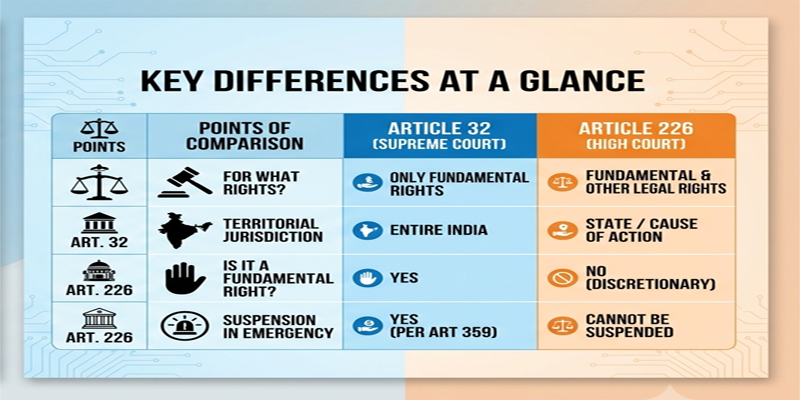
Article 32 vs Article 226: The Main Difference
The easiest way to understand the difference is this:
| Feature | Article 32 | Article 226 |
|---|---|---|
| Court | Supreme Court | High Court |
| Main purpose | Enforcement of Fundamental Rights | Fundamental Rights and certain other legal rights |
| Constitutional status | Itself a Fundamental Right | Constitutional power of High Courts |
| Writs | Five constitutional writs | Five constitutional writs |
| Territorial reach | Supreme Court’s constitutional jurisdiction | Generally connected with the High Court’s territorial jurisdiction and Article 226 conditions |
| Scope | Narrower in subject matter | Broader in subject matter |
| Discretion | Constitutional right, subject to legal requirements and judicial principles | Wider discretionary jurisdiction |
The most important distinction is that Article 32 is specifically for the enforcement of Fundamental Rights, while Article 226 has a wider scope.
Why Is Article 32 Called a Fundamental Right?
Article 32 is included in Part III of the Constitution, which contains Fundamental Rights.
This makes the right to approach the Supreme Court under Article 32 itself constitutionally protected.
If a person’s Fundamental Right is violated, Article 32 provides a direct constitutional route to the Supreme Court.
However, this does not mean that every complaint can automatically be filed under Article 32.
The case must involve the enforcement of a Fundamental Right.
Why Do People Often Approach High Courts Under Article 226?
High Courts are located within the States and are generally more accessible geographically than the Supreme Court.
Article 226 also has a wider scope because it covers:
- Fundamental Rights
- Certain other legal rights
- Other situations falling within the High Court’s constitutional writ jurisdiction
For this reason, High Courts play an important role in constitutional litigation.
A person does not necessarily have to approach the Supreme Court first.
Can You Go Directly to the Supreme Court?
Yes, Article 32 provides a direct constitutional remedy for enforcement of Fundamental Rights.
A person whose Fundamental Right has been violated can approach the Supreme Court under Article 32, subject to the requirements of the particular case.
But in practice, constitutional litigation also involves questions of jurisdiction, facts, alternative remedies, maintainability, and judicial discretion.
Therefore, the existence of Article 32 does not mean that every legal dispute can simply be taken directly to the Supreme Court.
Can You Approach a High Court Instead?
Yes.
A High Court can exercise jurisdiction under Article 226 in appropriate cases.
In fact, many constitutional and public-law disputes are brought before High Courts.
High Courts can examine whether government authorities have acted within their legal and constitutional powers.
Their jurisdiction under Article 226 is an important part of India’s system of judicial review.
Is Article 226 More Powerful Than Article 32?
It is better not to describe one as simply “more powerful” than the other.
They serve different constitutional purposes.
Article 32 is specifically designed to provide a remedy for Fundamental Rights violations through the Supreme Court.
Article 226 gives High Courts a broader writ jurisdiction, extending to Fundamental Rights as well as certain other legal rights.
Therefore, the better way to compare them is by looking at their purpose, scope, and jurisdiction, rather than calling one superior.
What Is Judicial Review?
Articles 32 and 226 are closely connected with the broader principle of judicial review.
Judicial review means that courts can examine whether laws, government decisions and administrative actions comply with the Constitution and applicable law.
For example, a court may examine whether:
- A government authority exceeded its legal powers
- A Fundamental Right was violated
- An administrative decision was unlawful
- A public authority failed to perform a legal duty
- A law is inconsistent with constitutional provisions
Judicial review helps maintain constitutional limits on government power.
Article 32 and Public Interest Litigation
Article 32 has also played an important role in the development of Public Interest Litigation (PIL).
Traditional litigation generally involves a person approaching the court because their own legal rights or interests have been affected.
PIL developed to allow courts, in appropriate cases, to consider matters involving broader public interest, particularly where affected people may have difficulty approaching the courts themselves.
The Supreme Court has used its Article 32 jurisdiction in several significant cases involving issues such as prison conditions, bonded labour, environmental protection and other public concerns.
However, PIL is not intended to turn courts into forums for every personal, political or private dispute.
Courts have developed principles concerning when PIL should be entertained.
Article 226 and PIL
High Courts can also entertain appropriate Public Interest Litigation under their writ jurisdiction.
This is one reason Article 226 is particularly important for public-law issues at the State level.
For example, a petition may concern the functioning of a State authority, unlawful administrative action, or protection of rights within the High Court’s jurisdiction.
Again, whether a petition is maintainable depends on the facts, legal provisions and judicial principles applicable to the case.
Do You Always Have to Go to the High Court Before the Supreme Court?
There is no general constitutional rule saying that a person must always approach the High Court before invoking Article 32.
Article 32 itself provides a direct remedy to the Supreme Court for enforcement of Fundamental Rights.
However, the Supreme Court has developed principles concerning the appropriate exercise of its jurisdiction.
In some situations, the Court may expect a petitioner to use an available alternative remedy or approach the appropriate High Court, particularly where factual issues need examination.
Therefore, Article 32 exists as a direct constitutional remedy, but that does not mean every case should necessarily begin in the Supreme Court.
What Is an Alternative Remedy?
An alternative remedy is another legal procedure through which a person may obtain relief.
For example, a person may have a statutory appeal, departmental remedy or another judicial remedy available under law.
High Courts often consider the availability of an alternative remedy when deciding whether to exercise writ jurisdiction.
However, the existence of an alternative remedy does not create an absolute constitutional prohibition against approaching a High Court under Article 226.
Courts consider the circumstances of each case.
Article 32 vs Article 226: A Simple Example
Imagine that a government authority unlawfully detains a person.
The detention potentially raises questions concerning personal liberty and Fundamental Rights.
A constitutional remedy may be sought through an appropriate writ petition.
Depending on the circumstances, the person may approach:
Supreme Court → Article 32
or
High Court → Article 226
Now imagine a different situation where a public authority violates a statutory legal duty, but the dispute does not involve a Fundamental Right.
Article 226 may still potentially provide a remedy because its scope extends beyond Fundamental Rights.
This example demonstrates the practical difference between the two provisions.
What About Private Disputes?
Articles 32 and 226 should not be understood as general-purpose remedies for every dispute between private individuals.
Writ jurisdiction primarily concerns the exercise of public power and enforcement of constitutional or legal obligations within the court’s jurisdiction.
For ordinary private disputes, other legal procedures may be appropriate.
For example, a contractual dispute between two private parties may ordinarily need to be addressed through the applicable civil or commercial legal process rather than simply by filing a constitutional writ petition.
There are, however, areas where public-law principles may apply to bodies performing certain public functions. The exact position depends on the facts and applicable law.
Article 32 and Article 226 in the Indian Constitutional System
These two provisions create an important network of constitutional protection.
The Supreme Court stands at the apex of India’s judicial system and has Article 32 jurisdiction for enforcement of Fundamental Rights.
High Courts operate within the States and have broad writ jurisdiction under Article 226.
Together, they provide important mechanisms for holding public authorities accountable to the Constitution and the law.
Important Cases
Several Supreme Court judgments have shaped the interpretation of Articles 32 and 226.
Romesh Thappar v. State of Madras
This early constitutional case demonstrated the importance of Article 32 as a remedy for enforcement of Fundamental Rights.
Daryao v. State of U.P.
The Supreme Court considered the relationship between writ proceedings under Articles 32 and 226 and principles such as finality of judicial decisions.
L. Chandra Kumar v. Union of India
The Supreme Court reaffirmed the constitutional importance of judicial review exercised by High Courts under Article 226/227 and by the Supreme Court under Article 32.
These cases illustrate that Articles 32 and 226 are not merely procedural provisions. They are important components of constitutional governance.
What Should an Ordinary Citizen Remember?
You do not need to memorize every legal rule to understand the basic idea.
Remember these points:
- Article 32 → Supreme Court → Fundamental Rights
- Article 226 → High Court → Fundamental Rights + certain other legal rights
- Both courts can issue constitutional writs.
- Article 226 has a wider scope than Article 32.
- Article 32 itself is a Fundamental Right.
- Writ jurisdiction is not a general replacement for ordinary civil or criminal procedures.
- Courts consider jurisdiction, maintainability, alternative remedies, and the facts of each case.
- Legal advice may be important before deciding where and how to file a case.
Final Takeaway
Friends, in this post(Article 32 vs Article 226), we have fully understood the difference between Article 32 and Article 226 within the Constitution. The work of the Constitution is not just to declare the rights, but it also ensures the protection of the rights through various mechanisms.
Article 32 lets the citizen approach the Supreme Court for the enforcement of their fundamental rights.
Article 226: For the enforcement of fundamental rights and, in appropriate cases, for some other legal purpose, High Courts get a power to issue writs under this Article.
The key difference(Article 32 vs Article 226) is very simple to understand:
Article 32 is concerned with the supreme court for the protection of the fundamental rights of the citizens. While Article 226 lets the High Courts a broader constitutional writ juridiction.
A fascinating combination of these two provisions comes up with an amazing system for reviewing judicial matters and protecting constitutional rights.
Citizens can get a more practical picture of the Constitution if they understand the difference between these two provisions: Article 32 vs Article 226. The meaningfulness of the rights does not come just from listing in the Constitution; rather, a legal system is always on standby for those who are seeking the protection of their rights in numerous ways.
Legal Disclaimer
This article “Article 32 vs Article 226” is intended for general educational and legal-awareness purposes only. It is not legal advice and should not be treated as a substitute for professional legal consultation. The appropriate remedy, court, and procedure depend on the facts and applicable law in each case.
If you have any queries, you can write to us at support@a5theory.com; we will get back to you ASAP.
Hope! You will have enjoyed this post, “Article 32 vs Article 226“.
Please feel free to give your feedback in the comment section below.
Have a great time!