

Hello, friends. In this blog post, we are going to discuss the Right to Information Act within the Constitution.
How do public institutions work in practice? To know about this, a right is given to citizens in a democracy.
There could be a lot of questions like this; a few are given below:
- How was a government decision made?
- How much money was spent on a public project?
- What happened to an application submitted to a government department?
- Why has a particular file been pending?
- How was a government contract awarded?
If you imagine this almost two decades ago, it was very difficult to get the answers to such questions for an ordinary citizen.
But because of this, the Right to Information Act, 2005 has given extraordinary power to an ordinary citizen.
Now any ordinary citizen can get the information from the public authorities using this legal mechanism.
RTI should not be seen simply as a way of asking the government questions.
Rather, it is a much more powerful and transparent mechanism that allows any citizen to…
…access copies of real documents, records, and other important information from any public authority.
And all this received information could be subject to the exemptions provided by law.
Understanding the RTI helps citizens monitor public services, understand government decisions, and participate effectively in democracy.
In this post, we are going to explore the Right to Information Act(RTI) in easy-to-understand language.
What Is the Right to Information?
The Right to Information (RTI) is a statutory right provided under the Right to Information Act, 2005.
The Act establishes a practical process through which citizens can seek information from public authorities.
The basic idea is simple:
Information held by public authorities should generally be accessible to citizens, subject to lawful exemptions.
The law recognizes transparency as an important part of accountable government.
Is RTI a Fundamental Right?
The Right to Information Act is a statutory law rather than a separate Fundamental Right listed by name in Part III of the Constitution.
However, the Supreme Court has recognized the constitutional connection between access to information and freedom of speech and expression under Article 19(1)(a).
The reasoning is straightforward: meaningful participation in a democracy requires citizens to have access to relevant information.
The RTI Act therefore provides a statutory framework for exercising this broader constitutional principle.
Who Can File an RTI Application?
Under the RTI Act, Indian citizens can seek information.
The law does not require an applicant to explain why they want the information.
This is an important feature.
You generally do not have to prove that you are personally affected by the matter before seeking information under the Act.
What Kind of Information Can You Ask For?
The definition of “information” under the RTI Act is broad.
It can include information relating to:
- Records
- Documents
- Memos
- Emails
- Opinions
- Advice
- Orders
- Circulars
- Contracts
- Reports
- Papers
- Samples
- Models
- Data held electronically
- Information relating to private bodies that can be accessed by a public authority under law
The Act also allows citizens, subject to the applicable provisions, to inspect certain works, documents and records and obtain certified copies or samples.
What RTI Is Not
One of the most important things to understand is that RTI is primarily a right to access information that exists and is held by a public authority.
It is not necessarily a mechanism for forcing an officer to create a new explanation or give an opinion that does not already exist on record.
For example, instead of asking:
“Why are you behaving unfairly?”
a more effective RTI request may ask:
“Please provide a certified copy of the order or record showing the reasons recorded for rejecting my application.”
Similarly, instead of asking:
“When will my road be repaired?”
you could ask:
“Please provide a copy of the sanctioned work order, estimated completion date and expenditure recorded for the road repair project.”
The second approach seeks identifiable information or records.
Who Is a Public Authority?
The RTI Act applies to public authorities as defined by the law.
This includes constitutional bodies, government departments and offices, institutions established or constituted by law, and bodies owned, controlled or substantially financed by the appropriate government, among others covered by the statutory definition.
The exact question of whether a particular organization qualifies as a public authority can sometimes be legally complex.
Therefore, RTI does not mean that every private company is automatically required to answer every question from the public.
Public Information Officers: The Person Who Receives RTI Requests
Public authorities generally designate Public Information Officers (PIOs) to deal with RTI applications.
At the Central level, the relevant officer is commonly called the Central Public Information Officer (CPIO).
At the State level, the officer is generally referred to as the State Public Information Officer (SPIO).
The PIO is responsible for processing RTI requests in accordance with the Act.
If the information is held by another public authority, the application may, where the statutory conditions are satisfied, be transferred to the appropriate authority.
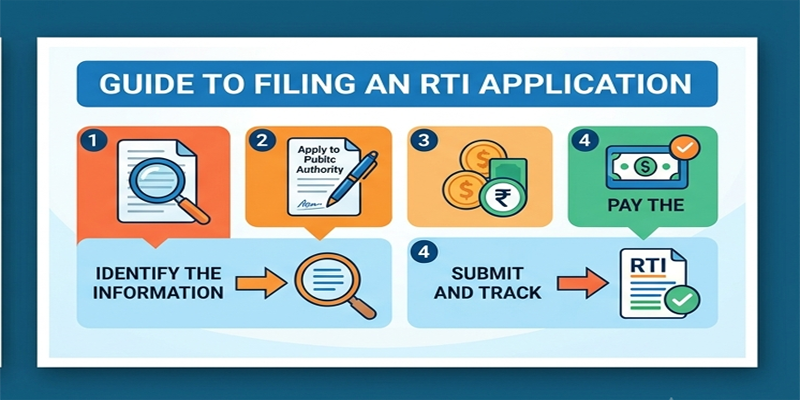
How Do You File an RTI Application?
An RTI application does not need to be written in complicated legal language.
A simple application should identify:
- The public authority from which information is sought.
- The specific information requested.
- The preferred form in which the information is requested, where relevant.
- The applicant’s contact details for receiving the response.
- The prescribed application fee, where applicable.
The application should be clear, specific, and limited to identifiable information.
Example of a Simple RTI Request
Suppose a government office has not acted on your application for a particular service.
Instead of writing a long complaint, you might ask for:
- The date on which the application was received.
- The diary or application number.
- The current status recorded in the file.
- Copies of notes or orders relating to the application, subject to applicable exemptions.
- The name/designation of the authority currently responsible for processing it.
- The prescribed time limit for disposal of the application, if recorded in the relevant rules.
This makes the request easier to process.
How Much Does an RTI Application Cost?
The RTI Act provides for an application fee, with the exact amount and procedure depending on the applicable Central or State rules.
For Central Government public authorities, the prescribed application fee is generally ₹10.
Additional charges may apply for providing copies or other forms of information according to the applicable rules.
Applicants belonging to the Below Poverty Line (BPL) category are exempt from payment of the prescribed fee under the applicable provisions and rules.
Because fee rules can vary depending on the public authority and jurisdiction, applicants should check the applicable RTI rules before filing.
How Long Does the Government Have to Respond?
In the ordinary case, information should be provided within 30 days of receipt of the RTI application.
There are important exceptions.
If the information sought concerns the life or liberty of a person, the law provides a much shorter response period of 48 hours.
Where an application is transferred to another public authority under the Act, the law also provides specific rules regarding the transfer and calculation of the response period.
The important point is that RTI applications are subject to statutory time limits.
What If the Information Is Denied?
Not all government information can be disclosed.
The RTI Act contains exemptions designed to protect legitimate interests such as:
- National security
- Strategic interests
- Certain confidential information
- Personal information in circumstances covered by the Act
- Information that could impede an investigation
- Certain information relating to fiduciary relationships
- Information protected by other legal provisions
The exemptions are primarily found in Section 8, while Section 9 deals with certain copyright-related grounds.
However, an exemption should not be understood as a blanket power to refuse every request.
The applicability of a particular exemption depends on the information and the statutory requirements.
What Is Partial Disclosure?
Sometimes a document contains both exempt and non-exempt information.
The entire document does not necessarily have to be withheld.
Under the RTI framework, information that can reasonably be separated from exempt material may be disclosed subject to the Act.
This principle is important because it supports transparency while protecting genuinely exempt information.
What Is the First Appeal?
Suppose:
- You receive no response within the applicable period.
- The information provided is incomplete.
- The information is incorrect.
- Your request is rejected.
- You believe an exemption has been wrongly applied.
You can generally file a First Appeal under the RTI Act.
The first appeal is made to the designated First Appellate Authority (FAA) within the relevant public authority.
The RTI Act provides the statutory framework and time limits for this process.
What Is the Second Appeal?
If the matter is not satisfactorily resolved through the first appeal, the applicant can, where appropriate, file a Second Appeal before the relevant Information Commission.
There are two principal types of Information Commissions:
- Central Information Commission (CIC)
- State Information Commission (SIC)
The appropriate commission depends on the public authority and the nature of the matter.
What Is a Complaint Under the RTI Act?
The RTI Act also provides a separate complaint mechanism in specified circumstances.
For example, a complaint may arise where a person is unable to submit an RTI request because a public authority has not appointed the required information officer or where the application is otherwise improperly obstructed in circumstances covered by the Act.
A complaint is not simply the same thing as a second appeal.
The appropriate route depends on what happened in the particular case.
Can an Officer Be Penalized?
Yes.
The RTI Act provides for penalties in specified circumstances.
Under Section 20, the Information Commission may impose a penalty on the concerned Central or State Public Information Officer where the statutory conditions for penalty are satisfied.
The penalty can be ₹250 per day, subject to a maximum of ₹25,000.
The law also provides an opportunity for the concerned officer to show reasonable cause before a penalty is imposed.
This provision is intended to encourage proper compliance with the RTI framework.
Can RTI Be Used to Obtain Personal Information About Someone?
Not automatically.
The RTI Act contains protections relating to personal information and privacy.
The legal position has also evolved through amendments and judicial decisions.
An applicant should therefore not assume that information about another person’s private affairs must always be disclosed simply because an RTI application has been filed.
The public interest and the specific statutory exemptions may be relevant.
RTI and Personal Information: A Practical Example
Suppose someone asks a government department for another person’s:
- Home address
- Medical records
- Personal contact details
- Personal financial information
Such information may attract privacy-related exemptions under the RTI Act.
On the other hand, information concerning public expenditure, official decisions or the functioning of a public authority may raise different considerations.
The answer depends on the precise information requested and the applicable provisions.
Can You Ask for Government Records Online?
Yes, in many cases.
The Central Government provides an online RTI filing system for eligible Central Government public authorities.
Several State Governments also have their own online RTI systems.
However, citizens should make sure that the application is being submitted to the correct public authority.
Sending an RTI application to the wrong authority can delay the process, even though the law contains provisions for transfer in appropriate cases.
RTI and Government Transparency
RTI is not only about individual complaints.
It can help citizens understand how public institutions function.
For example, citizens may use RTI to seek information concerning:
- Government expenditure
- Public works
- Administrative decisions
- Recruitment processes
- Government schemes
- Licensing procedures
- Public contracts
- Service-delivery records
- Official rules and guidelines
- Status of applications
This can make government functioning more transparent.
RTI and Corruption
RTI can also help expose irregularities by making government records accessible.
Suppose a public project is announced with a particular budget.
Citizens may seek records relating to:
- Sanctioned amount
- Work order
- Contractor
- Completion records
- Bills and payments
- Inspection reports
- Utilization records
RTI itself does not declare that corruption has occurred.
Rather, it can help citizens obtain documentary information that may reveal whether further action or investigation is warranted.
Important Limitations of RTI
RTI is powerful, but it is not unlimited.
A citizen cannot use RTI to demand disclosure of every piece of information held by the government.
The Act contains exemptions and procedural requirements.
Some information may be protected because disclosure could harm national security, investigations, privacy, or other legally recognized interests.
There may also be information that simply does not exist in the form requested.
Therefore, a well-drafted RTI application focuses on specific information or records rather than demanding explanations, arguments, or hypothetical answers.
How to Write a Better RTI Application
A few practical principles can make an RTI application more effective.
Be Specific
Instead of asking:
“Tell me everything about this project.”
Ask:
“Please provide a certified copy of the work order issued for the project and the expenditure recorded against it.”
Ask for Records
Use phrases such as:
- “Please provide a certified copy of…”
- “Please provide the recorded status of…”
- “Please provide the relevant file noting…”
- “Please provide the relevant order/circular/report…”
Avoid Unnecessary Arguments
An RTI application does not need to contain a long explanation of why a government officer is wrong.
The objective is to obtain information.
Break Large Questions Into Clear Points
If you need five separate pieces of information, list them as five numbered questions.
This reduces ambiguity.
RTI Is Different From a Complaint
This distinction is extremely important.
Suppose a municipal authority has not repaired a damaged road.
A complaint asks the authority to take action.
An RTI application can ask for information such as:
- When was the complaint registered?
- What is the complaint number?
- Which officer is responsible?
- What action has been recorded?
- What work order was issued?
- What expenditure has been recorded?
You may sometimes need both a complaint and an RTI application.
RTI gives you information; it does not automatically order the government to solve the underlying problem.
RTI and Accountability
The larger purpose of RTI is connected with democratic accountability.
When government records are accessible, citizens, journalists, researchers and civil society organizations can better understand how public institutions operate.
Transparency can also help identify administrative delays, inconsistencies and possible irregularities.
At the same time, RTI must operate alongside legitimate requirements of confidentiality, privacy, national security and effective administration.
The law therefore attempts to balance transparency with other public interests.
What Every Citizen Should Remember
If you remember only a few things about RTI, remember these:
- RTI is governed by the Right to Information Act, 2005.
- Indian citizens can seek information under the Act.
- You generally do not have to give a reason for requesting information.
- RTI mainly provides access to information and records held by public authorities.
- The normal response period is generally 30 days.
- Information concerning life or liberty has a 48-hour statutory response period under the applicable provision.
- Some information is exempt from disclosure.
- You can challenge an unsatisfactory response through the appeal mechanism.
- Information Commissions can hear appropriate appeals and complaints under the Act.
- RTI is different from a normal complaint.
- Clear and specific questions usually make better RTI applications.
Final Takeaway
Friends, in this post, we have understood the Right to Information Act(RTI), which provides the fascinating power of asking questions and monitoring the working of any public authority in practice.
Under this Right to Information Act, a citizen can easily get the required information along with the documents, records, decisions, and expenditure details from any public authority, and it is subject to statutory exemptions.
The power of RTI is not just limited to asking questions of any government department. But it is more fascinating to see that it could be used to create the legal process through which public information can be sought, and accountability can be strengthened.
A citizen who understands RTI can move from asking:
“What is happening?”
to asking:
“What does the official record say?”
That difference can be extremely important in a democracy and make it beautiful and safe.
Legal Disclaimer
This article is intended for general educational and legal-awareness purposes only. It is not legal advice and should not be treated as a substitute for professional legal consultation. RTI procedures, exemptions, fees, and applicable rules may vary depending on the public authority and circumstances. For a specific legal matter, consider obtaining advice from a qualified legal professional.
If you have any queries, you can write to us at support@a5theory.com; we will get back to you ASAP.
Hope! You would have enjoyed this post, “Right to Information Act“.
Please feel free to give your important feedback in the comment section below.
Have a great time!