

Hello Friends, in this blog post, we will discuss Women’s Legal Rights in India under the Indian Constitution.
There is a wide range of constitutional rights and laws protecting the women in India.
These protections generally cover education, employment, property, equality, marriage, safety,…
… domestic violence, and workplace rights, inheritance, protection from sexual offences, and maternity.
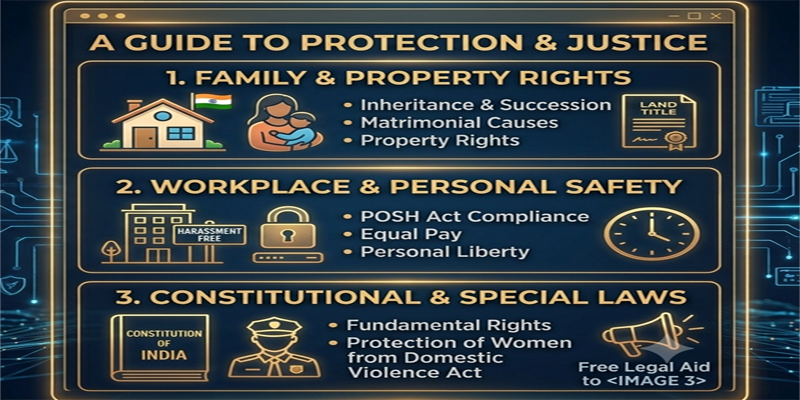
Being aware of these rights not only benefits women themselves but is also an advantage for families, institutions, employers, and every citizen.
These are the guarantees given by the Indian Constitution for equality before the law and restricting discrimination on certain grounds, including sex.
For some specific problems faced by women, several laws have been enacted by the Parliament at the same time.
In this post, “Women’s Legal Rights in India,” we will explore some of the important legal rights and protections that women should be aware of in easy-to-understand language.
Constitutional Rights of Women
The Constitution is the foundation of women’s legal rights in India.
Equality Before the Law
Article 14 guarantees equality before the law and equal protection of the laws.
This means women are entitled to legal protection on an equal basis with others.
Protection Against Sex-Based Discrimination
Article 15(1) prohibits discrimination by the State on grounds including sex.
At the same time, Article 15(3) permits the State to make special provisions for women and children.
This is important because equality does not always mean treating everyone identically. The Constitution allows special legal protections designed to address particular disadvantages.
Equality of Opportunity in Public Employment
Article 16 guarantees equality of opportunity in matters of public employment.
The State cannot discriminate in public employment on prohibited grounds, subject to constitutional provisions permitting certain forms of affirmative action.
Equal Pay and Fair Conditions
Article 39 contains Directive Principles relating to economic justice.
Article 39(d), in particular, speaks of equal pay for equal work for both men and women.
Labour and employment laws also contain protections relating to wages, discrimination, and working conditions.
Protection Against Domestic Violence
Domestic violence is not limited to physical beating.
The Protection of Women from Domestic Violence Act, 2005 recognizes different forms of domestic violence, including:
- Physical abuse
- Sexual abuse
- Verbal and emotional abuse
- Economic abuse
A woman facing domestic violence may seek legal protection and appropriate relief under the law.
Depending on the circumstances, courts can grant remedies such as:
- Protection orders
- Residence-related relief
- Monetary relief
- Custody-related orders
- Compensation
- Other appropriate orders recognized by the Act
The law can apply to women in domestic relationships, subject to its statutory requirements.
Right to Residence in a Shared Household
One important protection under the domestic violence law concerns the right of a woman in a domestic relationship to reside in a shared household, subject to the statutory framework.
The Supreme Court has also clarified important aspects of this protection.
A woman should therefore not assume that she automatically loses all residential protection merely because the property is not registered in her own name.
However, the exact legal position depends on the facts and the nature of the residence and relationship.
Sexual Harassment at the Workplace
Women have legal protection against sexual harassment at work.
The Sexual Harassment of Women at Workplace (Prevention, Prohibition and Redressal) Act, 2013, commonly called the POSH Act, provides a framework for preventing and addressing workplace sexual harassment.
Sexual harassment can include unwelcome conduct of a sexual nature, including certain physical, verbal or non-verbal behaviour.
Examples may include:
- Unwelcome physical contact
- Requests for sexual favours
- Sexually coloured remarks
- Showing sexually explicit material
- Other unwelcome physical, verbal or non-verbal conduct of a sexual nature
The law applies to workplaces covered by its provisions, including many organized and institutional workplaces.
Internal Committee at the Workplace
Employers covered by the POSH framework have responsibilities relating to prevention and redressal of sexual harassment.
Certain workplaces are required to constitute an Internal Committee to receive and address complaints.
Where an organization does not fall within the threshold or structure requiring such a committee, the law provides for the role of the Local Committee established by the appropriate authority for complaints covered by the law.
Women should know that a workplace complaint does not necessarily require them to immediately approach the police.
The appropriate mechanism depends on the nature of the conduct and the legal remedy being sought.
Protection Against Sexual Offences
The criminal law provides protection against various offences affecting the bodily autonomy and dignity of women.
Depending on the conduct, offences may include:
- Rape
- Sexual assault
- Sexual harassment
- Stalking
- Voyeurism
- Assault or criminal force intended to outrage a woman’s modesty
- Certain other offences involving sexual exploitation or abuse
India’s criminal laws were substantially reorganized in 2024, including the coming into force of the Bharatiya Nyaya Sanhita (BNS).
Therefore, anyone dealing with a current criminal matter should rely on the law applicable to the date and circumstances of the alleged offence rather than automatically relying on older section numbers from the Indian Penal Code.
Right to Complain to the Police
A woman who is a victim of a cognizable offence can approach the police for registration of an FIR in accordance with criminal procedure.
The law also contains safeguards and special procedures in certain cases involving women.
For example, in specified sexual-offence cases, the statement of the woman may be recorded by a woman police officer or woman officer, subject to the applicable law.
If a police station refuses to properly record information concerning a cognizable offence, legal remedies may be available, including escalation to senior police authorities and appropriate judicial forums.
Right to Privacy and Dignity
The Constitution protects personal liberty and dignity under Article 21.
The Supreme Court has recognized privacy as a constitutionally protected right.
This has important implications for women, particularly in matters involving:
- Personal choices
- Bodily autonomy
- Reproductive decisions
- Medical information
- Sexual privacy
- Personal relationships
However, constitutional rights operate within the legal framework applicable to particular situations.
Reproductive and Maternity Rights
Women have legal protections relating to pregnancy and maternity.
The Maternity Benefit Act, 1961, as amended, provides maternity-related benefits to eligible women employees covered by the law.
The law provides for maternity leave and related protections, subject to statutory eligibility and conditions.
It also addresses certain matters such as nursing breaks and protection against dismissal or disadvantage in circumstances covered by the Act.
The exact benefits depend on the employment situation and applicability of the legislation.
Right Against Workplace Discrimination
Employment-related protections can arise from multiple laws and constitutional principles.
A woman should be aware of her rights relating to:
- Equal treatment
- Wages
- Maternity benefits
- Workplace safety
- Sexual harassment
- Unlawful termination or discrimination
Employment rights can differ depending on whether a person works in the government sector, private sector, organized sector or another employment arrangement.
Therefore, the specific law applicable to a workplace dispute should always be identified.
Property and Inheritance Rights
Women’s property rights have changed significantly over time.
Under the Hindu Succession Act, 1956, as amended, a daughter in a Hindu coparcenary is recognized as a coparcener by birth in the same manner as a son, subject to the statutory framework.
The Supreme Court’s decision in Vineeta Sharma v. Rakesh Sharma (2020) clarified important aspects of daughters’ coparcenary rights.
This means that the common belief that a daughter automatically loses her ancestral/coparcenary rights simply because she was married is not correct under the applicable Hindu succession law.
However, inheritance laws are personal-law specific. Different religious communities may be governed by different statutory or personal-law rules.
Stridhan Is Different From Dowry
A woman’s stridhan refers broadly to property belonging to her, including certain gifts and assets that legally belong to her.
Stridhan should not be confused with dowry.
Dowry is prohibited under the Dowry Prohibition Act, 1961.
A woman’s property does not automatically become her husband’s property merely because it is kept in the matrimonial home.
Questions concerning recovery or misuse of stridhan can have civil and criminal dimensions depending on the facts.
Protection Against Dowry
The Dowry Prohibition Act, 1961 prohibits the giving and taking of dowry, subject to the definitions and statutory framework.
Criminal law also contains provisions dealing with certain offences connected with dowry and cruelty.
Women and their families should understand that legitimate customary gifts are not automatically the same thing as dowry; the legal definition and surrounding circumstances matter.
Cruelty by Husband or Relatives
Criminal law has historically recognized offences relating to cruelty by a husband or his relatives.
The criminal-law framework has changed with the introduction of the Bharatiya Nyaya Sanhita.
Therefore, when dealing with a current case, it is important to identify the applicable BNS provisions rather than automatically using the older IPC terminology or section numbers.
Cruelty can involve conduct that causes serious physical or mental harm or harassment connected with unlawful demands, depending on the applicable statutory provision.
Rights in Marriage and Divorce
Marriage does not eliminate a woman’s independent legal identity.
Depending on the applicable personal law and circumstances, a woman may have legal rights concerning:
- Divorce
- Maintenance
- Child custody
- Residence
- Property
- Domestic violence protection
- Inheritance
- Protection from cruelty
The exact rules depend on the law governing the marriage.
For example, Hindu marriages, Muslim personal law, Christian marriages, Parsi marriages and marriages under the Special Marriage Act can involve different legal frameworks.
Right to Maintenance
A woman may have legal remedies for maintenance depending on her relationship, circumstances, and applicable law.
Maintenance-related remedies can arise under:
- Personal laws
- Criminal procedure law
- Domestic violence legislation
- Other applicable statutes
Maintenance is not automatically determined by a single formula applicable to every case.
Courts generally consider relevant circumstances such as income, needs, liabilities and the facts of the relationship.
Rights of Women in Custody or Arrest
Women also have constitutional and statutory safeguards when arrested or detained.
These include protections connected with:
- Being informed of the grounds of arrest
- Access to legal assistance
- Production before a magistrate within the legally prescribed period
- Medical examination where applicable
- Protection against unlawful detention
Special procedural provisions can apply to the arrest of women, including rules concerning the timing and manner of arrest in specified circumstances.
Because the criminal procedure framework changed with the Bharatiya Nagarik Suraksha Sanhita (BNSS), the exact procedural rule should be checked under the law applicable to the case.
Legal Aid for Women
Women are specifically recognized as a category eligible for legal services under the Legal Services Authorities Act, 1987, subject to the Act and applicable procedures.
This means a woman may be able to obtain legal assistance through the legal services system without having to establish financial inability merely because she is a woman.
She can approach the appropriate:
- State Legal Services Authority
- District Legal Services Authority
- Taluk or equivalent legal services committee
- Legal services committee attached to a court
This can be particularly useful in matters involving domestic violence, maintenance, matrimonial disputes, custody, criminal proceedings and other legal issues.
Protection of a Woman’s Choice and Personal Liberty
The Constitution protects personal liberty under Article 21.
Indian courts have recognized that adults have important rights concerning personal decisions and relationships.
This can be relevant in situations involving:
- Choice of partner
- Marriage
- Residence
- Personal relationships
- Reproductive decisions
- Privacy
At the same time, individual choices remain subject to laws that validly regulate particular conduct.
What Should a Woman Do If Her Rights Are Violated?
The appropriate response depends on the problem.
If there is immediate physical danger
Contact emergency services or the police and seek immediate safety.
If there is domestic violence
A woman can seek assistance through the mechanisms available under the domestic violence law, including protection and other appropriate relief.
If there is workplace sexual harassment
She can use the Internal Committee or other mechanism prescribed under the POSH law, depending on the workplace.
If a criminal offence has occurred
She can approach the police and pursue the remedies available under criminal law.
If she cannot afford a lawyer
She can contact the appropriate Legal Services Authority to determine eligibility for legal aid.
If police authorities do not respond appropriately
Depending on the circumstances, escalation to senior police authorities or appropriate judicial remedies may be available.
Important Documents Women Should Keep Safe
Legal problems can become more difficult when important documents are unavailable.
Women should consider keeping secure copies of documents such as:
- Identity documents
- Educational certificates
- Bank records
- Property documents
- Marriage certificate
- Insurance documents
- Employment records
- Medical records where relevant
- Children’s documents
- Important legal notices
- Digital evidence of relevant communications
Where there is a risk of domestic violence or financial abuse, keeping important documents and emergency contacts accessible can be particularly important.
Common Myths About Women’s Legal Rights
“A married woman has no rights over her own property.”
False.
A woman’s property does not automatically become her husband’s property because of marriage.
“A daughter loses inheritance rights after marriage.”
This is not generally correct under the Hindu coparcenary framework after the Supreme Court’s interpretation in Vineeta Sharma, although inheritance rules depend on the applicable law.
“Domestic violence means only physical beating.”
False.
The domestic violence law recognizes several forms of abuse, including emotional, verbal, sexual and economic abuse.
“Workplace harassment is only a private matter.”
No.
The POSH Act creates a legal framework for prevention and redressal of workplace sexual harassment.
“A woman must hire an expensive private lawyer to enforce her rights.”
Not necessarily.
Eligible women can seek legal services through the legal services authorities.
A Practical Checklist for Women
Every woman should know at least these basic points:
- Article 14 protects equality before the law.
- Article 15 prohibits certain forms of discrimination and permits special provisions for women.
- Article 21 protects life and personal liberty.
- Domestic violence can include more than physical abuse.
- Workplace sexual harassment is covered by a specific legal framework.
- Dowry is prohibited by law.
- A woman’s stridhan is her property, subject to the applicable law.
- Daughters have important inheritance and coparcenary protections under applicable Hindu succession law.
- Women have maternity-related employment protections under applicable law.
- Women are specifically recognized for legal aid under the Legal Services Authorities Act.
- A woman facing a criminal offence can seek police and judicial remedies.
- In an emergency, immediate safety should come first.
Final Thoughts
Friends, in this post, we have fully understood Women’s Legal Rights in India within the Indian Constitution. Women facing harassment, violence, discrimination, financial exploitation, or a legal dispute can easily tackle if aware of all the supporting laws and rights. But the meaning of these legal rights is only worth it when people have full awareness to use them. A woman does not lose her constitutional rights in any circumstances like she is married, divorced, employed, separated, facing a financial problem or living with her parents.
At the same time, every legal dispute is fact-specific. The correct remedy depends on the circumstances, the applicable law, and the available evidence. Identify the problem very first with full clarity, collect and preserve the important documents, and seek assistance from a qualified legal professional or appropriate authority to claim your “Women’s Legal Rights in India“.
Legal Disclaimer: This article “Women’s Legal Rights in India” is for general educational and legal-awareness purposes only. Laws, procedures and judicial interpretations may change, and the law applicable to a particular matter depends on its facts and circumstances. This article does not constitute legal advice. For a specific legal issue, consult a qualified lawyer or the appropriate Legal Services Authority.
If you have any queries, you can write to us at support@a5theory.com; we will get back to you ASAP.
Hope! You will have enjoyed this post.
Please feel free to give your feedback in the comment section below.
Have a great time!