

Hello Friends, in this blog post we are going to discuss “how mobile communication works“.
It was really amazing & fascinating to see how our voice can reach the ear of a person…
… sitting at a distance of hundreds or thousands of kilometers through a phone when it first came.
Even today, it strikes our minds sometimes with updated amazing technologies added.
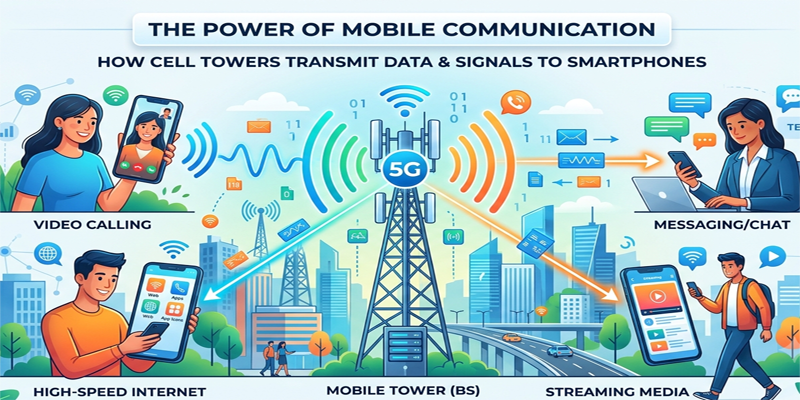
Like, it is equally interesting to know how messages and calls are delivered through WhatsApp,…
… how to browse websites, watch videos on a smartphone without any physical cable connection.
All questions discussed above can not be answered fully wihtout dive deep into the mobile communication technology.
Mobile devices are connected across cities, countries, and the world using…
… antennas, cell towers, radio waves, network infrastructure, and advanced communication protocols.
Mobile has been a very essential part of everyone’s life today. From making a simple voice call and sending text messages to accessing the internet and performing…
… online transactions, all are possible through mobile networks, which easily allow us to communicate anywhere a supporting network is available.
In this post, “How Mobile Communication Works,” we are going to explore how this communication actually takes place, the working of mobile networks…
… in depth, behind the scenes when you make a call or use mobile internet, in easy-to-understand language.
What Is Mobile Communication?
Mobile communication is the process of exchanging voice, text, images, videos, and other digital information between mobile devices through wireless networks.
Unlike traditional landline communication, which generally depends on physical cables connecting a telephone to a network, mobile communication allows devices to connect wirelessly using radio signals.
A mobile communication system typically includes the following components:
- Mobile device: A smartphone, tablet, or another cellular-enabled device.
- SIM or eSIM: Identifies the subscriber and provides credentials used to authenticate access to the mobile network.
- Cell tower and antennas: Transmit and receive radio signals between mobile devices and the network.
- Radio access network: Connects mobile devices to the operator’s network through base stations.
- Core network: Manages connectivity, mobility, authentication, and the routing of calls and data.
- External networks and services: Connect users to other mobile operators, telephone networks, websites, messaging apps, and online platforms.
All these components work together to provide seamless communication.
How Does Mobile Communication Work Step by Step?
To understand how mobile communication works, let’s consider a simple example: you make a phone call to a friend.
1. Your Mobile Phone Converts Your Voice into a Signal
When you speak into your smartphone, its microphone captures your voice as sound waves.
The phone converts these sound waves into an electrical signal and then into digital data. Voice-coding technology compresses the data so that it can be transmitted efficiently over the network.
Your phone prepares this information for wireless transmission using the communication standards supported by your device and mobile operator.
2. Your Phone Sends the Data Through Radio Waves
Your smartphone contains a radio transceiver and an antenna. The transceiver converts digital information into a radio signal that can travel through the air.
The phone transmits this signal to a nearby cellular base station.
Radio waves are a form of electromagnetic energy. They carry information without requiring a physical cable between your phone and the tower.
The distance over which your phone can communicate depends on factors such as signal strength, frequency, terrain, buildings, interference, and network design.
3. The Cell Tower Receives the Signal
A cell tower or other cellular base station receives the radio signal from your phone.
The base station processes the signal and forwards the information into the operator’s network. The network then determines how to deliver the communication to the intended recipient.
A tower often serves a particular geographic area called a cell. Mobile networks divide large areas into many cells to improve coverage and allow many devices to communicate at the same time.
The base station does more than receive signals. It also transmits signals back to mobile devices and manages radio resources for connected users.
4. The Mobile Network Processes the Communication
After the signal reaches the radio access network, it travels into the mobile operator’s core network.
The core network performs several important tasks, including:
- Checking whether the device and subscriber are authorized to use the network.
- Managing the connection between the mobile device and network.
- Routing calls, messages, or internet traffic to the appropriate destination.
- Managing mobility when a user moves from one cell to another.
- Applying relevant security and service policies.
The exact process depends on the network generation and service being used. For example, a modern 4G or 5G voice call commonly uses an IP-based voice service called Voice over LTE (VoLTE) or Voice over New Radio (VoNR), while other network arrangements may use different mechanisms.
5. The Network Sends the Communication to the Recipient
The recipient may be connected to the same mobile operator or to a different operator.
If the recipient uses another operator, the networks coordinate to deliver the call. Depending on the service, the communication may also pass through an interconnected telephone network or another service provider.
The recipient’s network identifies the destination device and routes the communication toward the appropriate serving cell.
6. The Recipient’s Phone Receives and Reconstructs the Voice
The recipient’s nearby base station transmits the information over radio waves to their phone.
The recipient’s phone receives the signal, decodes the transmitted data, and reconstructs the digital voice information into an audio signal.
Finally, the phone’s speaker converts that signal into sound.
Your friend hears your voice, even though your phones may be located far apart.
This entire process happens very quickly, allowing a normal conversation to feel almost instantaneous.
How Does Mobile Internet Work?
Mobile internet follows a similar wireless communication process, but instead of primarily carrying a voice conversation, the network transports internet data.
For example, when you open a website on your smartphone:
- You tap the website link in your browser.
- Your phone sends a request through its cellular radio connection to a nearby base station.
- The request travels through the mobile operator’s network toward the internet.
- The website’s server processes the request and sends the required information back.
- The data returns through the network and reaches your phone through the serving base station.
- Your browser processes the received data and displays the webpage.
The same basic process supports social media applications, online games, video streaming, email, and messaging services.
The speed and responsiveness of mobile internet depend on several factors, including network technology, available spectrum, signal quality, network congestion, server performance, and the capabilities of your device.
What Is the Role of a SIM Card in Mobile Communication?
A SIM card, or Subscriber Identity Module, helps identify and authenticate a subscriber on a mobile network. An eSIM provides the equivalent subscriber credentials through an embedded component in the device.
When your phone connects to a cellular network, the operator uses authentication procedures to verify that the subscription is allowed to access its services.
A SIM or eSIM is not the same as a cell tower, and it does not transmit your calls directly to another phone. Instead, it provides subscriber credentials that help your device establish authorized access to the network.
Your phone’s radio hardware handles the wireless communication, while the SIM or eSIM supports subscriber identification and authentication.
Why Are Cell Towers Important?
Cell towers and their antennas are essential because they provide the radio connection between mobile devices and the operator’s network.
Without suitable radio coverage, a phone generally cannot access its operator’s cellular services.
Cellular networks use many base stations rather than relying on one powerful transmitter to cover an entire country. This approach helps increase capacity and enables devices to connect to a suitable nearby cell.
Cell towers are important for several reasons:
- Coverage: They help provide mobile connectivity across cities, towns, highways, and rural areas.
- Capacity: Multiple cells allow networks to serve many users simultaneously.
- Mobility: Networks can transfer an active connection from one cell to another as a user moves.
- Data transmission: They provide the radio link used to access voice and internet services.
Base stations are also connected to the rest of the network through backhaul connections, which may use optical fibre, microwave links, or other suitable technologies.
What Happens When You Move While Using Your Phone?
Have you ever continued a phone call while travelling in a car or walking down a street? This is possible because of a process known as handover or handoff.
As you move, your phone and the network monitor radio conditions and other relevant measurements. When another cell becomes a better serving option, the network coordinates a transfer of the connection.
The process generally involves these stages:
- Your phone communicates with its current serving cell.
- The phone and network assess radio conditions and possible target cells.
- The network coordinates the transfer to a suitable cell.
- Your phone establishes the required radio connection with the new cell.
- The communication continues, ideally without a noticeable interruption.
The exact procedure varies between 4G, 5G, and other network technologies. If coverage is poor or the network cannot complete the transfer, a call or data session may be interrupted.
How Have 2G, 3G, 4G, and 5G Changed Mobile Communication?
Mobile communication has evolved significantly over the years. Each generation has introduced improvements in capacity, speed, service capabilities, or network architecture.
2G: Digital Mobile Communication
Second-generation networks introduced digital cellular communication on a large scale. They supported digital voice calls and text messaging, with technologies such as GSM and CDMA-based systems.
3G: Mobile Internet Becomes More Practical
Third-generation networks improved mobile data capabilities, making services such as web browsing, email, and early mobile video applications more practical.
4G: High-Speed Mobile Broadband
Fourth-generation technology, particularly LTE, brought significant improvements in mobile broadband performance. It supports modern applications such as HD video streaming, video calls, online gaming, and IP-based voice services.
5G: Greater Capacity and New Network Capabilities
Fifth-generation networks are designed to support higher data rates, increased capacity, improved responsiveness in suitable conditions, and a wider range of connected devices and applications.
Actual performance depends on spectrum availability, network deployment, signal conditions, device support, and traffic demand. A newer generation does not automatically guarantee better service in every location.
Is Mobile Communication Secure?
Mobile networks use security mechanisms to help protect subscriber identities, authenticate devices, and secure communications over parts of the network.
However, mobile security involves more than the cellular connection alone. The protection provided also depends on the network generation, operator configuration, applications, device software, and the services being used.
For example, end-to-end encryption in a messaging application can provide additional protection for message content between communicating users. Ordinary cellular connectivity by itself should not be assumed to provide end-to-end encryption for every type of communication.
Users can improve their security by keeping their phones updated, using trusted applications, setting a strong screen lock, and being careful with suspicious links and messages.
What Are the Main Factors That Affect Mobile Signal Strength?
Sometimes your phone displays a strong signal, while at other times calls drop or mobile internet becomes slow. Several factors can explain these differences:
- Distance from the base station: Greater distance can weaken the received signal.
- Buildings and physical obstacles: Walls, underground locations, hills, and other obstacles can reduce radio signal strength.
- Network congestion: Too many active users sharing limited network resources can reduce performance.
- Frequency band: Different frequencies have different propagation characteristics and coverage trade-offs.
- Weather and environment: Environmental conditions can affect some radio links, although buildings, terrain, interference, and network loading are often more important factors for everyday cellular performance.
- Device capabilities: Your phone’s supported frequency bands, antenna design, and modem capabilities can affect connectivity.
A strong signal does not always mean fast internet. Signal quality, available capacity, interference, and the operator’s network configuration also matter.
Conclusion
Friends, in this post, we have understood “how mobile communication works“. It is a very sophisticated process allowing people to share and exchange information wirelessly across short and long ranges. First upon making any call or using internet in your phone, it communicate with your nearby cellular base station using radio waves. The radio access network connects your device to the mobile operator’s core network, which authenticates access, manages connectivity, and routes communication to the intended destination.
The recipient’s device then receives and processes the transmitted information, allowing a voice conversation, message exchange, or internet session to take place. From early digital networks to modern 5G systems, mobile communication continues to evolve, becoming more capable and supporting a growing range of digital services(how mobile communication works).
If you have any queries, you can write to us at support@a5theory.com; we will get back to you ASAP.
Hope! You will have enjoyed this post, “How Mobile Communication Works“.
Please feel free to give your feedback in the comment section below.
Have a great time!