

हेलो दोस्तों आज इस ब्लॉग पोस्ट(After vs Later And Before vs Ago vs Back vs Earlier In Hindi.) में हम आपको कुछ ऐसी prepositions के बारे में बताने वाले है जिनका उपयोग हम ‘पहले’ और ‘बाद’ के लिए करते है |
वैसे सामान्यतः आप लोग जानते है कि पहले के लिए हम Before का उसे करते है और बाद के लिए हम After का उपयोग करते है |After vs Later And Before vs Ago vs Back vs Earlier In Hindi.|
पर इसके अलावा कुछ और Adverbs होती है जैसे कि Ago , Back , Earlier , Earlier than , Later , etc .|After vs Later And Before vs Ago vs Back vs Earlier In Hindi.|
इन सारी Adverbs का उपयोग भी ‘पहले’ और ‘बाद’ के लिए किया जाता है |After vs Later And Before vs Ago vs Back vs Earlier In Hindi.|
पर किस Adverbs का उपयोग कब किया जाना है यह हम आज इस ब्लॉग पोस्ट(After vs Later And Before vs Ago vs Back vs Earlier In Hindi.) के माध्यम से देखेंगे |
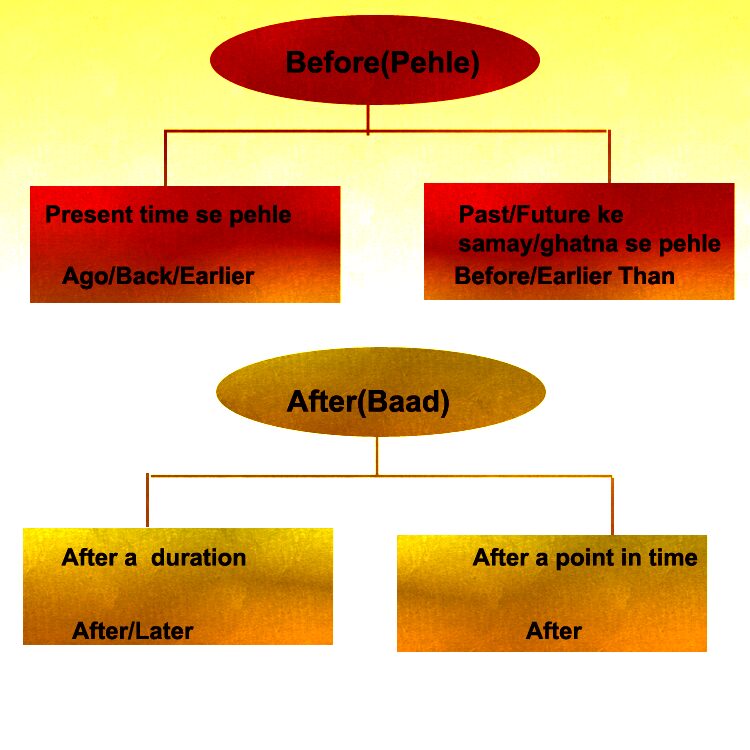
Ago /Back /Earlier : Present के इस वक़्त से पहले –
इनका उपयोग हम तब कर सकते है जब हम आज के प्रेजेंट समय, इस पल से पहले की बात कर रहे हो|
कहने का मतलब यह है कि प्रेजेंट टाइम के पहले की कोई भी बात हो रही हो तो फिर हम इनमे से किसी भी use कर सकते है |
Examples :
मै राकेश से 2 दिन पहले मिला |
I met rakesh 2 days ago.
वो मुझे 5 मिनट पहले कॉल कर रहा था |
He was calling me 5 min. ago.
एक हफ्ते पहले ही वो मेरे घर आया था |
Just a week ago, he had visited my house.
बहुत पहले यहाँ जंगल हुआ करता था |
Long ago, there used to be a forest here.
Before /Earlier than : Past /Future के समय/घटना से पहले-
इनका उपयोग हम तब करते है जब Past अथवा Future के किसी समय अथवा घटना के पहले की बात हो रही हो |
कहने का मतलब यह है कि specific Past time के पहले की बात हो या फिर specific Future टाइम के पहले की बात हो |
Examples :
ट्रेन आपके आने से 10 मिनट पहले निकल गयी थी |
The train had left 10 min before you came.
वो exam शुरू होने से 2 महीने पहले स्कूल गया था |
He had gone to school 2 months before the exam started.
मेरी सैलरी आपकी सैलरी से 10 दिन पहले मिलेगी |
My salary will be paid 10 days before yours.
नहाने जाने से ठीक एक मिनट पहले मैंने उससे बात की थी |
I had spoken with him just a minute before I went to take a bath.
चलिए अभी तक हमने उन prepositions को देखा जिनका उपयोग हम ‘पहले ‘ के लिए करते है |
अब हम उन prepositions को देखेंगे जिनका उपयोग हम ‘बाद’ के लिए करते है |
बाद के लिए हम After . Later , का use करते है |
पर अब हम यह देखते है कि हम किस प्रपोज़िशन का use कब कब करते है ‘बाद’ के लिए |
After /Later : duration के बाद –
जब किसी duration के बाद की बात हो रही हो तो फिर हम After या फिर Later का use करते है |
Examples :
मैं तुमसे 10 घंटे बाद मिलूंगा |
I will meet you after 10 hours.
I will meet you 10 hours later.
वो चार दिन बाद अमेरिका जायेगा |
He will go to america after 4 days.
He will go to america 4 days later.
मै तुमसे 10 बजे के बाद मिलूंगा |
I will meet you after 10 o’clock.
वो सोमवार के बाद अमेरिका जायेगा |
He will go to america after monday.
आज हम चार साल बाद फ़ोन पर बात कर रहे है |
Today, we are talking over the phone after four years.
Today, we are talking over the phone four years later.
मै पार्क से आने के बाद अपना होमवर्क कम्पलीट करूँगा |
I will complete my homework after I come back from the park.
After: point in time के बाद –
जब किसी point in time अथवा किसी specific time के बाद की बात हो रही हो तो इस जगह पर हम After का use करते है |
अगर ‘बाद’ के दोनों case में आप देखो तो हम After का उपयोग दोनों ही situation में कर सकते है |
Examples :
मै तुमसे 10 बजे के बाद मिलूंगा |
I will meet you after 10 o’clock.
मै पार्क से आने के बाद अपना होमवर्क कम्पलीट करूँगा |
I will complete my homework after I come back from the park.
नोट:- ‘बाद’ के sense के लिए After का उपयोग आप हमेशा कर सकते है फिर चाहे वहां पर duration of time हो या फिर पॉइंट इन टाइम हो |
और duration के case में केवल आप Later का भी use कर सकते है |
अभी तक हमने After और Before का use ‘बाद’ sense के लिए देखा |
पर क्या आप जानते है कि इन prepositions का उपयोग हम और भी कुछ sense के लिए करते है |
अगर आप नहीं जानते है तो फिर आप नीचे इन्हे विस्तार से examples के साथ देख सकते है |
After : के बाद, किसी के पीछे पड़ना –
After का use हम ‘के बाद’ और ‘किसी के पीछे पड़ना’ वाले sense के लिए भी करते है |
Examples :
मै इस प्रोजेक्ट को पूरा करने में मदद करने के लिए अपने प्रोफेसर के पीछे पड़ गया था |
I was after my professor to help me complete this project.
मेरे पापा ने पैसे देने से तीन बार मना कर दिया है पर मै अभी भी उनके पीछे पड़ा हुआ हूँ |
My father has refused to give money thrice but I am still after him.
पुलिस चोर के पीछे कल शाम से पड़ी हुई थी |
The police had been after the theif since yesterday evening.
Before : पहले, सामने –
Before का उपयोग हम ‘पहले’ के साथ साथ ‘सामने’ के sense के लिए भी करते है |
Examples :
अब मै आपके सामने खड़ा हूँ |
Now, I am standing before you.
दर्शको के सामने नर्वस मत होना |
Don’t get nervous before the audience.
वो मेरे सामने बोलने की हिम्मत नहीं कर सकता |
He can’t dare to speak before me.
Quick Q&A:
What is the difference between ago before and earlier? Ago , Before , Earlier में क्या अंतर है ?
देखिये इन सभी का उपयोग हम ‘पहले’ sense के लिए करते है |
Ago , और Earlier का उपयोग प्रेजेंट टाइम के reference में किया जाता है |
कहने का मतलब प्रेजेंट टाइम के पहले की बात होने पर हम ago अथवा earlier का उपयोग करते है |
और before का उपयोग past अथवा future के reference में किया जाता है |
कहने का मतलब past अथवा future के किसी time के पहले की बात बताने के लिए |
और इनमे एक अंतर यह भी है कि ago और earlier एक adverb है वही दूसरी तरफ before जो है वो एक preposition है |
What is the difference between ago and back? Ago और back में क्या अंतर है ?
देखिये ago और back दोनों ही adverb है और दोनों ही ‘पहले’ sense के लिए उपयोग की जाती है |
दोनों ही similar है और हम दोनों में से किसी का भी use कर ले कोई problem नहीं है |
इन दोनों के use हम प्रेजेंट टाइम के पहले की बात बताने के लिए करते है |
Is it 12 years ago or ago? 12 years ago और 12 years back दोनों में से कौन सा सही है ?
ये दोनों ही सही है | दोनों का ही उपयोग प्रेजेंट टाइम के पहले की बात बताने के लिए करते है |
Is earlier and before the same? क्या earlier और before same है ?
वैसे सामान्यतः तो लोग इन दोनों का उपयोग कर लेते है बोलचाल में और सामने वाला बात को समझ भी लेता है |
पर अगर आप ग्रामर की दृष्टि से देखे तो फिर before जो है वो एक preposition है|
और इसका उपयोग हम past अथवा future के किसी टाइम के पहले की बात को बताने के लिए करते है |
वही दूसरी तरफ earlier एक adverb है |
और इसका उपयोग हम present time के पहले की बात बताने के लिए करते है |
Is later and ago the same? क्या Later और ago same है ?
नहीं यह दोनों ही अलग अलग है |
और अपने अपने तरीके से उपयोग किये जाते है |
Later का मतलब होता है ‘बाद अथवा बाद में ‘ वही ago का उसे हम ‘पहले’ के सेंस के लिए करते है |
Later का उसे हम एक duration के बाद की बात बताने के लिए करते है |
वही ago का उसे हम प्रेजेंट टाइम के पहले की बात बताने के लिए करते है |
What is the synonym of ago? Ago के synonyms क्या होते है ?
Ago के synonyms है back, earlier, in the past, previously |
इस ब्लॉग(After vs Later And Before vs Ago vs Back vs Earlier In Hindi.) को लेकर आपके मन में कोई भी प्रश्न है तो आप हमें इस पते support@a5theory.comपर ईमेल लिख सकते है|
आशा करता हूँ, कि आपने इस पोस्ट(After vs Later And Before vs Ago vs Back vs Earlier In Hindi.) को खूब एन्जॉय किया होगा|
आप स्वतंत्रता पूर्वक अपना बहुमूल्य फीडबैक और कमेंट यहाँ पर दे सकते है|After vs Later And Before vs Ago vs Back vs Earlier In Hindi.|
आपका समय शुभ हो|
Way cool! Some extremely valid points! I appreciate you penning this post and the rest of the website is very good.
It’s very trouble-free to find out any matter on web as compared to textbooks, as I found this article at this web page.
I always used to read article in news papers but now as I am a user of internet thus from now I am using net for articles or reviews, thanks to web.
Thank you for some other fantastic post. The place else may anybody get that type of information in such an ideal method of writing? I’ve a presentation next week, and I am on the search for such information.
I am sure this piece of writing has touched all the internet people, its really really fastidious article on building up new blog.
You’ve made some good points there. I looked on the internet for more information about the issue and found most people will go along with your views on this website.
What’s Happening i am new to this, I stumbled upon this I have found It absolutely helpful and it has helped me out loads. I hope to contribute & help other customers like its aided me. Great job.
Every weekend i used to visit this site, as i want enjoyment, as this this site conations actually nice funny data too.
Glad to be one of many visitors on this awing internet site :D.
Pretty! This has been a really wonderful post. Thanks for supplying this information.
I’llright awa taske old of your rss feesd ass I cann nnot find your emaill subscription lijk oor newslettewr service. Do you hae any? Please llet mme realize so that I culd subscribe. Thanks.
Whoa! This blog looks exactly like my old one! It’s on a completely different subject but it has pretty much the same page layout and design. Wonderful choice of colors!
This website is truly impressive, filled with valuable and practical information. I’ve already recommended it to a number of my friends, and I’ll be sharing some of the most interesting details as well. It’s rare to come across such a well-organized and informative resource, and I really appreciate the effort that has gone into creating it. Thank you sincerely for all the hard work—you’ve made learning and sharing knowledge both enjoyable and worthwhile. Keep up the great work!
You could definitely see your expertise in the paintings you write. The sector hopes for more passionate writers such as you who aren’t afraid to mention how they believe. All the time follow your heart.
These are in fact impressive ideas in regarding blogging. You have touched some nice points here. Any way keep up wrinting.
Great post! Clear insights, practical examples, and engaging writing made this an enjoyable read. Thanks for sharing valuable perspectives that sparked new ideas today here.
You’ve made some decent points there. I checked on the internet for more info about the issue and found most people will go along with your views on this site.
Yay google is my king assisted me to find this great internet site!
Everyone loves it when individuals come together and share opinions. Great site, keep it up!
Great insights in this post! I especially appreciated the clear examples and practical tips. Looking forward to reading more of your thoughtful content soon.
There is definately a great deal to know about this issue. I like all of the points you made.
You made some decent points there. I looked on the net for more info about the issue and found most individuals will go along with your views on this web site.
Hi, I do believe this is a great site. I stumbledupon it 😉 I am going to return once again since i have book marked it. Money and freedom is the greatest way to change, may you be rich and continue to help others.
I like it when folks come together and share views. Great website, continue the good work!
You have made some decent points there. I looked on the net for additional information about the issue and found most individuals will go along with your views on this web site.
I want to to thank you for this wonderful read!! I certainly enjoyed every little bit of it. I have got you book marked to check out new stuff you
Ahaa, its nice dialogue concerning this post at this place at this blog, I have read all that, so now me also commenting at this place.
I will immediately snatch your rss feed as I can not in finding your email subscription link or e-newsletter service. Do you’ve any? Please permit me know so that I may subscribe. Thanks.
Many students appreciate that Go Study Russia doesn’t just help with applications but also offers pre-departure guidance for a smooth transition abroad. They connect students with cultural orientation materials and help them prepare for life in Russia. For those planning to study MBBS abroad, having this extra support reduces confusion and helps with study abroad decision-making.
Experience Fun Clicker, the viral psychological horror sensation. Tap the smiley face, unlock terrifying upgrades, and uncover dark secrets online today.
Impostor Juego Online – Juega Gratis al Juego del Impostor
Test your GPU instantly with professional volumetric ray marching. No install needed. Compare scores on global leaderboard for PC, Mac, iPhone & Android.
Enter The Freak Circus online. A dark horror visual novel of twisted romance. Survive the deadly obsession of Pierrot and Harlequin in this fan game portal.
Endfield Calculator: The ultimate tool for Arknights: Endfield. Plan complex factory production, optimize resource chains, and build the perfect efficient base.
This is an outstanding post, and I genuinely enjoyed reading it. It’s rare to find content that feels fresh, insightful, and distinct from the usual material we encounter every day. The ideas were presented in a way that was both engaging and memorable. Pieces like this are uncommon and truly deserve recognition for the value they offer. It’s always refreshing to come across something that captures your interest and leaves a lasting impression.