

Introduction
Hello Friends, in this blog post(Think in English), we are going to discuss a few amazing techniques to think in English without any prior translation in our mind.
It is seen on a broader scale that most of the people first think in their native language and then translate it into english specially in the beginning phase of spoken English learning.
So if you are doing the same, then you don’t have to worry at all, as this is a very common problem for most of the people. And this is considered a main problem or obstacle while speaking English.
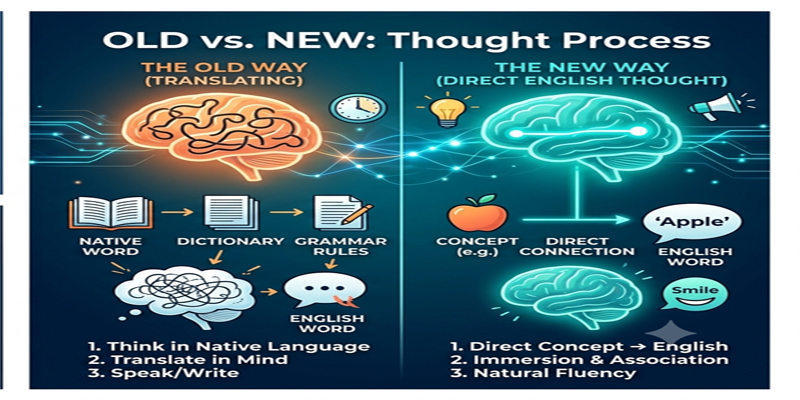
This problem affects your English speaking in many ways. It slows down your thinking process and sentence delivery in English.
Sometimes it also creates a hesitating scenario, which often makes you make grammatical mistakes.
People who speak fluent English don’t translate each sentence; rather, they directly think in English
The best thing for you is that thinking in English is a skill that you can master with regular practice.
It does not require relocating to relocate in english speaking countries or collecting some very advanced vocabulary.
If you follow the right techniques explained in this blog post above consistently, then it would be very easy to train your brain for processing ideas in English naturally.
In this post(Think in English), we are going to explore a few amazing practical techniques to stop translating and directly think in English.
Why Do We Translate in Our Minds?
Most learners begin by learning English through their native language. This creates a habit of translating every thought before speaking.
For example:
Native language → English → Speak
This extra step slows down conversations and makes you lose confidence.
The goal is to make your brain work like this:
Thought → English → Speak
This makes communication faster and more natural.
Benefits of Thinking in English
Learning to think in English offers many advantages:
- Speak more fluently.
- Respond more quickly in conversations.
- Improve pronunciation naturally.
- Build confidence.
- Reduce grammatical mistakes.
- Understand English more easily.
The less you translate, the smoother your communication becomes.
1. Start with Simple Thoughts
Don’t begin with difficult topics.
Instead, think about everyday activities.
Examples
- I’m brushing my teeth.
- I’m making tea.
- It’s raining today.
- I need to buy vegetables.
- I’m getting ready for work.
These simple thoughts train your brain to use English naturally.
2. Describe Your Surroundings
Wherever you are, describe what you see in English.
Example
You’re sitting in your room.
Think:
- The room is clean.
- The window is open.
- My laptop is on the table.
- The fan is running.
- I need to organize my books.
This exercise improves vocabulary and sentence formation.
3. Stop Looking for Perfect Words
Many learners stop speaking because they can’t remember one specific word.
Instead of remaining silent, use simpler words.
Example
Instead of:
“I forgot the word for…” (hesitation)
Say:
“It’s the machine we use to wash clothes.”
Even if you don’t remember “washing machine,” you can still communicate effectively.
The goal is communication, not perfection.
4. Learn Ready-to-Use English Phrases
Thinking becomes easier when you know common expressions.
Examples
- I think…
- In my opinion…
- I don’t know.
- That’s interesting.
- Let me check.
- It depends.
- I agree.
- I don’t think so.
These phrases help you respond quickly without translating.
5. Talk to Yourself in English
Self-talk is one of the best fluency exercises.
Describe your daily routine aloud.
Example
“I’m making breakfast.”
“I have an important meeting today.”
“I should finish my work before lunch.”
This builds confidence without the pressure of speaking to others.
6. Read and Think at the Same Time
While reading an English article or book:
- Understand the idea.
- Avoid translating every sentence.
- Visualize what you’re reading.
Visualization helps your brain connect directly with English.
7. Watch English Content Without Constant Translation
Choose beginner-friendly videos.
Instead of translating every sentence:
- Focus on understanding the main idea.
- Observe expressions.
- Notice sentence patterns.
Over time, your brain will naturally recognize common structures.
8. Build Vocabulary by Topics
It’s easier to think in English when words are organized.
Example Categories
Kitchen
- Spoon
- Plate
- Knife
- Cup
- Refrigerator
Office
- Laptop
- Meeting
- Project
- Deadline
Knowing related words together makes recall faster.
9. Practice Mental Conversations
Imagine real-life situations.
Example
Someone asks:
“What did you do yesterday?”
Answer mentally:
“I visited my grandparents, watched a movie, and completed my homework.”
This prepares you for actual conversations.
10. Don’t Fear Mistakes
Many learners stop thinking in English because they’re afraid of using incorrect grammar.
Remember:
Thinking is practice.
Nobody is judging your thoughts.
Focus on expressing ideas rather than creating perfect sentences.
Daily Practice Plan
Morning (10 Minutes)
Think about your plans for the day in English.
Afternoon (10 Minutes)
Describe your surroundings or current activity.
Evening (15 Minutes)
Watch an English video and summarize it mentally in English.
Night (10 Minutes)
Recall your day using simple English sentences.
Common Challenges and Solutions
Challenge 1: Limited Vocabulary
Solution
Learn useful words related to your daily life instead of memorizing random vocabulary.
Challenge 2: Fear of Mistakes
Solution
Remember that making mistakes is a natural part of learning. Focus on communicating your ideas rather than speaking perfectly.
Challenge 3: Slow Thinking
Solution
Practice with short and simple sentences. Speed improves naturally with regular use.
Challenge 4: Translating Automatically
Solution
Whenever you notice yourself translating, pause and try expressing the idea using simpler English words.
Tips for Faster Progress
- Read English every day.
- Speak aloud regularly.
- Learn phrases instead of isolated words.
- Watch English videos.
- Listen to podcasts.
- Practice self-talk.
- Think in English during daily activities.
Small daily habits produce significant long-term improvement.
Frequently Asked Questions
Is thinking in English necessary for fluency?
Yes. It reduces hesitation and helps you respond more naturally during conversations.
How long does it take to think in English naturally?
It varies from person to person. With consistent daily practice, many learners notice improvement within a few months.
Should beginners try thinking in English?
Absolutely. Start with simple words and short sentences. As your vocabulary grows, your ability to think in English will improve as well.
Conclusion
Friends, in this blog post(Think in English), we have gone through some fantastic techniques to start thinking in English. If you really want to be a fluent English speaker, then it is very important to think in English before speaking. You may have some difficulties in the beginning, but once you practice it regularly, you will be able to instruct your brain to process the ideas directly in English.
In the beginning, you can start with some very simple thoughts. You can start thinking about ideas related to your surroundings and neighbourhood, and start self-talk in English. Instead of perfection or grammar, your focus should be on communication. Soon you will find you don’t need to translate every sentence anymore before speaking.
This is the fact that fluency does not come from knowing everything; rather, it is the game of expressing your ideas confidently in a natural way.
If you have any queries, you can write to us at support@a5theory.com; we will get back to you ASAP.
Hope! You would have enjoyed this post(Think in English).
Please feel free to give your important feedback in the comment section below.
Have a great time!