

Introduction
Hello Friends, in this blog post(Business English for Beginners), we will let you know about Business English skills.
In today’s time, we have a global network to work with, and that obviously needs a communication medium that could be common and general across the world.
English is that medium, as it is an international language, and the whole world can be connected with this one single language.
It is the most widely spoken language(Business English for Beginners) for communication across the globe.
Business English skills help you very effectively and make you grow professionally whether you apply for your…
… very first job, work in an MNC, work as a freelancer for international clients, or run your own business or startups.
This English has some differences compared to the ordinary day-to-day English.
It’s prime focus remains on the normal official communication that you see in offices, emails, meetings, interviews, presentations, customer support, and team discussions.
The best thing about this is that you don’t need to go for a separate English course to learn this official communication.
You just have to learn some common expressions, the right vocabulary, along with some polite habits.
By practicing this, you can create a huge difference in your English communication and easily make it appropriate for official or business communication.
In this post(Business English for Beginners), we will explore some common and necessary business English words along with phrases that every new learner should know.
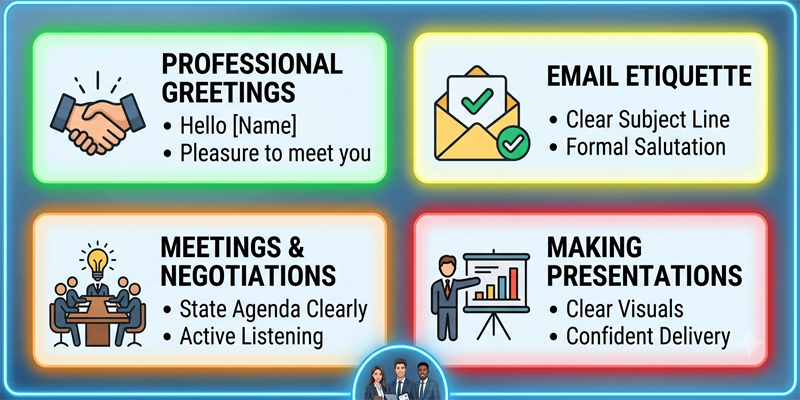
What Is Business English?
Business English refers to the English language used in professional and workplace environments. It includes vocabulary, expressions, and communication styles commonly used in business settings.
Examples include:
- Writing professional emails
- Participating in meetings
- Giving presentations
- Speaking with clients
- Discussing projects
- Negotiating with colleagues or customers
Business English emphasizes clarity, politeness, and professionalism.
Why Is Business English Important?
Learning Business English can help you:
- Communicate confidently at work.
- Improve your chances of getting hired.
- Build stronger relationships with colleagues and clients.
- Write professional emails and reports.
- Participate effectively in meetings.
- Work with international teams.
Strong communication skills are often just as valuable as technical skills.
Essential Business Vocabulary
Here are some common workplace words every beginner should know:
| Word | Meaning |
|---|---|
| Client | A customer who receives professional services |
| Customer | A person who buys products or services |
| Project | A planned piece of work |
| Deadline | The final date for completing a task |
| Meeting | A discussion between people for work purposes |
| Presentation | A formal talk with information or ideas |
| Schedule | A plan of activities or appointments |
| Agenda | A list of topics to discuss in a meeting |
| Proposal | A formal suggestion or plan |
| Report | A document containing information or findings |
| Feedback | Comments or suggestions for improvement |
| Target | A goal to achieve |
| Budget | A financial plan |
| Revenue | Income earned by a business |
| Profit | Money earned after expenses |
| Invoice | A bill requesting payment |
| Contract | A legal agreement |
| Department | A division within a company |
| Manager | A person who supervises a team |
| Colleague | A person you work with |
Common Business English Phrases
These expressions are frequently used in professional conversations.
Starting a Conversation
- Good morning. How are you today?
- It’s nice to meet you.
- Thank you for your time.
- I appreciate your help.
Asking for Information
- Could you explain that, please?
- Could you provide more details?
- Would you mind clarifying this point?
- May I ask a question?
Giving Opinions
- In my opinion…
- I believe…
- From my perspective…
- I agree with that point.
- I have a different opinion.
Making Suggestions
- I suggest that we…
- How about trying…?
- Perhaps we could…
- It might be better to…
Agreeing and Disagreeing Politely
Agreeing:
- Absolutely.
- I completely agree.
- That’s a good idea.
Disagreeing:
- I understand your point, but…
- I see it differently.
- That’s an interesting perspective.
Business Email Expressions
Professional emails should be polite, clear, and concise.
Opening
- Dear Mr. Sharma,
- Dear Ms. Patel,
- Hello John,
Beginning
- I hope you’re doing well.
- Thank you for your email.
- I’m writing regarding…
Requesting Information
- Could you please send…
- Would you be able to…
- Kindly let me know…
Closing
- Thank you for your time.
- I look forward to your response.
- Best regards,
- Kind regards,
- Sincerely,
English for Meetings
Useful expressions during meetings include:
- Let’s begin the meeting.
- Shall we start?
- Today’s agenda includes…
- Let’s discuss the next topic.
- Could you share your thoughts?
- That’s a valuable suggestion.
- Let’s summarize today’s discussion.
- Thank you, everyone.
Presentation English
When giving presentations, use clear transition phrases.
Starting
- Good morning, everyone.
- Thank you for joining today.
Moving Between Points
- First…
- Next…
- Let’s move on to…
- Another important point is…
Ending
- Thank you for your attention.
- Are there any questions?
Telephone and Online Communication
Useful phrases include:
- May I speak with Mr. Singh?
- Could you repeat that, please?
- The connection isn’t very clear.
- I’ll call you back shortly.
- Can everyone hear me?
- You’re on mute.
- Could you share your screen?
These expressions are especially useful for virtual meetings.
Workplace Etiquette in English
Professional communication is about more than vocabulary.
Remember to:
- Be polite.
- Listen carefully.
- Avoid interrupting others.
- Respect different opinions.
- Respond professionally, even during disagreements.
- Thank people for their assistance.
Good manners strengthen workplace relationships.
Tips to Improve Business English
Read Business Articles
Business news helps you learn professional vocabulary in context.
Write Professional Emails
Practice writing clear and polite emails.
Watch Business Presentations
Observe how experienced speakers communicate.
Learn Industry-Specific Vocabulary
If you work in IT, healthcare, finance, or marketing, focus on words commonly used in your field.
Practice Speaking
Use business expressions during mock meetings or discussions with friends or colleagues.
Common Mistakes to Avoid
❌ Using slang in formal emails.
❌ Writing overly long sentences.
❌ Using informal greetings like “Hi buddy” in professional communication.
❌ Ignoring grammar and punctuation.
❌ Being too direct when making requests.
Instead, use polite expressions such as:
- Could you please…
- Would you mind…
- I’d appreciate it if…
Practice Exercises
Exercise 1
Write a short email requesting a meeting with a client.
Exercise 2
Introduce yourself as a new employee in five sentences.
Exercise 3
Use these words in your own sentences:
- Deadline
- Proposal
- Feedback
- Agenda
- Project
Frequently Asked Questions
Is Business English different from general English?
Yes. Business English focuses on professional communication, workplace vocabulary, meetings, presentations, and formal writing.
Can beginners learn Business English?
Absolutely. Start with common workplace words, polite expressions, and simple email writing. Build your vocabulary gradually through regular practice.
How can I improve my Business English?
Read business articles, practice writing emails, watch professional presentations, and use workplace vocabulary in daily conversations.
Key Takeaways
- Business English is essential for professional communication.
- Learn common workplace vocabulary and expressions.
- Use polite language in emails and meetings.
- Practice writing and speaking regularly.
- Good communication skills can improve your career opportunities.
Conclusion
Friends, in this blog post(Business English for Beginners) we have learnt about business English communication. This is one of the most valuable skills that could greatly help you in many contexts, such as better job opportunities, stronger workplace relationships, and professional growth. For gettting a good command of this business English, you don’t need to be a master of grammar; rather, you should focus on polite expression, clear language, and necessary official vocabulary or words.
But without practice, you can never achieve this goal, so practice these words and phrases regularly in your daily routine work, emails, and conversations. If you do this with full consistency and confidence, you will soon become a master of this business English communication skill. |Business English for Beginners|
If you have any queries, you can write to us at support@a5theory.com; we will get back to you ASAP.
Hope! You would have enjoyed this post(Business English for Beginners).
Please feel free to give your important feedback in the comment section below.
Have a great time!