

Hello Friends, in this blog post(Atoms, Molecules, and Elements), we are going to tell you about the basic building blocks that are the reasons behind everything that we see.
Here we are going to discuss atoms, Molecules, and elements. Everything that you see, including you, is made of very tiny particles.
But you can not see them through your naked eye as they are very small. |Atoms, Molecules, and Elements|
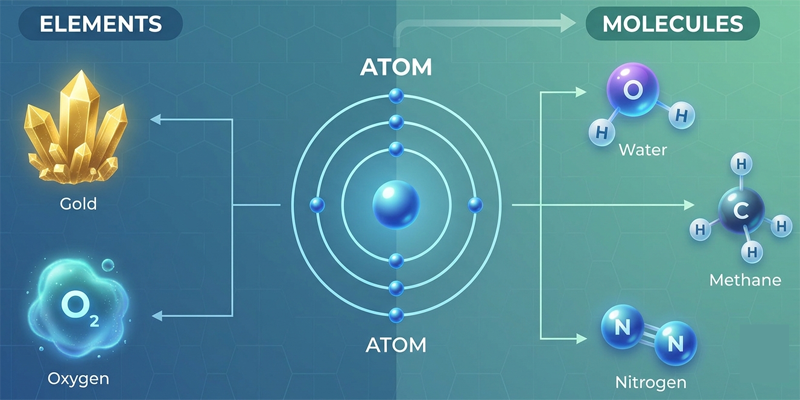
Atoms are nothing but tiny building blocks. They transform into molecules when they join together.
An element is formed when the same kind of atoms join together.
They are also considered the basic blocks of chemistry; you must have heard this name as a subject in your study days.
To understand chemistry better, you must understand these atoms, molecules, and elements first.
In this post(Atoms, Molecules, and Elements), we are going to discuss all these basic building blocks in a very easy-to-understand manner.
What Is Matter?
Before learning about atoms, let’s understand matter.
Matter is anything that has mass and occupies space.
Everything around us is matter.
Examples include:
- Air
- Water
- Wood
- Iron
- Plastic
- Your body
- A pencil
- A book
Scientists discovered that all matter is made up of extremely tiny particles called atoms.
What Is an Atom?
An atom is the smallest unit of an element that retains its chemical properties.
Atoms are incredibly small. In fact, millions of atoms could fit across the width of a human hair!
Think of an atom as a single LEGO® brick. One brick is useful, but many bricks joined together can build something much larger.
Structure of an Atom
Every atom has three main particles:
| Particle | Charge | Location |
|---|---|---|
| Proton | Positive (+) | Nucleus |
| Neutron | No charge (0) | Nucleus |
| Electron | Negative (-) | Around the nucleus |
The nucleus is the dense center of the atom, containing protons and neutrons. Electrons move around the nucleus in regions called energy levels or shells.
What Is an Element?
An element is a pure substance made up of only one type of atom.
Every atom in an element has the same number of protons.
Examples of common elements include:
| Element | Symbol |
|---|---|
| Hydrogen | H |
| Oxygen | O |
| Carbon | C |
| Nitrogen | N |
| Iron | Fe |
| Gold | Au |
| Silver | Ag |
| Copper | Cu |
There are 118 known elements, and together they form everything in the universe.
What Is the Periodic Table?
The Periodic Table is a chart that organizes all known elements based on their atomic structure and properties.
It helps scientists predict how elements behave and how they react with one another.
Some familiar elements from the periodic table include:
- Oxygen – essential for breathing
- Hydrogen – a component of water
- Carbon – the basis of life
- Iron – used in construction and manufacturing
- Gold – used in jewelry and electronics
We’ll explore the Periodic Table in detail in a future blog.
What Is a Molecule?
A molecule is formed when two or more atoms join together through chemical bonds.
These atoms may be the same or different.
Examples:
| Molecule | Atoms Present |
|---|---|
| Oxygen (O₂) | Two oxygen atoms |
| Nitrogen (N₂) | Two nitrogen atoms |
| Water (H₂O) | Two hydrogen + one oxygen atom |
| Carbon Dioxide (CO₂) | One carbon + two oxygen atoms |
Molecules are the smallest units of substances that can exist independently.
What Is a Compound?
A compound is a substance formed when atoms of different elements chemically combine in a fixed ratio.
Examples:
| Compound | Formula |
|---|---|
| Water | H₂O |
| Carbon Dioxide | CO₂ |
| Common Salt | NaCl |
| Ammonia | NH₃ |
| Glucose | C₆H₁₂O₆ |
Compounds often have properties that are very different from the elements that make them up.
For example:
- Sodium is a highly reactive metal.
- Chlorine is a poisonous gas.
- Together, they form table salt (NaCl), which we use every day.
Atom vs Molecule vs Element vs Compound
| Feature | Atom | Molecule | Element | Compound |
|---|---|---|---|---|
| Smallest unit | Yes | No | No | No |
| Made of atoms | One | Two or more | One type | Different types |
| Can exist independently | Sometimes | Yes | Yes | Yes |
| Example | Hydrogen atom | H₂ | Oxygen | Water (H₂O) |
How Atoms Join Together
Atoms combine to become more stable.
They form chemical bonds by sharing, gaining, or losing electrons.
The main types of chemical bonds are:
- Covalent Bond – atoms share electrons.
- Ionic Bond – atoms transfer electrons.
- Metallic Bond – found in metals.
These bonds are responsible for creating the wide variety of substances around us.
Real-Life Examples
Water
Every drop of water contains billions of H₂O molecules.
Each molecule has:
- Two hydrogen atoms
- One oxygen atom
Air
The air we breathe contains several molecules:
- Nitrogen (N₂)
- Oxygen (O₂)
- Carbon dioxide (CO₂)
- Water vapor (H₂O)
Diamond and Graphite
Both are made entirely of carbon atoms, but the arrangement of those atoms is different.
That’s why:
- Diamond is one of the hardest natural substances.
- Graphite is soft enough to be used in pencils.
Fun Facts
- A single drop of water contains an enormous number of molecules.
- Your body is made up of trillions of cells, and each cell contains countless atoms.
- Carbon is often called the “element of life” because all known living organisms contain carbon.
- Gold and silver have been used for thousands of years because they resist corrosion.
- Helium is lighter than air, which is why it is used in balloons.
Common Misconceptions
Myth: Atoms are the smallest particles in the universe.
Fact: Atoms are made of smaller particles—protons, neutrons, and electrons.
Myth: Molecules always contain different atoms.
Fact: Molecules can be made of the same type of atom (like O₂) or different types (like H₂O).
Myth: Elements and compounds are the same.
Fact: Elements contain one type of atom, while compounds contain two or more different elements chemically combined.
Why This Topic Matters
Understanding atoms, molecules, and elements helps explain:
- Why substances have different properties.
- How chemical reactions occur.
- How medicines are developed.
- Why materials like steel, plastic, and glass behave differently.
- The foundation of chemistry, biology, and materials science.
These concepts are also essential for CBSE exams and competitive exams such as JEE, NEET, and Olympiads.
Conclusion
Friends, in this blog post(Atoms, Molecules, and Elements), we have understood some amazing science concepts: atoms, Molecules, and Elements. You will be amazed to know that from stars in the sky to the cells in your body, even everything in this whole universe is made up of atoms. Molecules are formed when atoms combine. Elements and compounds are formed when same kind of atoms categories combines and make a beautiful world around us.
These are the very basic concepts of science, and it is just like learning the alphabet before reading a book. You can only be a master of chemistry when you get a good command over these tiny particles Atoms, molecules, and elements and understand their working properly. |Atoms, Molecules, and Elements|
If you have any queries, you can write to us at support@a5theory.com; we will get back to you ASAP.
Hope! You would have enjoyed this post(Atoms, Molecules, and Elements).
Please feel free to give your important feedback in the comment section below.
Have a great time!