

Hello Friends, in this blog post(Why Do We See Lightning Before Hearing Thunder), we are going to talk about the science behind an amazing natural phenomenon that is “Lightning before thunder”.
I guess all of us have watched this lightning in the sky before thunder, either outside of the house or through windows, sometimes in our whole lives.
When this type of natural event occurs in the sky, lots of bright flashes start to show up instantly. |Why Do We See Lightning Before Hearing Thunder|
Just after this light show in the sky, what we hear is—
BOOM – A Blasting Sound! |Why Do We See Lightning Before Hearing Thunder|
You hear a loud crash sound of thunder, so you often cover your ears.
Have you ever stopped to think why lightning shows up first?
“Light travels faster than sound”; we can justify the above question with this answer as per theory or discoveries.
But this is just the beginning of this whole event of nature; lots of things are left to be explored.
With some amazing, powerful natural forces, a thunderstorm involves water, electricity, rapidly moving air, temperature differences, ice particles, and pressure too. |Why Do We See Lightning Before Hearing Thunder|
In this post(Why Do We See Lightning Before Hearing Thunder), we are going to explore the complete science working inside a thundercloud.
What Is Lightning?
Lightning is a huge electrical discharge that occurs in the atmosphere.
It can happen:
- Inside a cloud
- Between different parts of a cloud
- Between clouds
- Between a cloud and the ground
A single lightning flash can involve enormous amounts of electrical energy.
How Does Lightning Form?
Thunderclouds contain:
- Water droplets
- Ice crystals
- Hail particles
- Powerful upward and downward air currents
Inside the cloud, these particles collide with one another.
These collisions help separate electrical charges.
Eventually, different parts of the cloud develop different electrical charges.
A large electrical potential difference can build up.
When the electric field becomes strong enough, the air can no longer effectively act as an insulator.
An electrical discharge occurs.
That discharge is lightning.
Why Does a Cloud Become Electrically Charged?
This is a fascinating area of atmospheric physics.
Inside a large thundercloud, tiny ice crystals and larger particles such as graupel and hail-like ice pellets collide while being carried by strong air currents.
These interactions can transfer electrical charge between particles.
The exact microscopic processes are complex, but the result is a separation of charge within the storm.
A simplified picture is:
- Upper regions become more positively charged.
- Lower regions become more negatively charged.
The ground beneath the storm can also become electrically influenced.
What Is the Temperature of Lightning?
Lightning is incredibly hot.
The air along a lightning channel can reach temperatures of roughly 30,000 K for a very short time.
That’s several times hotter than the surface of the Sun.
This extreme heating happens almost instantly.
And this sudden heating is what produces thunder.
How Is Thunder Created?
When lightning travels through the atmosphere, it heats the surrounding air extremely rapidly.
The air expands suddenly.
This rapid expansion creates a powerful shock wave.
As that shock wave travels through the atmosphere, we hear it as thunder.
So:
Lightning → Rapid heating → Sudden expansion of air → Shock wave → Thunder
Why Do We See Lightning Before Hearing Thunder?
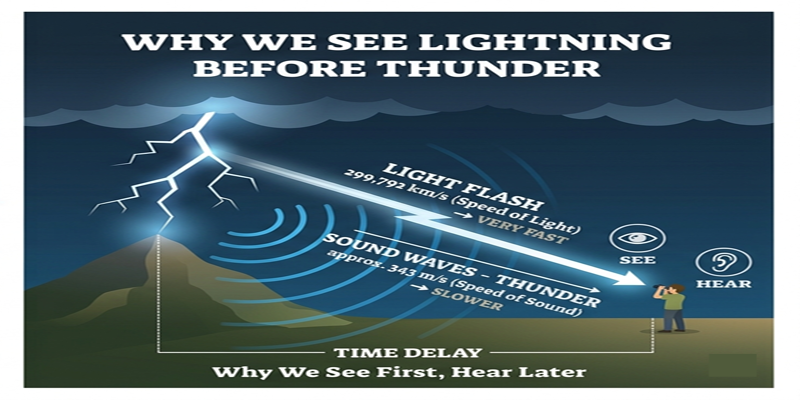
This is because light travels enormously faster than sound. |Why Do We See Lightning Before Hearing Thunder|
Speed of Light
Approximately:
300,000 km/s
Speed of Sound in Air
Approximately:
343 m/s at room temperature near sea level.
So the flash of lightning reaches your eyes almost instantly, while the sound takes considerably longer to reach your ears.
How Can You Estimate the Distance of Lightning?
You can actually perform a simple calculation.
After seeing lightning, count the seconds until you hear thunder.
A rough rule is:
3 seconds ≈ 1 kilometre
For example:
If you count approximately 9 seconds:
9 ÷ 3 ≈ 3 km
So the lightning occurred roughly 3 kilometres away.
This is only an approximation because the speed of sound changes with temperature, humidity, and other atmospheric conditions.
Why Does Thunder Sometimes Sound Like a Huge Explosion?
Lightning isn’t usually one simple, instantaneous event.
A lightning channel can branch and contain multiple electrical discharges.
Sound from different parts of the lightning channel reaches you at slightly different times.
The surrounding landscape and atmosphere can also reflect the sound.
As a result, thunder may sound like:
- A sharp crack
- A loud bang
- A rumble
- A rolling sound
Why Does Thunder Sometimes Continue for Several Seconds?
Imagine a long lightning bolt stretching across the sky.
The sound produced near the closest part of the bolt reaches you first.
Sound from farther sections arrives later.
The result can be a long rumbling sound.
This is why thunder can sometimes seem to “roll” across the sky.
What Is a Thunderstorm?
A thunderstorm is a storm system that produces lightning and thunder.
Thunderstorms generally require:
- Moisture
- Atmospheric instability
- Rising air
Warm, moist air rises rapidly.
As it rises, it cools, and water vapor condenses.
This helps form large clouds called cumulonimbus clouds.
How Big Can a Thundercloud Become?
A mature cumulonimbus cloud can grow to an enormous size.
It can extend many kilometres vertically and horizontally.
Strong thunderstorms may contain:
- Heavy rain
- Lightning
- Strong winds
- Hail
- Sometimes tornadoes
Why Does Lightning Strike the Ground?
Lightning can occur between different regions inside a cloud.
But sometimes a powerful electrical discharge travels between the cloud and Earth’s surface.
This is called cloud-to-ground lightning.
The electrical path develops through the atmosphere until a conductive channel forms between the cloud and ground. |Why Do We See Lightning Before Hearing Thunder|
Does Lightning Always Strike the Tallest Object?
Not necessarily.
Tall objects can increase the likelihood of receiving a nearby or direct strike because they reduce the distance between the ground and the developing electrical discharge.
But lightning can strike objects that aren’t the tallest.
That’s why simply standing beside a shorter object does not make you safe.
Can Lightning Strike the Same Place Twice?
Absolutely.
The saying:
“Lightning never strikes the same place twice”
is a myth.
Tall structures can be struck repeatedly.
For example, the Empire State Building is struck by lightning multiple times in some years.
Why Are Trees Dangerous During Lightning?
Trees can provide a path for electrical current.
A person standing under a tree during a thunderstorm can be injured by:
- A direct strike
- Side flash
- Ground current
- Electrical effects from the tree
Therefore:
Never shelter under a tree during a thunderstorm.
Can Lightning Strike You Indoors?
It is much safer indoors, but lightning can still enter buildings through conductive paths.
Potential pathways include:
- Electrical wiring
- Plumbing
- Antennas
- Cables
During a severe thunderstorm, avoid unnecessary contact with wired electrical equipment and plumbing.
What Is Ball Lightning?
Ball lightning is a reported atmospheric phenomenon involving glowing spherical objects associated with thunderstorms.
Scientists have proposed several explanations, but ball lightning remains poorly understood.
It is an excellent example of how science sometimes encounters phenomena that are difficult to explain completely.
Why Does Lightning Look Like a Zigzag?
Lightning doesn’t simply travel in one smooth line.
The electrical discharge develops through branching channels as it finds paths through the atmosphere.
These channels create the familiar jagged appearance of lightning. |Why Do We See Lightning Before Hearing Thunder|
What Is a Lightning Rod?
A lightning rod is a conductive system installed on buildings to provide a controlled path for electrical discharge toward the ground.
It doesn’t magically “stop” lightning.
Instead, a properly designed lightning protection system helps reduce damage by providing a safer path for electrical current.
Can Lightning Create New Materials?
Yes.
The enormous heat of lightning can melt or fuse certain materials.
For example, when lightning strikes sandy soil, it can sometimes create glassy structures called fulgurites.
These are sometimes described as “lightning fossils.”
They provide physical evidence of lightning’s tremendous energy.
Lightning and the Human Body
Lightning is extremely dangerous.
A strike can cause:
- Burns
- Heart problems
- Nervous-system injuries
- Hearing damage
- Other serious injuries
However, not every person struck by lightning dies.
Immediate medical attention can be critical.
How to Stay Safe During a Thunderstorm
If you hear thunder, lightning is close enough to pose a risk.
If You Are Outdoors
- Move indoors if possible.
- Avoid open fields.
- Stay away from isolated trees.
- Avoid water.
- Stay away from metal structures.
- Do not lie flat on the ground.
If You Are Indoors
- Stay away from windows.
- Avoid unnecessary contact with plumbing.
- Avoid using wired electrical equipment.
- Stay indoors until the storm has passed.
A useful safety principle is:
If you can hear thunder, seek shelter.
Why Does Lightning Sometimes Happen Without Rain Reaching the Ground?
A storm can produce lightning even when rain evaporates before reaching the ground.
This is sometimes called virga.
Lightning can also occur in parts of a storm where rainfall at your exact location is absent.
So:
No rain ≠ No lightning risk.
Lightning on Other Planets
Earth isn’t the only planet where electrical activity can occur.
Scientists have observed or inferred lightning-like electrical phenomena on other planets and moons.
For example, powerful electrical activity has been detected in the atmospheres of planets such as Jupiter and Saturn.
Different atmospheric compositions can produce very different types of storms. |Why Do We See Lightning Before Hearing Thunder|
Did You Know?
- Lightning can heat air to roughly 30,000 K.
- Thunder is caused by the rapid expansion of air around a lightning channel.
- Light reaches you almost instantly compared with sound.
- Lightning can occur inside clouds without striking the ground.
- Lightning can strike the same location multiple times.
- Some lightning channels can extend for many kilometres.
- Lightning can produce fulgurites when it strikes suitable sandy ground.
Try This at Home
Make a Thunderstorm in a Glass
You’ll Need:
- A transparent glass or jar
- Water
- Shaving foam
- Food coloring
- A spoon or dropper
Steps
- Fill the glass mostly with water.
- Add a layer of shaving foam on top.
- Drop small amounts of colored water onto the foam.
- Watch as the colored water moves downward.
What Does It Demonstrate?
This is a simple cloud-model activity, not a model of the electrical processes that create real lightning.
It demonstrates how water can accumulate in a cloud-like layer and eventually move downward as the material becomes saturated.
Common Mistakes Students Make
❌ Thinking lightning is caused simply by clouds rubbing together.
✔ Electrical charge separation inside thunderstorms involves complex interactions between ice particles, water droplets, and strong air currents.
❌ Thinking thunder causes lightning.
✔ Lightning happens first; thunder is produced by the rapid heating and expansion of air caused by the lightning discharge.
❌ Thinking lightning cannot strike twice in the same place.
✔ It can—and tall structures may be struck repeatedly.
❌ Thinking you’re safe from lightning just because rain has stopped.
✔ Lightning can occur away from the heaviest rainfall.
Frequently Asked Questions (FAQs)
1. Why do we see lightning before hearing thunder?
Because light travels much faster than sound.
2. How hot is lightning?
The air in a lightning channel can reach roughly 30,000 K for a very short period.
3. What causes thunder?
Lightning rapidly heats the surrounding air, causing it to expand and produce a shock wave that we hear as thunder.
4. Can lightning strike the same place twice?
Yes. It can strike the same structure many times.
5. Is it safe to stand under a tree during lightning?
No. Trees can be dangerous during thunderstorms and should not be used as shelter.
Why This Topic Matters
Lightning is a perfect example of science happening directly above our heads.
It combines:
- Electricity
- Physics
- Atmospheric science
- Thermodynamics
- Weather
- Chemistry
- Earth science
Understanding thunderstorms isn’t just interesting—it can also help us make safer decisions during severe weather. |Why Do We See Lightning Before Hearing Thunder? |
Conclusion
Friends, in this blog post(Why Do We See Lightning Before Hearing Thunder?), we have discovered various amazing facts related to lightning before thunder and thunderclouds. You can definitely consider it as one of nature’s most powerful electrical phenomena, where bright flashes show up followed by a deep rumble in the sky.
Lightning in the sky immediately heats the surrounding air, causing it to expand explosively. And thunder is nothing but a loud sound created within this explosive air expansion. And as we already know that light travels much faster than sound, it is very obvious to first see the lightning before thunder. |Why Do We See Lightning Before Hearing Thunder|
From the outside look, a thunderstorm may look chaotic to you, but there is a fascinating mixing of electricity, physics, energy, and atmospheric motion happening beneath the clouds in the sky. |Why Do We See Lightning Before Hearing Thunder|
It won’t be surprising to say that nature has established a huge electrical laboratory in the sky. |Why Do We See Lightning Before Hearing Thunder|
If you have any queries, you can write to us at support@a5theory.com; we will get back to you ASAP.
Hope! You would have enjoyed this post(Why Do We See Lightning Before Hearing Thunder).
Please feel free to give your important feedback in the comment section below.
Have a great time!