

Hello Friends, in this blog post(Why Does a Rainbow Have Seven Colours), we are going to explain to you the complete theory behind the seven colors of the rainbow.
As we all know, the rainbow as a most beautiful sights in nature and is always a nice and amazing experience to see.
It is often seen just after the rain; it is in an arc shape and looks like a giant colorful arc stretched across the sky. |Why Does a Rainbow Have Seven Colours|
You can see Orange, Yellow, Red, Green, Indigo, Blue, and violet colors in it. But have you ever thought about:
Where do these colours come from that form the shape of a rainbow?
We generally see sunlight as white. So what turns it into a beautiful band of colors?
It can only be answered with the involvement of reflection, refraction, dispersion, and light’s geometry concepts.
And you would be even more surprised to know the fact that “A rainbow is actually a complete circle.“
Only a part of it is seen by us, so in this blog post(Why Does a Rainbow Have Seven Colours), we will discover the complete science of rainbow colours along with some other amazing facts.
What Is a Rainbow?
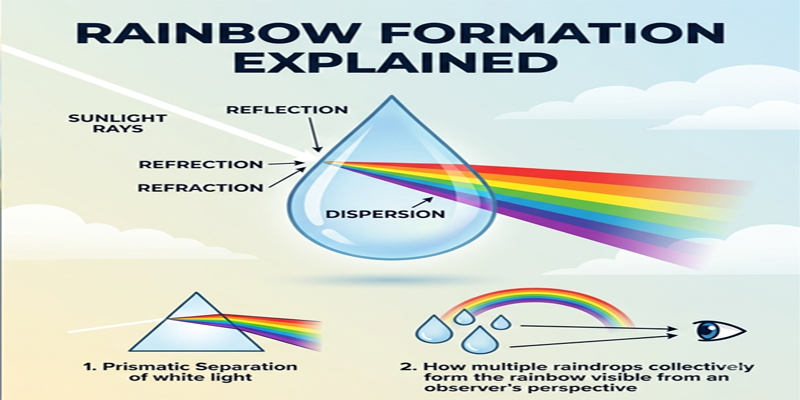
A rainbow is an optical phenomenon produced when sunlight interacts with water droplets in the atmosphere.
When sunlight enters a raindrop, it can:
- Refract
- Disperse into different colours
- Reflect inside the droplet
- Refract again as it leaves
Millions of droplets can work together to create the colourful arc we see in the sky. |Why Does a Rainbow Have Seven Colours|
Is Sunlight Really White?
Yes.
Visible sunlight contains a range of wavelengths that our eyes perceive as different colours.
When these wavelengths reach our eyes together, they can appear approximately white.
A prism can separate this light into a spectrum.
A raindrop can do something similar. |Why Does a Rainbow Have Seven Colours|
What Are the Seven Colours of a Rainbow?
The traditional sequence commonly taught in school is:
Red → Orange → Yellow → Green → Blue → Indigo → Violet
A popular memory aid is:
VIBGYOR
- V – Violet
- I – Indigo
- B – Blue
- G – Green
- Y – Yellow
- O – Orange
- R – Red
But there is an important scientific detail.
Nature doesn’t actually divide the rainbow into seven perfectly separated bands.
The visible spectrum is continuous.
The seven-colour classification is a traditional way of describing the major regions of the visible spectrum.
What Is Refraction?
When light travels from one transparent medium into another, its speed changes.
This can cause the direction of the light to change.
This bending of light is called:
Refraction
For example, light travels at different speeds in:
- Air
- Water
- Glass
When sunlight enters a raindrop from air into water, it bends. |Why Does a Rainbow Have Seven Colours|
Why Does Light Bend?
Light changes speed when it enters a different medium.
The change in speed can cause its path to change direction.
The amount of bending depends partly on the wavelength of the light.
This difference becomes extremely important for rainbows.
What Is Dispersion?
Dispersion is the separation of white light into its component colours because different wavelengths are refracted by different amounts.
When sunlight enters a water droplet:
- Different colours bend by slightly different amounts.
- The colours begin separating.
- The result is a spectrum of visible light.
This is why a rainbow contains different colours instead of simply appearing white. |Why Does a Rainbow Have Seven Colours|
Why Does Violet Bend More Than Red?
Different colours of visible light have different wavelengths.
Red light has a longer wavelength than violet light.
When passing through water, violet light is generally refracted more strongly than red light.
Therefore:
Violet → greater deviation
Red → smaller deviation
This difference helps spread the colours apart.
What Happens Inside a Raindrop?
Let’s follow one ray of sunlight.
Step 1: Sunlight Enters the Raindrop
Sunlight travels through the air and reaches a water droplet.
As it enters the water:
Refraction occurs.
The different wavelengths begin separating. |Why Does a Rainbow Have Seven Colours? |
Step 2: The Light Travels Through the Droplet
The separated colours travel through the water.
The light reaches the back surface of the droplet.
Step 3: Internal Reflection
Some of the light reflects from the inside surface of the water droplet.
This is called:
Internal reflection
The light changes direction and travels back toward the front of the droplet.
Step 4: The Light Leaves the Droplet
When the light exits the droplet and returns to the air, it refracts again.
The colours are now separated enough that they can travel toward an observer at different angles.
The Four Main Processes
The formation of a primary rainbow can therefore be simplified as:
Refraction → Dispersion → Internal Reflection → Refraction
This is the basic optical process behind the rainbow.
Why Does the Rainbow Appear Opposite the Sun?
This is an important observation.
If you are looking at a rainbow, the Sun is generally behind you.
The rainbow appears in the part of the sky opposite the Sun.
That’s because the light from the Sun enters raindrops in front of you and is redirected toward your eyes.
So:
Sun behind you → Rain in front of you → Rainbow ahead
Why Does a Rainbow Look Like an Arc?
The colours reaching your eyes come from water droplets positioned at particular angles relative to:
- The Sun
- The raindrop
- Your eyes
For a primary rainbow, the light reaching your eye is concentrated around an angle of roughly 42° from the direction opposite the Sun.
Because countless droplets are positioned throughout the sky, the result appears as a curved arc.
Is a Rainbow Really a Circle?
Yes!
Under suitable viewing conditions, a rainbow is actually a complete circle.
From the ground, the lower part of the circle is usually hidden below the horizon.
That’s why we normally see only an arc.
Can You See a Full Rainbow?
Sometimes.
If you are high enough above the ground, you may be able to see much more of the circular rainbow.
This can happen when viewing conditions and the position of the Sun and rain are suitable, such as from:
- An aircraft
- A high mountain
- A tall building
- Certain elevated viewpoints
Why Can’t Everyone See the Same Rainbow?
A rainbow is not a physical object located at one particular point in the sky.
It depends on the geometry between:
- The Sun
- Water droplets
- The observer
If two people stand several metres apart, they are looking at different sets of droplets and different light paths.
Therefore, each observer effectively sees their own rainbow. |Why Does a Rainbow Have Seven Colours|
Can Two People See the Same Rainbow?
They can see the same general rainbow phenomenon, but the exact collection of droplets contributing light to each person’s view is different.
Move your head, and the geometry changes.
Move to another location, and the rainbow changes too.
Why Does a Rainbow Usually Appear After Rain?
A rainbow requires two important ingredients:
Sunlight + Water droplets
Rain provides millions of tiny water droplets suspended in the atmosphere.
If sunlight shines through these droplets at the correct angle, a rainbow can appear.
That’s why rain showers combined with sunshine create ideal rainbow conditions.
Why Are Rainbows Often Seen in the Morning or Evening?
The Sun needs to be relatively low in the sky for a typical high rainbow to be visible from the ground.
When the Sun is high overhead, the geometry makes the rainbow appear below the horizon for many observers.
This is why rainbows are often easier to see:
- In the morning
- In the late afternoon
- During showers when the Sun is relatively low
Can a Rainbow Appear at Noon?
Yes, depending on your location and viewing conditions.
But when the Sun is high in the sky, much of the rainbow can fall below the horizon.
So the visible portion may be small or completely hidden from a ground-level observer.
Why Does Red Appear on the Outside?
In a primary rainbow:
Red is on the outer edge.
Violet is on the inner edge.
This happens because different wavelengths of light leave the droplets at different angles.
Red is deviated less than violet, so it appears on the outer side of the primary rainbow.
What Is a Primary Rainbow?
The rainbow we most commonly see is called a:
Primary rainbow
It is produced after sunlight undergoes one major internal reflection inside the water droplets.
Its colour order is:
Red → Orange → Yellow → Green → Blue → Indigo → Violet
from the outside toward the inside.
What Is a Secondary Rainbow?
Sometimes you can see a fainter second rainbow outside the primary rainbow.
This is called a:
Secondary rainbow
It forms when light undergoes two internal reflections inside a raindrop. |Why Does a Rainbow Have Seven Colours|
Why Is the Secondary Rainbow Fainter?
Each time light interacts with the droplet, some energy is redirected or lost from the particular path reaching the observer.
After two internal reflections, less light contributes to the secondary rainbow compared with the primary rainbow.
Therefore, the secondary rainbow is usually:
- Fainter
- Wider
- Less obvious
Why Are the Colours Reversed in a Secondary Rainbow?
This is one of the most fascinating features.
In a primary rainbow:
Red → outside
Violet → inside
But in a secondary rainbow:
Violet → outside
Red → inside
The colour order is reversed because of the additional internal reflection.
What Is the Dark Region Between Two Rainbows?
When both primary and secondary rainbows are visible, you may notice a darker region between them.
This region is called:
Alexander’s band
It occurs because fewer rays from the relevant scattering geometry reach the observer in that angular region. |Why Does a Rainbow Have Seven Colours|
Can There Be More Than Two Rainbows?
Yes.
Under special conditions, higher-order rainbows can occur.
These are much more difficult to see because they are usually faint and can be overwhelmed by scattered sunlight.
So nature can produce more complicated rainbow patterns than the familiar single arc.
Can a Rainbow Occur Without Rain?
Yes.
Rain is not strictly necessary.
Any collection of suitable water droplets can produce rainbow-like effects.
For example, you can sometimes see rainbows in:
- Waterfalls
- Fountains
- Garden sprinklers
- Sea spray
- Mist
The essential requirement is appropriately positioned water droplets and light.
Can You Make a Rainbow at Home?
Absolutely.
You’ll Need
- A glass of water
- Sunlight
- A white wall or sheet of paper
Try This
Place a transparent glass filled with water where sunlight can pass through it.
Under suitable conditions, the light can be dispersed and produce coloured patterns on a nearby surface.
You can also create rainbow effects using a prism.
Important
Never look directly at the Sun while experimenting.
What Does a Prism Have to Do With a Rainbow?
A prism can separate white light into its component colours through dispersion.
The basic idea is similar to what happens inside raindrops.
The difference is that a prism has a fixed solid shape, while a rainbow is produced by enormous numbers of individual spherical water droplets.
Rainbow vs Prism
| Rainbow | Prism |
|---|---|
| Formed by water droplets | Formed by transparent material |
| Natural phenomenon | Laboratory/classroom demonstration |
| Involves refraction and internal reflection | Involves refraction and dispersion |
| Produces a curved appearance | Usually produces a straight spectrum |
| Requires suitable sunlight and viewing geometry | Can work with a controlled light source |
Why Does the Sky Sometimes Look Like a Rainbow Without Rain?
You may occasionally see colourful arcs or patches in the sky caused by ice crystals rather than raindrops.
These can include phenomena such as:
- Halos
- Sundogs
- Circumhorizontal arcs
They are related to atmospheric optics but are not ordinary rainbows.
What Is a Sundog?
A sundog, or parhelion, is a bright spot that can appear on either side of the Sun.
It is produced by the interaction of sunlight with ice crystals in high clouds.
It can look like a small, colourful patch of light.
This is another example of nature acting like a giant optical laboratory.
Why Does a Rainbow Sometimes Look Extremely Bright?
The brightness depends on several factors, including:
- Number and size of water droplets
- Sunlight intensity
- Cloud conditions
- Background sky brightness
- Viewing angle
A darker cloud background can make a rainbow appear especially vivid. |Why Does a Rainbow Have Seven Colours|
Why Does a Rainbow Fade Away?
A rainbow may disappear when:
- The Sun moves
- The rain stops
- The water droplets evaporate
- Clouds block sunlight
- The viewing geometry changes
Remember:
A rainbow isn’t a permanent object.
It is an optical effect that exists only while the necessary geometry and conditions exist.
Is There Really a Pot of Gold at the End?
Unfortunately, no.
A rainbow doesn’t have a physical “end.”
Because the rainbow depends on the observer’s position, moving toward the apparent end simply changes the geometry.
The rainbow can appear to move as you move.
So you can’t actually reach the end of a rainbow.
Why Can’t We Touch a Rainbow?
Because a rainbow isn’t a solid object.
It is light reaching your eyes from specific directions after interacting with water droplets.
You can move through the region where a rainbow appears without touching anything.
Does Everyone See the Same Seven Colours?
Not necessarily.
Human colour perception varies, and the spectrum is continuous rather than divided into seven perfectly distinct bands.
The traditional seven-colour description is useful for education, but scientifically the visible spectrum contains a continuous range of wavelengths. |Why Does a Rainbow Have Seven Colours|
What Is the Visible Spectrum?
Human eyes detect only a small portion of the electromagnetic spectrum.
This region is called:
Visible light
It lies approximately between:
400–700 nanometres
The exact limits vary somewhat depending on how they are defined.
Outside visible light are forms of electromagnetic radiation such as:
- Ultraviolet
- Infrared
- Microwaves
- Radio waves
- X-rays
- Gamma rays
We cannot see these wavelengths with our eyes.
Why Can’t We See Infrared in a Rainbow?
Infrared radiation has wavelengths longer than visible red light.
Our eyes aren’t sensitive to it.
Similarly, ultraviolet radiation has wavelengths shorter than visible violet light and is also invisible to human eyes.
So the rainbow we see represents only the visible portion of the electromagnetic spectrum.
Did You Know?
- A rainbow is actually a full circle under suitable viewing conditions.
- The Sun is usually behind the observer.
- A primary rainbow occurs through one major internal reflection.
- A secondary rainbow involves two internal reflections.
- Secondary rainbows have reversed colour order.
- Rainbows can occur in mist, waterfalls, fountains, and sea spray.
- The visible spectrum is continuous rather than naturally divided into exactly seven colours.
- Each observer effectively sees a rainbow produced by a different set of droplets.
- A rainbow has no physical end that you can reach.
Common Mistakes Students Make
❌ Thinking a rainbow is an object floating in the sky.
✔ It is an optical phenomenon produced by light interacting with water droplets.
❌ Thinking sunlight contains only white light.
✔ White sunlight can be separated into a range of visible wavelengths.
❌ Thinking a rainbow always needs rain.
✔ Mist, spray, waterfalls, and other collections of water droplets can also produce rainbow effects.
❌ Thinking every rainbow must contain exactly seven colours.
✔ The visible spectrum is continuous; seven colours are a traditional classification.
❌ Thinking the rainbow has a physical end.
✔ Its apparent position depends on the observer’s viewing geometry.
Frequently Asked Questions (FAQs)
1. Why does a rainbow have seven colours?
Sunlight contains a continuous range of visible wavelengths. Different wavelengths are refracted by different amounts inside water droplets, producing the familiar sequence traditionally described as seven colours. |Why Does a Rainbow Have Seven Colours? |
2. Why is red on the outside of a rainbow?
Red light is deviated less than violet light during the formation of a primary rainbow, so it appears on the outer edge.
3. Why is violet on the inside?
Violet light is refracted more strongly than red light and therefore appears toward the inner edge of the primary rainbow.
4. Why does a rainbow appear after rain?
Sunlight interacting with appropriately positioned water droplets can produce the refraction, dispersion, and internal reflection needed for a rainbow.
5. Can a rainbow be a complete circle?
Yes. From an elevated position, a sufficiently large portion—or potentially a full circular rainbow—can be visible.
6. Why can’t we reach the end of a rainbow?
A rainbow has no physical endpoint. Its apparent position depends on the observer and the geometry between the observer, Sun, and water droplets.
Why This Topic Matters
A rainbow isn’t just a beautiful sight.
It demonstrates several fundamental concepts of physics:
- Light
- Refraction
- Reflection
- Dispersion
- Wavelength
- Electromagnetic radiation
- Geometry
- Atmospheric optics
It also teaches an important scientific lesson:
Something that looks magical can often be explained by surprisingly elegant physical laws.
Conclusion
Friends, in this blog post(Why Does a Rainbow Have Seven Colours), we have understood the science behind the seven colors. So, next time when you see any rainbow in the sky, you will not just enjoy or admire its colors; rather, you will know the science happening behind this scene. When millions of tiny water droplets are hit by sunlight, the light gets refracted, causing different wavelengths to separate. Inside the droplets, light gets reflected and again gets refracted on leaving. And some of this light travels towards your eyes.
The different wavelengths coming to your eyes are further considered as different colors by your brain. Because of all these combined phenomena, we see the most beautiful optical display of nature, and we call it a rainbow. It might seem to be a colorful bridge across the sky. |Why Does a Rainbow Have Seven Colours|
This event is even more fascinating as per science: A spectacular demonstration of the physics of light.
If you have any queries, you can write to us at support@a5theory.com; we will get back to you ASAP.
Hope! You will enjoy this post(Why Does a Rainbow Have Seven Colours).
Please feel free to give your feedback in the comment section below.
Have a great time!