

Hello Friends, in this blog post(Direct and Indirect Speech), we are going to let you know about another amazing and important topic of English grammar: direct and indirect speech, also known as Narration.
Narration allows us to present someone else’s statement either identical to the words as they said it or in our own words.
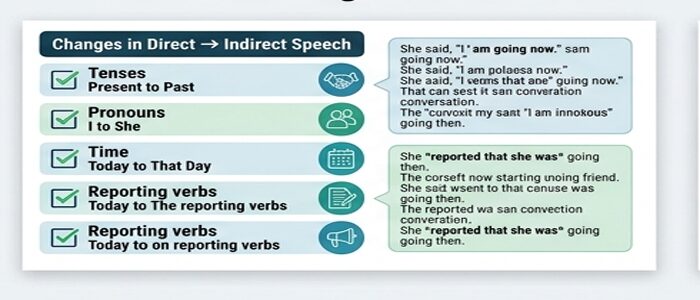
We use Narration on a larger scale in:
- Daily conversations
- News reporting
- Storytelling
- Academic writing
- Professional communication
A good command of direct and Indirect speech greatly improves our writing as well as our speaking English skills.
So in this post, we are going to learn all the rules, changes in tense, pronouns, and reporting verbs along with plenty of examples of each.
Direct and Indirect Speech:-
What Is Direct Speech?
Direct Speech reports the exact words spoken by a person.
The spoken words are placed inside quotation marks (” “).
Examples
- Rahul said, “I am happy.”
- She said, “I will help you.”
- The teacher said, “Complete your homework.”
In Direct Speech, the speaker’s exact words are preserved.
What Is Indirect Speech?
Indirect Speech reports the meaning of what was said without using the exact words.
Quotation marks are removed, and certain grammatical changes are made.
Examples
Direct:
- Rahul said, “I am happy.”
Indirect:
- Rahul said that he was happy.
Direct:
- She said, “I will help you.”
Indirect:
- She said that she would help me.
Why Is Narration Important?
Narration helps:
- Report conversations accurately
- Improve writing skills
- Enhance spoken English
- Understand grammar structures
- Communicate information effectively
It is a common topic in school exams and competitive tests.
Parts of a Narration Sentence
Every narration sentence generally has two parts:
1. Reporting Clause
The part that tells who is speaking.
Example:
- Rahul said
2. Reported Speech
The actual statement being reported.
Example:
- “I am happy.”
Together:
- Rahul said, “I am happy.”
General Rules for Changing Direct to Indirect Speech
Rule 1: Remove Quotation Marks
Direct
- She said, “I am busy.”
Indirect
- She said that she was busy.
Rule 2: Add a Suitable Conjunction
Usually, that is used in statements.
Example
- He said, “I know the answer.”
becomes
- He said that he knew the answer.
Rule 3: Change Pronouns
Pronouns change according to the speaker and listener.
Example
Direct:
- Rahul said, “I am tired.”
Indirect:
- Rahul said that he was tired.
“I” changes to “he.”
Rule 4: Change Tenses (When Required)
If the reporting verb is in the past tense, the tense of the reported speech usually changes.
Tense Changes in Indirect Speech
| Direct Speech | Indirect Speech |
|---|---|
| Simple Present | Simple Past |
| Present Continuous | Past Continuous |
| Present Perfect | Past Perfect |
| Simple Past | Past Perfect |
| Will | Would |
| Shall | Should/Would |
| Can | Could |
| May | Might |
Examples of Tense Changes
Simple Present → Simple Past
Direct:
- She said, “I play football.”
Indirect:
- She said that she played football.
Present Continuous → Past Continuous
Direct:
- He said, “I am studying.”
Indirect:
- He said that he was studying.
Present Perfect → Past Perfect
Direct:
- They said, “We have completed the work.”
Indirect:
- They said that they had completed the work.
Simple Past → Past Perfect
Direct:
- She said, “I visited Delhi.”
Indirect:
- She said that she had visited Delhi.
Will → Would
Direct:
- He said, “I will come tomorrow.”
Indirect:
- He said that he would come the next day.
Changes in Time Expressions
Certain time-related words change in Indirect Speech.
| Direct Speech | Indirect Speech |
|---|---|
| Today | That day |
| Tomorrow | The next day |
| Yesterday | The previous day |
| Now | Then |
| Here | There |
| Tonight | That night |
| This | That |
| These | Those |
Examples
Direct:
- She said, “I will come tomorrow.”
Indirect:
- She said that she would come the next day.
Direct:
- He said, “I am busy today.”
Indirect:
- He said that he was busy that day.
Narration of Assertive Sentences
These are simple statements.
Direct
- Rahul said, “I am learning English.”
Indirect
- Rahul said that he was learning English.
Narration of Interrogative Sentences
Questions require special changes.
Yes/No Questions
Use if or whether.
Direct
- She said, “Are you ready?”
Indirect
- She asked if I was ready.
Direct
- He said, “Do you like cricket?”
Indirect
- He asked whether I liked cricket.
Wh-Questions
Words such as who, what, where, when, why, and how remain unchanged.
Direct
- She said, “Where do you live?”
Indirect
- She asked where I lived.
Narration of Imperative Sentences
Imperative sentences express commands, requests, advice, or instructions.
Direct
- The teacher said, “Complete your homework.”
Indirect
- The teacher ordered the students to complete their homework.
Direct
- She said, “Please help me.”
Indirect
- She requested me to help her.
Narration of Exclamatory Sentences
Exclamatory sentences express emotions.
Direct
- He said, “What a beautiful day!”
Indirect
- He exclaimed that it was a very beautiful day.
Direct
- She said, “Hurrah! We won the match.”
Indirect
- She exclaimed with joy that they had won the match.
When Tense Changes Are Not Required
Tense changes may not occur when the reported speech expresses:
Universal Truths
Direct:
- The teacher said, “The Earth revolves around the Sun.”
Indirect:
- The teacher said that the Earth revolves around the Sun.
The statement remains true at all times.
Common Reporting Verbs
Different reporting verbs are used depending on the sentence type.
| Sentence Type | Reporting Verb |
|---|---|
| Statement | Said, Told |
| Question | Asked |
| Request | Requested |
| Command | Ordered |
| Advice | Advised |
| Exclamation | Exclaimed |
Common Mistakes in Narration(Direct and Indirect Speech)
Mistake 1: Forgetting Tense Changes
❌ He said that he is busy.
✔ He said that he was busy.
Mistake 2: Incorrect Pronoun Changes
❌ Rahul said that I was happy.
✔ Rahul said that he was happy.
Mistake 3: Keeping Question Structure
❌ She asked where do I live.
✔ She asked where I lived.
Mistake 4: Forgetting Time Changes
❌ He said that he would come tomorrow.
✔ He said that he would come the next day.
Tips to Master Direct and Indirect Speech
Learn Tense Change Rules
Most narration questions involve tense transformations.
Practice Pronoun Changes
Identify the speaker and listener before changing pronouns.
Understand Sentence Types
Different sentence types require different reporting verbs.
Read and Rewrite Dialogues
Convert conversations from Direct Speech to Indirect Speech for practice.
FAQ(Direct and Indirect Speech)
What is another name for Indirect Speech?
Indirect Speech is also called Reported Speech.
Do all sentences require tense changes?
No. Universal truths and certain present-tense reporting situations may not require tense changes.
Why is narration important?
Narration helps us report conversations and communicate information accurately.
Conclusion
Friends, in this post(Direct and Indirect Speech), you would definitely have learned a lot about narration. In English grammar, direct and indirect speech are very important concepts. They are the best medium to present statements, questions, commands, requests, and emotions in a very identical and efficient manner.
However, most of you may face a little difficulty in understanding them in the very beginning stage. But once you are familiar with their rules for changing tense, pronouns, and reporting verbs, they seem to be very simple to you. And the most important thing is practice; you are going to achieve more perfection in your English communication if you regularly practice them as much as possible.
If you learn all the rules and examples explained in this blog post sincerely, then you will be very comfortable changing direct speech into indirect speech with ease. And it would be very easy to use reported speech accurately in your writing as well as speaking.
If you have any queries, you can write to us at support@a5theory.com; we will get back to you ASAP.
Hope! You would have enjoyed this post(Direct and Indirect Speech).
Please feel free to give your important feedback in the comment section below.
Have a great time!