

Introduction
Hello Friends, in this blog post(Email Writing in English), we are going to let you know a few amazing email writing techniques.
Over two decades of professional or personal work, email has been an important medium of professional communication and is still popular.
Emails help you in many ways, like applying for a job, connecting with clients, requesting leave, communicating with teachers, and responding to customers.
You can surely leave a positive and impactful impression if you can write clear and professional emails.
Most English learners have a full or partial idea of grammar, but they still find it difficult to write professional emails.
The most probable reason behind this is that they are unaware of the correct email format, wording, and tone.
Writing emails is an amazing skill that itself has many big career opportunities with a vast career-oriented domain.
Any of you can learn this email writing skill easily by following a simple structure and using polite language.
You should always try to write easy-to-understand, professional, and action-oriented emails.
In this post, we are going to teach you some amazing email writing fundamentals in English. |Email Writing in English|
We will also explore some practical samples of email writing based on different situations. |Email Writing in English|
Why Email Writing Skills Are Important
Good email writing helps you:
- Communicate professionally.
- Build trust with clients and employers.
- Apply for jobs confidently.
- Request information politely.
- Improve workplace communication.
- Avoid misunderstandings.
A well-written email often reflects your professionalism and attention to detail.
Types of Emails
Understanding the purpose of your email helps you choose the right tone.
1. Formal Emails
Used for:
- Job applications
- Business communication
- Official requests
- Customer support
- Communication with teachers or government offices
2. Semi-Formal Emails
Used for:
- Colleagues
- Existing clients
- Professional acquaintances
3. Informal Emails
Used for:
- Friends
- Family
- Close colleagues
This article focuses mainly on formal and business emails.
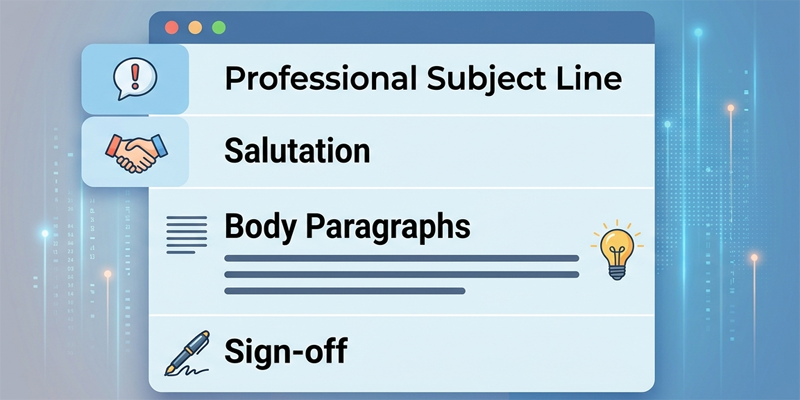
Basic Structure of a Professional Email
Every professional email should include the following sections:
1. Subject Line
Keep it short and specific.
Examples:
- Leave Request for 15 July
- Job Application for Software Developer
- Meeting Confirmation
- Request for Project Update
2. Greeting
Examples:
- Dear Mr. Sharma,
- Dear Ms. Gupta,
- Dear Hiring Manager,
- Hello John,
Avoid greetings like:
❌ Hi Buddy
❌ Hey Dude
in professional communication.
3. Opening
Start politely.
Examples:
- I hope you are doing well.
- Thank you for your email.
- I am writing regarding…
- I would like to request…
4. Main Message
Explain your purpose clearly.
Use short paragraphs and include only relevant information.
5. Closing
Examples:
- Thank you for your time.
- I look forward to your response.
- Please let me know if you need any additional information.
6. Signature
Example:
Kind regards,
Rahul Sharma
Software Developer
Phone: +91 XXXXX XXXXX
Email: rahul@email.com
Professional Email Writing Rules
Follow these best practices:
- Use a clear subject line.
- Address the recipient respectfully.
- Keep your message concise.
- Use proper grammar and punctuation.
- Avoid slang and abbreviations.
- Proofread before sending.
- End with a polite closing.
Professional emails should be easy to read and understand.
Useful Email Phrases
Making a Request
- Could you please…
- I would appreciate it if…
- Would you mind…
Providing Information
- Please find the attached document.
- I would like to inform you that…
- Here are the requested details.
Following Up
- I’m following up regarding…
- I wanted to check whether…
- Kindly let me know if there are any updates.
Expressing Gratitude
- Thank you for your assistance.
- I appreciate your support.
- Thank you for your prompt response.
Professional Email Examples
Example 1: Leave Request
Subject: Leave Request for 15 July
Dear Mr. Sharma,
I hope you are doing well.
I would like to request leave on 15 July due to a family function. I have completed my current assignments and will ensure that any pending work is handed over before my leave.
Thank you for your understanding. I look forward to your approval.
Kind regards,
Amit Verma
Example 2: Job Application Email
Subject: Application for Software Developer Position
Dear Hiring Manager,
I am writing to apply for the Software Developer position advertised on your website.
I have completed my Bachelor’s degree in Computer Science and possess strong knowledge of Python, HTML, CSS, JavaScript, and SQL. I have attached my resume for your review.
Thank you for considering my application. I look forward to hearing from you.
Sincerely,
Rahul Sharma
Example 3: Meeting Request
Subject: Request for Project Discussion
Dear Ms. Gupta,
I hope you’re having a great day.
I would like to schedule a meeting this week to discuss the progress of our current project and review the next steps.
Please let me know a convenient time.
Thank you.
Best regards,
Ankit Singh
Example 4: Customer Inquiry
Subject: Request for Product Information
Dear Customer Support Team,
I hope you are doing well.
I would like to know more about your premium subscription plans, including pricing, features, and available discounts.
Thank you for your assistance.
Kind regards,
Priya Kapoor
Example 5: Thank-You Email
Subject: Thank You for the Interview Opportunity
Dear Ms. Verma,
Thank you for taking the time to interview me today. I enjoyed learning more about your company and the role.
I appreciate the opportunity and look forward to hearing from you.
Kind regards,
Rohit Sharma
Common Email Writing Mistakes
Avoid these mistakes:
❌ No subject line.
❌ Using all capital letters.
❌ Writing one very long paragraph.
❌ Using informal language in business emails.
❌ Grammar and spelling mistakes.
❌ Forgetting attachments.
❌ Ending without a closing or signature.
Tips to Write Better Emails
- Think before you write.
- Keep emails brief and focused.
- Use bullet points when sharing multiple items.
- Always proofread before sending.
- Reply promptly to important emails.
- Maintain a polite and professional tone.
- Use meaningful subject lines.
Practice Exercises
Exercise 1
Write a professional email requesting information about an online course.
Exercise 2
Write a leave application email for two days.
Exercise 3
Write a thank-you email after attending a job interview.
Exercise 4
Edit this sentence:
Hi dude, send me the files ASAP.
Rewrite it as a professional email request.
Frequently Asked Questions
What is the ideal length of a professional email?
Keep professional emails concise. Most emails can communicate their purpose effectively within 100–200 words, depending on the situation.
Should I use emojis in business emails?
Generally, avoid emojis in formal business communication unless your workplace culture specifically encourages their use.
How can I make my emails more professional?
Use a clear subject line, polite greetings, short paragraphs, proper grammar, and a professional closing. Always proofread before sending.
Key Takeaways
- Professional emails should be clear, concise, and polite.
- Use a logical structure: Subject, Greeting, Body, Closing, and Signature.
- Match your tone to the recipient and purpose.
- Proofread every email before sending.
- Strong email writing skills improve both academic and professional communication.
Conclusion
Friends, in this post(Email Writing in English), we have learned a few amazing email writing techniques. In today’s digital world, email writing is a very important communication skill. It helps you in many ways, like applying for a job, connecting with clients, or requesting information. Your professionalism, thought clarity, and respect can be easily identified through your emails. So always make sure that your email stands up to a standard.
If you follow the structure and examples given in this blog post above, you will be able to write effective emails for a variety of situations confidently. Email writing also takes time and effort to be perfect or standard. So make sure you do regular practice for email writing to make your communication refined. |Email Writing in English|
If you have any queries, you can write to us at support@a5theory.com; we will get back to you ASAP.
Hope! You would have enjoyed this post(Email Writing in English).
Please feel free to give your important feedback in the comment section below.
Have a great time!