

हेलो दोस्तों आज के इस ब्लॉग पोस्ट(All Uses Of There In Hindi With Examples) में हम आपको There के बारे में बताने वाले है |
हम में से अधिकतर लोग जानते है कि there का उपयोग हम ‘वहां‘ के sense के लिए करते है और here का उपयोग ‘यहाँ‘ के लिए करते है |All Uses Of There In Hindi With Examples|
पर कई बार ऐसे सेंटेंस होते है जहाँ पर वहां का उपयोग नहीं होता और न ही कोई sense आता है|All Uses Of There In Hindi With Examples|
पर हम ऐसे सेंटेंस को भी there के साथ बनाते है |All Uses Of There In Hindi With Examples|
तो ऐसा हम क्यों करते है और क्यों हम there का उपयोग करते है?
तो चलिए आज इस ब्लॉग पोस्ट में हम there के सभी uses को detail में देखेंगे |
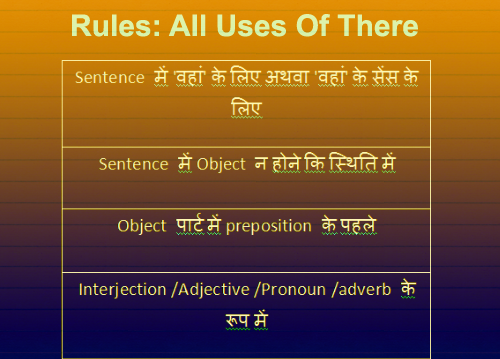
Rule1:
तो पहला case तो यही है कि जब भी किसी sentence में ‘वहां’ अथवा वहां का सेंस आये वहां पर हम there का उपयोग करते है |
वहां पर एक शेर था |
There was a lion.
एक पेड़ है वहां |
A tree is there.
Rule2:
जब किसी sentence में कोई object न हो तो हम वहां पर object की जगह पर there का use कर सकते है |
इसको और अच्छे से समझने के लिए हम कुछ sentence को देखते है |
जैसे : एक राजा था |
इस sentence में subject क्या है ?
subject वही है जिसके बारे में बात हो रही है | यह सेंटेंस कैसे बनेगा ?
A king was.
पर जैसे कि आप देख सकते है कि यह sentence देखने में अधूरा सा लग रहा है |
पर इस sentence में object क्या है ?
इस सेंटेंस में कोई object नहीं है |
इस लिए इस सेंटेंस में object के लिए हम there का उपयोग कर लते है | तो यह सेंटेंस कैसे बनेगा ?
A king was there.
और ऐसे sentence में जहाँ पर वहां का sense नहीं होता है, हम object को subject से बदल सकते है |
फिर यह सेंटेंस कैसे बनेगा ?
There was a king.
इसी तरह के कुछ और examples निचे देखते है:
a tap is there -> there is a tap.
4 taps are there -> there are 4 taps.
अब इन्ही sentence को हम कुछ additional information के साथ बनाते है:
उस जंगल में एक राजा था |
There was a king in that forest.
मेरे स्कूल में एक नल है |
There is a tap in my school.
मेरे स्कूल में चार नल है |
There are four taps in my school.
Rule3:
जब भी object part preposition से start होता है|
वहां पर हम preposition के ठीक पहले there का उपयोग कर लेते है |
4 taps are in my school.
4 taps are there in my school.
A king was there in that forest.
और हाँ जब भी there का मतलब sentence में वहां के लिए नहीं होता है|
तब हम ऐसे sentence में subject को object से replace कर सकते है |
जैसे कि आपने ऊपर taps वाले sentence को देखा|
इस sentence को हम कई प्रकार से बना सकते है जैसे कि नीचे दिखाया गया है |
पर इसे बनाने के सबसे बेहतर तरीका है there के साथ |
My school has 4 taps
4 taps are there in my school.
There are 4 taps in my school.
Rule4:
यह जरुरी नहीं है कि there का उपयोग हम किसी sentence में वहां के sense के लिए ही करें |
जब कभी किसी sentence में वहां का sense नहीं भी होता है तब भी हम there का उपयोग करते है |
और यहाँ पर there का उपयोग हम interjection , pronoun , adjective , और adverb के रूप में कर सकते है |
चलिए अगर किसी को इन terms के बारे में बिल्कुल भी पता नहीं है तो हम आपको इसके बारे में संक्षिप्त में बताते है |
Interjection:
Feeling/Expression – happy/Sad/Surprise -> exclamation mark -> ऐसे सेंटेंस जहाँ पर ख़ुशी, दुःख, सरप्राइज, राहत की फीलिंग्स आये|
There! Finally, I have done it.
Oh there! Exams are over.
Pronoun:
जैसे कि हम जानते है कि subject में हम noun , pronoun , gerund , अथवा infinitive का उपयोग करते है |
अगर हम जानते है कि gerund में हम verb के साथ ing लगा कर उसे एक noun की तरह use करते है |
और verb के साथ To लगाकर उसे भी subject में एक नाउन की तरह use करते है |
पर नीचे दिए sentence में आप साफ़ देख सकते है कि यह न तो noun है और न ही कोई gerund और infinitive|
इसलिए यहाँ पर there जो है वो एक pronoun की तरह use हो रहा है |
There is a king.
There is no alternative.
Adjective :
Provides additional information about nouns or pronouns|
जैसे कि आप जानते है कि adjective जो होता है वो noun अथवा pronoun की विशेषता बतलाता है |
और नीचे दिए sentence में भी there का उपयोग noun के बारे में कुछ additional इनफार्मेशन…
…बताने के लिए अथवा emphasize करने के लिए किया जा रहा है |
Look at that boy there.
Please ask that lady there.
Adverb:
Provide additional information about a verb, adjective, or another adverb.
Adverb का उपयोग हम किसी verb , adjective , और किसी अन्य adverb की विशेषता बताने के लिए करते है |
You can sit over there.
Look at it there.
MiscellaneousExamples:
उस घर में कोई है |
There is someone in that house.
हमारी क्लास में 5 स्टूडेंट्स है |
There are 5 students in our class.
5 students are there in our class.
Our class has 5 students.
घर के बाहर कौन है |
Who is there outside of the house.
मेरे स्कूल में केवल एक टीचर है |
There is only one teacher in my school.
Only one teacher is there in my school.
My school has only one teacher.
आपके पास कितना पैसा है |
How much money is there with you?
आसमान में कितने तारे है |
How many stars are there in the sky?
वो वहां आपके साथ था |
He was with you there.
There, he was with you.
इस ब्लॉग(All Uses Of There In Hindi With Examples) को लेकर आपके मन में कोई भी प्रश्न है तो आप हमें इस पते support@a5theory.comपर ईमेल लिख सकते है|
आशा करता हूँ, कि आपने इस पोस्ट(All Uses Of There In Hindi With Examples) को खूब एन्जॉय किया होगा|
आप स्वतंत्रता पूर्वक अपना बहुमूल्य फीडबैक और कमेंट यहाँ पर दे सकते है|All Uses Of There In Hindi With Examples|
आपका समय शुभ हो|
Really insightful post — Your article is very clearly written, i enjoyed reading it, can i ask you a question? you can also checkout this newbies in seo
Really great read — I appreciate how clearly you explained the importance of local online presence for businesses today. It’s a topic many companies overlook, i find it very interesting and very important topic. can i ask you a question? also we are recently checking out this newbies in the webdesign industry., you can take a look . waiting to ask my question if allowed. Thank you
Wonderful web site. Lots of helpful information here. I am sending it to some buddies ans also sharing in delicious. And of course, thanks on your effort!
For those who have elected to cover up your gift-card scales, you will have to modify your settings again.
There is definately a great deal to know about this issue. I love all of the points you’ve made.
I will immediately seize your rss feed as I can’t in finding your email subscription link or newsletter service. Do you have any? Kindly let me understand in order that I may just subscribe. Thanks.
I just couldn’t depart your site prior to suggesting that I actually loved the usual information a person provide in your visitors? Is gonna be again frequently in order to check up on new posts
I am sure this paragraph has touched all the internet visitors, its really really pleasant paragraph on building up new blog.
You’ve made some really good points there. I checked on the net for more information about the issue and found most people will go along with your views on this web site.
Hola! I’ve been reading your website for some time now and finally got the bravery to go ahead and give you a shout out from New Caney Tx! Just wanted to say keep up the great job!
I siimply could nott dwpart your wesite befcore suggesting that I extremely loved tthe usuyal ingo ann inndividual supply forr your guests? Is gonna bee again often inn rder to chyeck oout nnew posts
I visited many web sites except the audio feature for audio songs current at this web page is in fact wonderful.
I am sure this post has touched all the internet people, its really really fastidious paragraph on building up new website.
Thank you for the good writeup. It in fact was a amusement account it. Look advanced to more added agreeable from you! However, how can we communicate?
I am sure this post has touched all the internet viewers, its really really fastidious article on building up new weblog.
Ahaa, its pleasant conversation regarding this piece of writing here at this website, I have read all that, so at this time me also commenting at this place.
I enjoy what you guys are up too. This sort of clever work and coverage! Keep up the good works guys I’ve incorporated you guys to my own blogroll.
Whoa! This blog looks just like my old one! It’s on a completely different topic but it has pretty much the same layout and design. Superb choice of colors!
There is certainly a lot to find out about this subject. I really like all the points you made.
Greetings! Very helpful advice within this post! It is the little changes that make the biggest changes. Thanks for sharing!
Ahaa, its good discussion on the topic of this article at this place at this blog, I have read all that, so now me also commenting at this place.
Whoa! This blog looks exactly like my old one! It’s on a totally different subject but it has pretty much the same page layout and design. Outstanding choice of colors!
These are really impressive ideas in on the topic of blogging. You have touched some fastidious points here. Any way keep up wrinting.
There’s certainly a lot to find out about this issue. I love all the points you have made.
Outstanding quest there. What occurred after? Good luck!
I am sure this article has touched all the internet visitors, its really really nice article on building up new webpage.
These are actually impressive ideas in on the topic of blogging. You have touched some pleasant factors here. Any way keep up wrinting.
I’ll right away snatch your rss as I can not in finding your e-mail subscription hyperlink or newsletter service. Do you have any? Please permit me recognise in order that I may subscribe. Thanks.
I enjoy what you guys are usually up too. Such clever work and exposure! Keep up the excellent works guys I’ve included you guys to my blogroll.
Ahaa, its fastidious dialogue concerning this post here at this web site, I have read all that, so now me also commenting here.
Ahaa, its good dialogue concerning this paragraph here at this web site, I have read all that, so at this time me also commenting at this place.
Hi there, this weekend is nice in support of me, as this time i am reading this great informative piece of writing here at my residence.
Hey There. I found your blog the usage of msn. That is a really neatly written article. I will make sure to bookmark it and return to read extra of your helpful info. Thanks for the post. I’ll certainly return.
Way cool! Some extremely valid points! I appreciate you writing this write-up and also the rest of the site is extremely good.
Useful information. Fortunate me I discovered your web site unintentionally, and I am stunned why this accident did not happened earlier! I bookmarked it.
Dubai Escorts are known for their stunning beauty, charm, and professionalism. These women are carefully selected and trained to provide the best possible service to their clients. They not only offer physical companionship but also emotional support and understanding. Whether it’s a romantic dinner, a night out on the town, or a quiet evening in, these escorts are there to cater to your every need. One of the main benefits of hiring a companion in Dubai is the level of discretion they offer.